WWDD?

Here's a patriotic elephant, looking all U.S.A. And his friend, the patriotic donkey, also 'merica'd out.

My dad was a New Deal democrat. He had a spate as shop steward at his factory before me and my sibs were conscious. He filed a grievance after he was fired for taking the day–not the whole day–to bring my mom home from the hospital. She was in the hospital to have a baby. Me. He won. For the other guys, too.

I remember him saying that the union should negotiate for a new dental benefit–of which I begot my straight teeth–rather than incrementally higher wages. He thought he was paid well-enough and that the real value of organized labor was ensuring that his family had access to the tools of good health. He was also for the vision plan.

He worked at the forge plant. In Hamtramck. His toughest days were those days when he had to put out fires. Literally. He’d come home smelling of burning factory with a bit of ash on his cheek as he made his way to the shower. On days his relief didn’t show up, he had to stay at his post. He’d work a double. He couldn’t leave.

He’d get two days off in a row. Each week they would slide one day over so once in a while he’d have a “weekend” off. Weekends weren’t a big part of our family life since the school weekend rarely coincided with his work weekend.

Every fifth or sixth week–I don’t exactly remember but I had it down pat when I was negotiating hard to schedule a trip to Cedar Point–he’d have three consecutive days off. He worked every Christmas Day that I can remember, except one. The calendar dice didn’t roll that way. He did get double time for our troubles. Oh, and he was the only man at ballet class. Again, literally. The only. He took me every week. Sometimes twice a week.

My dad lied to get into the Navy. He said he was older. He was as much looking to sow oats, of the wild variety thank you very much, as he was to serve. He did both. With distinction. His tats displayed ports in Panama, Honolulu, Manila, Cairo and Cyprus. I never asked him if he sailed through the Suez Canal. I’m thinking about that scene when Lawrence of Arabia looks up from his dusty desert journey to see a ship floating out of the sand. I bet Dad rolled through those sandy straits on a U.S.N. boat. I betcha.

He didn’t talk about his service. I know he did a small stint on a sub, which he hated, and once, offhandedly, he said something that made me know that he knew what embalming fluid smelled like.

After the Big War and a stint stateside after he married and after his discharge, he joined the union.

My dad was also a Reagan Democrat. He had no love for a naval officer nor for a peanut farmer. He was frustrated by an awful economy. The auto companies were on life support. There was a steady exodus to the south for jobs. Jobs with less pay, no benefits and no security. He felt betrayed by his union, was adrift from their agenda. He was offered  a buyout deal to get rid of the guys with seniority. To replace them with lower-waged grunts without the same protections.

He took his decent pension. He took his terrific health benefits. He asked me to look at the agreement because he thought my mid-college educated opinion had value. Any value from that request accrued to me. I didn’t add anything to his thinking, since I agreed with him, but he catapulted me into a new part of my life that was grown and independent and validated. Because my Dad believed in me enough to ask my opinion on something important to his life. Jeez.

But, I digress.

Reagan spoke of resolve, of strength and of the promise that is America. My dad didn’t care about taxes. He did care about the U.S.S.R. He was susceptible to the racist dog whistles of busing and welfare queens with big TVs. He cared most about our future. He saw the solutions for that future through the lens of the past.

I railed against his wrong choice of candidate and party with the fervor of a young idealist at the beginning of life’s trail. He respected my disagreement, and we were never disagreeable.

He voted as Dad (R-MI) for Reagan and Bush 41. Then things got a little murky. I don’t know for sure when he started voting D again, but I know that he voted for John Kerry over George W. Bush. He was cagey about his vote for Al Gore, but based on his disgust over the hanging chads and the results, we think he pulled the D lever. And I know without any doubt at all that he thought that George W. Bush was an idiot. I have no doubt because he told me. More than once. Frequently using colorful language that would crack me up.

I would call home and he’d pick up the phone. We’d exchange a few pleasantries and then he would go full tilt into current events. Not conspiracy crap. Not anybody’s party line. Nope. He would read the newspaper (I don’t know how given he was mostly blind) and listen to the radio and watch multiple newscasts, including the Sunday morning public affairs shows. So he was always well informed. And he had a definite point of view.

I loved how he’d get riled up, and we’d get a good exchange going. Then, in the background, I’d hear my mother shouting, “SPOUSE! SPOUSE! What are you talking about? NOBODY cares about what you think.”

She was wrong. I cared very much. He kept me plugged in to where I was from and provided an analysis that I could agree or disagree with, but was an articulation of one American’s legit point of view.

She’d grab the phone away sometimes, just giving me and Dad enough time to share our I-love-yous as the receiver left his hands. But I’d get to talk with him next time, likely the next week, and we would continue. I would just say George Bush to him sometimes. It was my trigger to get him going. I was never disappointed.

My father never had the experience of watching Barack Obama run against Hillary Clinton during the 2008 election. My last discussion of national polictics with him was in early June of 2007. I don’t know if he would have cast a vote for our first African-American president, but I really believe that he would. Because of how I know, I mean knew, him.

I’ve been thinking about my Dad a lot during this presidential campaign dirge. Mostly, I’m thinking WWDD? What would Dad do?

Would he be enraged and engaged with Trump? I don’t really see any of the other Rs inflaming his fancy, but there are some parts of Trump that might appeal to him. Would he settle on Hillary as a solid, but flawed, answer for the next four years? I can see him eyeballing Sanders, especially his fervor over Wall Street largesse, but it’s hard to project him as a Bernie Bro.

I use my Dad as a lens to understand good people that I may disagree with. It’s not really right, though, because I can’t stop seeing his depth of field colored by my own focus through my memories of him. My view of him limits how I can use his view. It’s like a hologram of Tupac singing with Snoop, you can literally see through the facade. Or maybe it was just all a dream, an interpretation.

I’ve been thinking about this for months. I’ve created scenarios and opinions that may not be supported by the historical evidence. Maybe me using him, how I contort him to be my representative of a smart, white, working class man, may be simply ridiculous.

And, if I’m perfectly honest, I just might have to say that I don’t actually know WWDD. But I bet it’d be interesting to find out. Damn. I wish I could find out.

Bar None

The Bar.

Brunch was long over by the time he got to the bar. When he walked in, he had to close his eyes for a minute so they could adjust. Although it was gray outside, it was still daylight, and the bar was dark like a bar should be.

He stumbled a bit into the wall. Maybe, though, he was pushed a little as his party crowded into the small square space at the front. There were a few of them and there were already a few in the square.

He wasn’t so interested in his group as they were getting settled. He figured that they would take care of themselves. He looked up at the wall behind the bar, with the shelves of bottles of different shapes and colors. They were mostly the same size, though. He pushed his copper hair away from his eyes. He needed to squint a bit to look at the options.

It was still early, there was room at the bar.  A couple cashed out with the bartender and took their pints to a table. There was more room now.

He wasn’t very tall, so it was a bit of an effort to climb up on the barstool. To make it even more complicated, the stools were fairly light aluminum with tiny backs. They were sturdy enough when you sat in them, but getting into them could be a challenge for the clumsy. The bar itself was old wood, as were the floors, the benches along the wall and the tables. The chairs were a new addition that didn’t make much sense.

He scooched his chair in a bit and put his elbow up on the bar. He glanced at his squad for a second, but they were still disorganized. The bartender came up and moved the Collins glass from in front of him. He looked at her, but didn’t seem ready to order.

He looked down to the darker side of the bar, where people were coming in and out of the kitchen in a very narrow passage. The bar itself had a drawbridge, but the bartender ducked underneath to come through except when she was carrying food. People to his left, around the bend of the bar were looking at him. He didn’t notice them, but they were very interested in him.

After another minute of family kerfuffle, the mom looked around confused and then looked up. He was sitting up high enough that he was almost at her eye level. She looked at the people at the bar a little sheepishly and shook her head. His hipster dad laughed as he scooped him out of the barstool. He grabbed the adorable little sister by the hand and the family disappeared into the restaurant part of the bar.

The people around the bend of the bar were disappointed. They were waiting for him to order. And they were all ready to buy this first-timer a drink.

Monkey Shines

Trees at the subway. Washington DC

The boy dropped his dad’s hand at the top of the escalator. He was barely a boy, really, more like just-past baby. It was the end of the day and the rush hour throng was thinning. They, the boy and his dad, had just walked the half-mile from school.

School was what they called where he spent his day. The curriculum was directed by the kids. It included many games that they made up, some reading of stories, much playing outside and eating. The boy liked the eating. He liked the other parts, but he liked the eating.

They would cut through the subway on the way home, coming down the escalator on the west side, walking underneath the tracks and out the other side up the escalator. The boy liked to run through the in between tunnel with his dad.

It was early spring so the shadows were long. The boy wore his green zip up fleece. It wasn’t a bright green, more like a pine green. The cap that he wore over his titian hair was a contrasting blue. This blue was between light blue and aqua blue. More blue than green and more bright and vibrant than light. His cap was also fleecy, but baseball style. It sat on his head with the bill a bit to the left, not centered over his nose.

His nose had the mark of a run-in with a tree. A few days before, he was running–he ran a lot–and forgot to look where he was going. A tree reminded him of where he was. You could still see where the tree stopped him, but the wound was covered with a brown scab on his otherwise smooth, porcelain skin.

He took off down the sidewalk. He ran past the double metal fence that created an unnecessary walkway that only kids used. He didn’t use it today. He ran around it. He didn’t see that the cherry trees lining the walkway were starting to bud. He buzzed past the low evergreen shrubs. They weren’t low to him, though. He couldn’t see above them. Maybe that’s why he missed the cherries behind them.

He ran toward the street, but there was no worry that he would run out into it. He was going to his tree. His dad lengthened his step and reached the tree just as the boy was climbing one of the low branches. The old tree trunk was almost split, so the boy didn’t have to struggle to find his place in it’s arms. This was an apple tree–maybe crabapple–so it was behind the cherry trees in blooming. He perched himself in the tree, about four and a half feet above the ground.

“Daddy, I’m Hans the monkey. And this is my Hans tree.”

Nobody knew where the name Hans came from. There were no monkeys named Hans in his books or in his songs or in his movies. None of his friends or relatives had the name Hans. But there he was, Hans the Monkey, nesting in the tree.

He was close to face level with his dad, as his dad sidled up under the tree and placed his face near his. They shared some nonsense and then his dad started to walk up the rise to the street.

“Come on, Hans.”

The little monkey scampered down the tree and grabbed his dad’s hand. They walked the rest of the way home.

Nobody ever asked who Hans was. That would break the spell.

Valor in Discretion

question authority

When I was but a wisp of a person, maybe all of 116 pounds soaking wet while wearing a heavy wet towel, I had this shirt. It was a black tee. It was a present. I forgot who gave it to me, but they thought it captured my essence well. It said “QUESTION AUTHORITY” in big white block letters. That wasn’t all, though.

The “QUESTION” part was X’d out and printed on top in a screaming red scrawl was a four-letter word that began with an Eff and completed with a Kay. You figure it out.

I wore it in public.

My world was a college campus populated primarily by 18-24 year olds. I don’t think that I would recognize old people or families with kids. If professors walked across campus, they didn’t register to me. I would buy my coffee from a student or maybe a recent student. The bar patrons were reflections of me. People in the library didn’t look up. If somebody thought that my shirt was an affront, I didn’t recognize it.

I told my kids about that shirt. And I told them I was sorry that I wore it.

Sure, it was my right to speech. Sure, I liked being provocative in a crude and danger-loving kind of way. Sure, nobody ever said anything to me. But I’m also sure that someone was upset or hurt or shocked. There was really no value to parading around in that shirt–other than to display my immaturity and self-absorption. Nope, not much value there.

But at that time, I was trying things out and was foolishly proud that I didn’t shirk from being on the wrong side of people who weren’t me and my narrow tribe. I was all id in formation of a grown-up ego.

It makes me think about that scene in a movie where the woman is trying to get someone to attend to her sick child and finally gets the attention of the insensitive doctor via tirade. Or the scene where the snooty sales clerk humiliates a shopper and the friend tears the clerk up one side and down the other. Or when the mild-mannered mom stands up against book burning at the PTA meeting of neanderthals. Or when a character finally and publicly tells off his boss in a most clever and profanity peppered speech. And there’s always the guy screaming out the window that he’s mad as hell and not going to take it anymore.

All of us cheered for each one of them. We were all on the side of the person who pushed through polite mores and let loose. We were relieved by these moments when someone is not holding back, when they act free from the constraints of civilized society and when they are being righteous!

Civilized society, though, stops us from screaming at strangers when wronged. Mostly because screaming and giving in to our lizard brains feel good, but only for that minute. Mostly because our perceived slights are more slight than not. Mostly because we risk substituting our lack of control for being truly righteous.

Grown ups know that we damage our relationships with others when we act outrageously. Usually the goal is to come to a resolution versus stage an excellent colloquy in which the character we play “wins.”

I learned to measure my foot-stomping child-self. I sometimes fail, but I know that there is good reason to avoid most fights. It’s to make sure when you do fight, it’s worth fighting for.

The Works

Crazy spinning tilt-a-whirl

I got my first job through family connections.

My Sibling. She worked at the nearby–at least in midwest suburban standards–hamburger joint called Burger Chef. The manager, Ken, really liked her alot. There was a shift opening, and she got me in. I don’t think Ken thought that I’d be a hard worker, but since he liked Sib, alot, he took a chance. It wasn’t a big risk. Kids got on and off that store like an amusement park ride, and there was always another 16-year-old needing a first job.

I don’t think that I worked a shift with the Sib. She soon got a school sponsored co-op job at a graphics shop and couldn’t do the hamburger thing. Lucky.

My first day I donned my plastic uniform. It was plastic. Seriously. They made this awful double-knit fabric that was made out of melted straws and drink cup lids. You would pull it out of the washing machine and it would be mostly dry because it wasn’t actually fabric.

It was topped by a crappy brown plastic tunic and crappy brown plastic pants–I guess to hide the stains of a day’s work–with 70’s orange and yellow stripes. Like the worst that the Brady’s would wear.  And then there was the worst cap ever. These days fast food workers wear baseball caps. In those days we wore clown jester hats. Nobody looked good in it. Even Emma Watson wouldn’t be able pull it off. Judge for yourself here.

My training shift was a two hour gig between lunch and dinner rush. Since there was virtually nobody there, the boss could actually spend time telling you what to do.

It was my first day at my first job and I didn’t yet constitutionally hate my crappy brown plastic uniform. I was cheerful and bouncy–like a worker should be, right? Ken showed me how to punch in and gave me my name tag. I toured the back of the house. I had never actually seen a grill or a triple sink before. The walk-in fridge was incredibly impressive. [Ask me sometime what I did when I accidently dumped over the pickle bucket in the walk-in. Be assured I never ate pickles again at that store. Another fun fact, when we were overcome by peeling and slicing onions, we’d go into the walk-in and put our faces next to the fan. Cleared the tears in a minute.]

After the tour, it was time for some actual work. Ken gave me a towel and a bucket with some diluted cleaning solution. He showed me how to wipe down the table and the booths, being sure to sponge the back of the bench as well as the seats.

I methodically worked my way through the dining room. Leaning over to make sure that I did a really good job. I went around the perimeter washing each booth then moved to the bolted down tabletops and twisty chairs. The booths were orange and the twisty chairs were beige and yellow. [Who chose those colors? Papa Brady?]

It probably took me 25 minutes to do a thorough job. Ken was behind the counter, prepping the cash registers or identifying what needed to be stocked for the dinner rush. When I was done, I walked back behind the counter–not gonna lie, it felt cool to cross the line to the back of the house. Boss Man was leaning against the stainless steel expo area and talking to another staffer. I eagerly asked him what I should do next.

He looked at me and surveyed the empty dining room. “Clean the tables.”

I thought he must have misspoke since I had just done that and nobody had sat down in that time. “I just did that.”

“Do it again.”

“What?” I thought. And I am sure that my face was somewhere between are you kidding me and screw you. But he was serious.

He was letting me know that he was the guy in charge and I answered to him. It didn’t matter that the tables were cleaned almost contemporaneously. He was paying me. Paying at below minimum wage, I might add still bitter decades later, because Burger Chef participated in a rip-off program that hired high school students at a lousy wage so they could exploit us even more while we got work experience so we could hop off their tilt-a-whirl.

“I said, go clean the dining room.”

I furiously grabbed my rag and my bucket and with a high level of attitude began rewiping down the tables and chairs. I mouthed and maybe spoke many curse words aimed primarily at my boss. The litany included everything except the F-word, because it was not yet my go-to when spitting vulgar profanities at the injustices of the world.

I was significantly pissed. I could have quit right then and there, I was telling myself. It was so stupid and unreasonable, I complained in my head as I squeezed out my towel. Why did I have to do something that was already done, I blasphemed as I extended my reach to the back of the booth next to the window and wiped again. I hated that stupid weasel-faced Ken with his stupid white shirt with short sleeves and that lame brown tie, those hideous aviator glasses and his awful mousy hair parted neatly on the side when all the guys I knew wore their hair like Jon Bon Jovi if they had curls or Tom Petty if they did not.

Somehow I worked my way around the dining room and my shift was over. I clocked out. I came back the next day and learned the cash register. And that’s how I learned to work.

God, it was awful. I swore I would never ever ever work with food again. That was a promise I kept.

When I left, they were sorry to see me go. They told me I had a future, as a crew chief. That’s the other thing I learned. Don’t go away mad. Just go away.

Now I’m thinking about Ken for the first time as a person. He was in his early twenties–just six or seven years my elder–even though he seemed like an old man when I was sixteen. I’m the old person at work. I hope I’m not so unreasonable. I hope I either advertently or inadvertently grant some valued lessons. And I hope that Ken has had a great life.

Mockingbirds

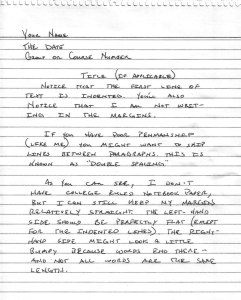
a sample of a format for a handwritten paper

Dear Miss Harper Lee,

I know you’re dead, and therefore unlikely to read this, but I write it nonetheless, because it’s a letter not just to you. You are welcome to read it, though, if that is such a thing given your current state.

I wanted to thank you for my favorite teacher, Mr. Davidson. He loved your book so so so so very much. He made me love it, too. I bet he made other students feel about it, as well.

He taught us the word empathy via your story. I remember that day. I was at Carter Jr. High School.

He was a beloved teacher who tragically lost his young wife who I think also taught at the school. I knew that his wife died because there was a memorial to her in a glass enclosed garden at the school. I don’t know when it happened. It was before my time there, and as a 12-year-old anything 3-4 years prior was the equivalent of olden days. Also this was just something we “knew” and didn’t ask questions about at that time. Like Scout knew some things she just knew.

This is just background, though, because this thing we “knew” was just, you know, background. I don’t have any inkling if he was a different teacher before, since I didn’t know him before.

He didn’t bring his personal loss into the classroom. But, as you wrote, we all bring all of us into every interaction. I’m sure it impacted him, and therefore us, but that’s something I didn’t realize until many years later.

Yes, I still think about this English teacher who taught me to walk around in someone else’s skin before passing judgement (or was that you?). Trying to understand someone doesn’t make what they do “right,” but it acknowledges the other’s humanity, and that makes us more human, too.

I was a bratty smarty pants–not as smart as Hermione Granger but equally annoying. I would read ahead and do my assignments ahead because I was engaged. The class slowed me down. I bet my class participation included spoilers. Mr. Davidson let me write my final paper early. Then he had to do something with me as the class plodded through your novel.

He gave me my first book of poetry to read and sent me off on independent study in the library. I was to write a paper about Edna St. Vincent Millay. I didn’t realize at the time that he was encouraging me to keep my own independence and follow my dreams. Something else I realized many years later when I reread her and about her.

When he handed me back my paper, he looked at me very seriously. Me, Hermione Granger-esque, figured that I was in for it. I really didn’t understand poetry, and maybe I misinterpreted like everything.

He apologized to me.

He said that he was sorry that he was unable to challenge me enough. I heard this at the same time I saw the A+ on the top of the page.

I learned right in that moment that it wasn’t enough to do well or even excellently. Although that remains an ambition. In that exchange, I learned that it was important to stretch yourself as much as you can and to seek out people who will make you reach.

A few years later, I was in the high school gym watching a basketball game. Mr. D. was there and I hadn’t seen him for a long time (3 years which had become less like “olden days” but still a long time). I don’t recall the specifics of the dialogue, but I do remember what he said at the end.

He admonished my high school cynicism–translated to 2016 that would be the unending teen irony. He also told me that a cynic is simply an idealist. In that sentence, he created a space for me to be both.

I finally met up with Mr. D. in his office at the school three or four years ago (which in today’s time frame seems like just yesterday) after decades apart. I thanked him in person for his encouragement that I still draw down from. It wasn’t enough, but I brought him a coffee and a donut.

Thank you, Miss Harper Lee, for being a connector. And for your wonderful book.

Your loyal reader,
Doc Think


Ever After?

old fashioned bride and groom cake topper

My parents didn’t go to my Sib’s wedding.  Mom boycotted and Dad wasn’t crossing her pickett line.

I’ve always given Dad a bit of a pass on this, holding Mom more accountable in this ugliness. Because it’s ugly when parents don’t show to a child’s wedding.

The entire scenario had many missteps that played themselves out in the worst ways possible. A secret romance, an inability to tell the secret, and a toxic build up of resentment and expectations and disappointment. I’m not quite sure that there was ever an actual invitation. But everyone knew.

I was assigned the making of the meatballs. I had finals that week and the following week. My Sib asked for a couple hundred of my “famous” meatballs. Really not famous other than it was one of the things I could cook. It was literally the least I could do, so since not much was asked, I made the meatballs.

I was a broke student. I didn’t have any dress clothes that weren’t a costume.  I borrowed my friend’s dress. It was a simple heavy cotton t-shirt fabric with a boat neck and green and pink and yellow stripes. It was as dressy as we could find. It wasn’t my best look. (I never returned the dress. I never wore it again, either. It hung in my closet for years.) I did have some pretty shoes, though.

My boyfriend and I drove the VW Superbeetle into town. I think we went right to the church. We helped a little with the set up. Warming up the meatballs. Setting out some favors. Not much. My Sibs, the one who was getting married and the one that lived at home with her and the parents who were not scheduled to attend, and the bridesmaids did most of the lift.

This is my memory and my story, and I know that I don’t have many of the details. I was busy and self-absorbed and living away. The main story is not mine.

Others can likely remember with more clarity and more particulars and much more flavor. Others experienced their own feelings–their own sadness and incredible joy. But I mostly remember two things.

We sat in the front row, on the bride’s side of the church. It wasn’t our church. I’m not sure it was the groom’s church, but it was a church. I sat in the row with my Other Sib and our respective boyfriends. Nobody else from our family attended. Not one of my father’s eight siblings or their families. Not one of my mother’s six siblings or their families.

My Other Sib and I were pretty sure that Dad would come. We were definite that Mom would remain absent. But Dad wouldn’t let his daughter down. We waited in our seats and our Sib appeared at the back of the church. She had a pretty ring of flowers, a crown, in the curls of her hair. Still no Dad.

She was on the arm of some short old man that we had never seen before. He was spry enough. I guess this stranger was going to give my Sib away. It really should be Dad. I exchanged glances with the Other Sib who was having the same thought.

I guess there had been music the entire time, but I didn’t notice until this weird little guy was walking my Sib down the aisle. I looked beyond them to the door of the church. This is the time when the man who belongs there walks in and takes her arm and does his job and there are tears of joy and relief that all is well.

Instead I was standing there like Princess Buttercup in the Princess Bride. When she believes that she was married and her true love did not come and save her.

CUT TO: BUTTERCUP standing there. Dazed.

BUTTERCUP: “He didn’t come.”

He let my Sib down. He let us all down. He was supposed to come and save our hearts from breaking. Instead they felt trampled, even as my Sib was saying her vows. He didn’t come. There was no Hallmark moment.

But it was still a wedding. A time for dancing and drinking and meatball eating. There was a lot of food in addition to my two-hundred homemade meatballs. There was garter throwing and bouquet tossing (this was the beginning of my streak of 5 catches). And at the end of the night, we helped clean up. 

The Other Sib’s boyfriend was the D.J. for the night. One guest was especially stewed and didn’t want the evening to end. She kept requesting one song again and again in her drunken slur.

Turn the Page.

Turn the Page.

Turn the Page.

Turn the Page.

That’s the other thing I remember. Turn the Page.

After the sweeping and storing, I kissed my Sibs goodnight, and me and my boyfriend got back into the Beetle and drove back to school.


Origin Stories

As part of the offsite, participants had to share their origin stories. It wasn’t put that way, but it was part of the ice breaker exercise.

One person spoke about an idyllic childhood in a communist country. Since there were so many constraints it was a simple time. When pressed, it might not have been all good. They did have to stand in crazy lines for hours and the shelves in the stores were empty.

Another person conveyed the challenges of being bi-racial. They didn’t know that it was important until high school when people started confronting them with “what are you?” This led to much soul searching. Someone else lost a parent at a very tender age and had to overcome being a nerdy outcast but found a circle of great friends on the way to great success.

It seemed everyone had a struggle to overcome–although everyone seemed to see their struggle as simply part of their origin. Made me wonder if there is something about the expereinces people have that draw them to different types of work. This offsite was at a non-profit.

What would this ice-breaker be like in the investment banking industry. Would participants talk about growing up with cooks and servants? About prep school, the tennis instructor and the golf team? Would they talk about meeting their future spouses at a Renaissance Weekend at an exclusive Hilton Head hotel? Would they talk about their parents and grandparents and great-grandparents preceding them at their Ivy League college? About getting a loan from Dad to start their first firm or build up their investment portfolio or to pay off a bad business break? Would they bemoan the challenge in getting a good apartment in Manhattan?

Just wondering about origin stories.

Bam Ba Lam

Old lady singing into a large microphone

“Oh, God!” said my high-school boyfriend.

Me: What?
HSBF: You know that song, ‘bam ba lam’?
Me: Yeah?
HSBF: It came on the radio today and MY MOM WAS SINGING IT!!!

Oh. The, Horror.

It was a little funny, except that I never met his mom. So I didn’t have much perspective. Come to think about it, I never met his dad. Or his brothers. In 30ish months of “going together,” with our ancestral homes separated by about a mile, I never met his people.

My mom introduced me to the Beatles. She would play Meet the Beatles and Introducing The Beatles. She had a bunch of old records we’d listen to, like Limbo Rock. I grew up with people listening to music. People had records and also listened to music on the radio. And sang along.

My folks gave me my first AM radio when I was about seven. I used to listen to CKLW [the motor ciiitttttyyy] like church. Detroit radio introduced me to the Stones, Supremes, Little Stevie, Smokey, Aretha, Clapton/Cream/Stevie W/Traffic, Zeppelin, The Who, Kiss, Prince, George Clinton and GrandMaster Flash.

When I was ten, I got my first turntable. It also had a radio that included FM! I bought my first LP–Elton John’s Greatest Hits. In high school I had a job in a record store. I always had music on–in the house, in the car, via my portable FM radio and eventually on my boombox.

On school mornings, I’d get up, pad into the kitchen and turn on the radio to eat breakfast. We’d listen to the AOR station (I’ll be the roundabout). I guess my Mom listened. She didn’t turn it off or tell us to turn it down. She’d be in the room, so I guess she listened or at least heard.

So, like who cares that your mom knows your song?

Maybe that’s why I didn’t know his mom and family. He cared that his mom knew his song. As if only we teens owned the public airwaves. As if it was unacceptable that his mom was part of that public. What if he was embarassed of his family? I didn’t know them so maybe they were embarrassing. That said, they couldn’t be much worse than mine, and he was over our house all the time. What if WE were the embarrassing ones–lacking even the most basic self-awareness that we were embarrassing?

I know that I resemble an embarrassment to my spawn. Rolling into the Boys and Girls Club after summer camp with Get Low blasting from the minivan is certainly cringe-worthy. Or when a millennial colleague caught me on my headphones and asked me what I was listening to. Don’t judge an old book by it’s cover, I say.

So I’m thinking about HSBF’s mom, enjoying music. And hope that she looked like this:

https://youtube.com/watch?v=Kum4O_fh0_E%3Frel%3D0

And for the record, these Black Betty induced memories were triggered as the Big Guy blared it from his phone, followed by some Creedence. He ain’t no fortunate son. He came by it honest.

Feelings Behind

plane flying in a pretty sky

Dear Mom and Dad,
I remember leaving. I was 18, and so glad to be on my own. You two were already grown. I didn’t really give you any thought. As if my next steps would have any impact on you–my parents. I was about me.

Today I was at the airport. I watched Baby Bear walk away from me to get on that big metal bird to the mountains. Where he lives.

So, Mom and Dad, I have some questions. Did your heart break when I drove away? Every time? Did you wonder if I was going to be okay? Were you conflicted by your amazement of your spawn functioning without you and your worry that you couldn’t protect me?

Did this ever stop? These feelings of an ever-alert, yet redundant, guard dog? Was I always your kid? Your baby, in your heart? Did you whiplash when conversing with a grownup while stuffing protective impulses back inside you before I noticed? I know you know that I would have insisted, again, that I was an adult and didn’t need anything.

Did you wonder if you were doing enough? Too much? Did you worry about respecting my autonomy? Did you worry if I was paying my bills? Drinking too much? Breaking a heart? Getting my heart broken?

When I was starting out and job hopping, did you think I was making mistakes? Wonder if I was carrying health insurance? Saving for retirement? Paying my mortgage? Getting up on time for work?

Did you think that I was able to balance being a parent and breadwinner? Did you look at me looking at you in your hospital bed and think about how you being in that bed was affecting me?

I never thought about how you felt about me. Not from the point of view of a parent. Not until today. I’m sorry for not seeing this. It’s crazy love.

Thanks, Mom and Dad.
xo,
Your (grown) Child