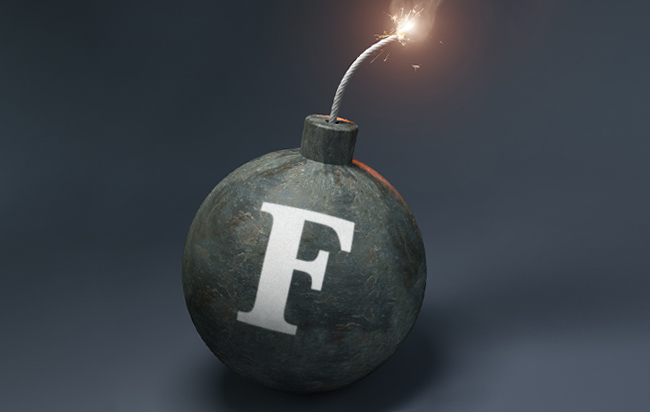
My favorite video from the past few weeks was former Presidente de Mexico, Vicente Fox, dropping the F-bomb on Fox Business News in relation to a proposed construction project.
He was responding to a question by the reporter and did not intend to be misunderstood. He spoke clearly and deliberately. He began by pausing dramatically before hissing out the “f”-sound. He emphasized the harsh middle K sound and then punctuated the ending of the word with a guttural G from the back of his throat. [He used the gerund form of the F-word.] His enunciation was excellent.
Language fascinates me. I can barely speak my native tongue, and to hear others glibly communicate in more than one language puts me in awe. I notice this especially when non-native English speakers use colloquialisms, and, especially, when they curse.
Now I learned to curse, as my children after me, from my mother. One day, when The Big Guy was seven, he was standing with her on the back deck as they observed the dog taking a crap. She casually remarked to him, “Boy, that dog sure does shit a lot.” I think she was impressed with that specific movement’s volume. The Big Guy knew that “shit” was a word not used by or around his other grandmother and most nice old people–especially old people at school. My mother followed with, “I guess all that shit is good for the lawn.” [We never had a dog growing up, so she didn’t have a good reference. She was just a city girl making farmer conversation.] I’m not sure if The Big Guy was more shocked or more impressed.
I didn’t, however, learn the F-word from her. I really didn’t have much exposure to it until I got to college. I was a quick learner, though, and immediately incorporated it into my cursing repertoire. I may have been a bit too facile in my adoption, but so be it.
It’s impressive to hear different accents and different English proficiencies deliver the F-bomb. A friend from a Spanish-speaking Caribbean island brilliantly described the potential of having her folks and her in-laws in town together at Christmas using FML, not the acronym but the words. Perfection.
A colleague with only a hint of her first twenty years in Moscow frequently asks about the meaning of English slang, but she definitely knows when something is Eff’d-up. I know this because she expresses it with the perfect lowering of her voice a half-octave because she means it.
Maybe it doesn’t really count when Irish friends use it. You’ll hear more feck than the short-U sound, but the longer they live in the States, the less feck you hear. I always delight in hearing a well delivered F-U from the Irish.
When I hear French or French Canadian use of the American F-word, mon Dieu! So bon! [Yes, I did that on purpose.] There is a speed or an acceleration of this short short word that isn’t heard with other non-US speakers. I have heard it usually as an insult, or accompanied by a frustrated throw of something to the ground.
I must say that I have never, and I mean never ever, heard the F-word misused by anyone. Ever. Not everyone uses it, but if they do, they do it right.
Maybe you just can’t get it wrong.

 Doctor of Thinkology