On Purpose?

img_52c6772e7692-1

I was asked–in the course of a conversation so there was some context because this would be weird to come from the blue–if I liked learning stuff about myself. I had to think about this for a little bit. Do I enjoy mining the depths of my psyche? Did I savor unlocking truths about Doc? I rolled this thought back and forth through my brain, considering what it means. Then I was like, “No.”

Seriously, there are so many things to learn that are not me, and I spend plenty of time with me. All of the time. Like ALL of my time. I can’t get away from me. And if I am using my learning time on myself, how will I ever figure out how the blockchain works?

The questioner, unlike my shallow self, really enjoys self exploration, finds it fascinating, revels in the time to attain knowledge of their substance. For them, there is value in the activity itself and in the insight gained.

And I’m like, “Why?”

Why would I struggle through the probing and, sometimes, pain of reflection? Because it’s good for me? I eat vegetables–even learned to like spinach and brussels sprouts. I walk past the closest subway stop to the next one to get more steps in. I cut back on booze. I got a flu shot. I do plenty good for me stuff.

Don’t roll your eyes. I’m learning how to cook fish. I’m learning about how video games are rewiring the brains of especially young men. I’m learning about institutional racism. I’m learning how to get rid of the damn raccoon that’s trying to move in without paying rent or signing a lease. I’m learning how to change my wiper blades. I’m learning which bus can get me to work when the Red Line closes down next month. I’m learning  the limits of political decorum and gridlock. I’m learning about the Outkast catalog.

So, ambient learning about me? I don’t think so.

I don’t like to do things just to do them. I don’t get jazzed about process as much as I do results. So, all of the self-learning that I do is about outcomes. Understanding my role in an argument with The Spouse so my apology is meaningful. Being the boss who helps staff succeed. Figuring out how I contribute to the pool of general negativity so I can combat it. Mastering my triggers and maximizing my strengths to be a better Doc.

I don’t want to know about myself. I need to know about myself.

In search of my mother’s garden, I found my own. ~Alice Walker
 

Mastery

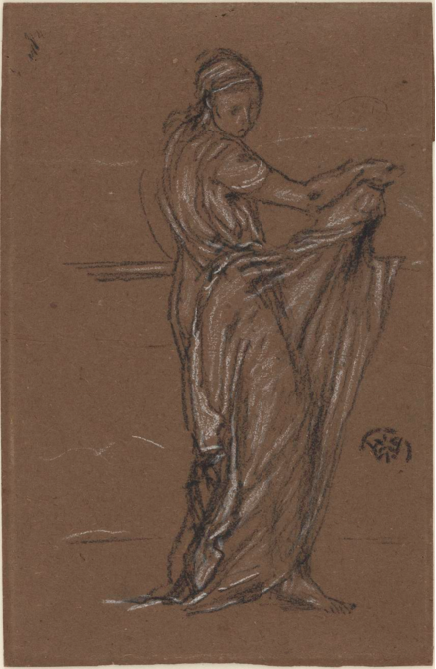
Drawing of a woman draped in a sheer fabric. Chalk on brown paper by James Whistler.

James McNeill Whistler, the guy who famously painted his mother, went back to the drawing board–literally–to create a masterpiece.

It seems that the already well-accomplished artist felt that his work on the human form was weak. So he went about practicing and perfecting his drawing by spending hours in the studio studying and reworking images on paper. He thought he didn’t do enough work earlier. He crammed on the form of the body and the draping of fabric. He worked in chalk on brown paper or sketched in oil.

I was struck by the exhibit showing a piece of art that never was. (Well, it was, but then it was destroyed. But that’s not my point.) There were many studies, many explorations, many versions of the work. All in preparation for the final canvas, which was itself reworked, painted, scraped and repainted. This went on for ten years, incomplete. His mom thought that “he had tried too hard to make it the perfection of art.”

Ten years working on a singular painting. While this wasn’t his sole effort, it was an ongoing effort. Learning, working, improving, struggling, and doing it more.

This is someone acquiring mastery. It is a process that takes time. It is a process that requires sustained effort. It is a process that accesses multiple aspects of thinking and feeling.

I live in a world of immediacy, of instantaneous transfer of messages, some of which are programmed to disappear immediately. I am surrounded by people anxious to master, but in our anxiety and rush we move past the task that is completed, but far from mastered. We claim to respect and admire craft and virtuosity, yet adopt a DIY mentality, “I can do this.” And then think that we DID attain a high level–but it was just cleverness.

It’s the neighbor’s house that they remodeled seven years ago. They can’t sell it now. The work they did was good. It looked good. They were not proficient in laying floors and hanging cabinets and taping drywall. It was the first time they tiled a bathroom. Their work was more than sufficient. It was fine. But it took them much longer than the practitioners who had apprenticed and studied. It lacked the familiarity, judgement and awareness of the master. They were neophytes. It was their first rodeo. Their work did not stand the test of time.

Also, today I was reading a critique of the White House work on a cancer “moonshot.” Dr. Vinay Prasad, a cancer researcher at Oregon Health and Science University, took the idea to task. After challenging the Ground Hog Day aspects (War on Cancer in the 70s anyone?) and efforts to push drugs out faster, accelerating new therapies and opening clinical trials (none of which are groundbreaking), he identified the deficiency with the moonshot approach. The fundamental problem he sees is that a surge of concentrated effort to cure cancer doesn’t fit medical discovery. Science is a long process of experimentation, applying lessons and connecting dots across disciplines. It takes time. And mastery.

I’m wondering, what I am working on? What am I trying to master? What will I leave that will stand the test of time?

Damn, that museum trip has my mind working.