Monkey Shines

Trees at the subway. Washington DC

The boy dropped his dad’s hand at the top of the escalator. He was barely a boy, really, more like just-past baby. It was the end of the day and the rush hour throng was thinning. They, the boy and his dad, had just walked the half-mile from school.

School was what they called where he spent his day. The curriculum was directed by the kids. It included many games that they made up, some reading of stories, much playing outside and eating. The boy liked the eating. He liked the other parts, but he liked the eating.

They would cut through the subway on the way home, coming down the escalator on the west side, walking underneath the tracks and out the other side up the escalator. The boy liked to run through the in between tunnel with his dad.

It was early spring so the shadows were long. The boy wore his green zip up fleece. It wasn’t a bright green, more like a pine green. The cap that he wore over his titian hair was a contrasting blue. This blue was between light blue and aqua blue. More blue than green and more bright and vibrant than light. His cap was also fleecy, but baseball style. It sat on his head with the bill a bit to the left, not centered over his nose.

His nose had the mark of a run-in with a tree. A few days before, he was running–he ran a lot–and forgot to look where he was going. A tree reminded him of where he was. You could still see where the tree stopped him, but the wound was covered with a brown scab on his otherwise smooth, porcelain skin.

He took off down the sidewalk. He ran past the double metal fence that created an unnecessary walkway that only kids used. He didn’t use it today. He ran around it. He didn’t see that the cherry trees lining the walkway were starting to bud. He buzzed past the low evergreen shrubs. They weren’t low to him, though. He couldn’t see above them. Maybe that’s why he missed the cherries behind them.

He ran toward the street, but there was no worry that he would run out into it. He was going to his tree. His dad lengthened his step and reached the tree just as the boy was climbing one of the low branches. The old tree trunk was almost split, so the boy didn’t have to struggle to find his place in it’s arms. This was an apple tree–maybe crabapple–so it was behind the cherry trees in blooming. He perched himself in the tree, about four and a half feet above the ground.

“Daddy, I’m Hans the monkey. And this is my Hans tree.”

Nobody knew where the name Hans came from. There were no monkeys named Hans in his books or in his songs or in his movies. None of his friends or relatives had the name Hans. But there he was, Hans the Monkey, nesting in the tree.

He was close to face level with his dad, as his dad sidled up under the tree and placed his face near his. They shared some nonsense and then his dad started to walk up the rise to the street.

“Come on, Hans.”

The little monkey scampered down the tree and grabbed his dad’s hand. They walked the rest of the way home.

Nobody ever asked who Hans was. That would break the spell.

Valor in Discretion

question authority

When I was but a wisp of a person, maybe all of 116 pounds soaking wet while wearing a heavy wet towel, I had this shirt. It was a black tee. It was a present. I forgot who gave it to me, but they thought it captured my essence well. It said “QUESTION AUTHORITY” in big white block letters. That wasn’t all, though.

The “QUESTION” part was X’d out and printed on top in a screaming red scrawl was a four-letter word that began with an Eff and completed with a Kay. You figure it out.

I wore it in public.

My world was a college campus populated primarily by 18-24 year olds. I don’t think that I would recognize old people or families with kids. If professors walked across campus, they didn’t register to me. I would buy my coffee from a student or maybe a recent student. The bar patrons were reflections of me. People in the library didn’t look up. If somebody thought that my shirt was an affront, I didn’t recognize it.

I told my kids about that shirt. And I told them I was sorry that I wore it.

Sure, it was my right to speech. Sure, I liked being provocative in a crude and danger-loving kind of way. Sure, nobody ever said anything to me. But I’m also sure that someone was upset or hurt or shocked. There was really no value to parading around in that shirt–other than to display my immaturity and self-absorption. Nope, not much value there.

But at that time, I was trying things out and was foolishly proud that I didn’t shirk from being on the wrong side of people who weren’t me and my narrow tribe. I was all id in formation of a grown-up ego.

It makes me think about that scene in a movie where the woman is trying to get someone to attend to her sick child and finally gets the attention of the insensitive doctor via tirade. Or the scene where the snooty sales clerk humiliates a shopper and the friend tears the clerk up one side and down the other. Or when the mild-mannered mom stands up against book burning at the PTA meeting of neanderthals. Or when a character finally and publicly tells off his boss in a most clever and profanity peppered speech. And there’s always the guy screaming out the window that he’s mad as hell and not going to take it anymore.

All of us cheered for each one of them. We were all on the side of the person who pushed through polite mores and let loose. We were relieved by these moments when someone is not holding back, when they act free from the constraints of civilized society and when they are being righteous!

Civilized society, though, stops us from screaming at strangers when wronged. Mostly because screaming and giving in to our lizard brains feel good, but only for that minute. Mostly because our perceived slights are more slight than not. Mostly because we risk substituting our lack of control for being truly righteous.

Grown ups know that we damage our relationships with others when we act outrageously. Usually the goal is to come to a resolution versus stage an excellent colloquy in which the character we play “wins.”

I learned to measure my foot-stomping child-self. I sometimes fail, but I know that there is good reason to avoid most fights. It’s to make sure when you do fight, it’s worth fighting for.

Pass The Nuts

I know that lots of people only occasionally fly. I know that airports and airport etiquette can be very foreign. I do not expect expertise from my fellow travelers, and, in fact, sometimes exhibit airport clumsiness myself.

That caveat aside, seriously, what the hell is wrong with some of you?

How do you normally figure things out?

I recommend less going to your memory banks on how it was last time you flew–2008?–or a whack video you saw on YouTube. Also please disregard the purported inside tips from your somewhat-sophisticated brother-in-law or from your fantasy football league commissioner, especially if their great knowledge is based upon an email they received from an “expert” source. [PSA: please check wild claims that get passed around social media on snopes.com before adding to the noise. We all thank you in advance.]

Another idea is to use environmental information. One really great technique is to read the signs. There are many, many signs in airports. People actually have jobs to create signage. You don’t have to let all their work go to waste.

When I checked in for my flight, I was jazzed to see that the travel gods bestowed upon me a random TSA PreCheck. Jazz was induced especially because I was wearing boots–it’s the little things in travel. Also, I hate stripping down to my skivvies and filling up 4 or 5 gray bins with my laptop (must be alone in a bin) and shoes and scarves and a one-quart plastic bags full of liquids in containers all less than 3.4 ounces. You still can’t bring a bottle of water, though.

At today’s airport, there are two concourses. My flight was out of Concourse B. Only one had PreCheck open. Of course it was the Concourse A. The sign said the concourses are connected, so I turned around and walked across the mall and food court to the other security line. The woman in front of me read the PreCheck notice and did the same.

Concourse A displayed a 4×3 foot sign directing PreCheck travelers to the left and all others to the right. The sign explained the PreCheck rules which was pretty much put any bag you have on the belt and walk on through.

The woman in front of me removed her shoes and placed her coat in a bin. The family of four also in front of me confusedly pulled multiple bins out. Computers and tablets, belts and sweaters, watches and quart-sized plastic bags all unnecessarily placed with much consternation. The woman behind tapped my shoulder and asked if you could get from Concourse A to Concourse B. I told her yes, at least that’s what the sign said. She said she didn’t read that part.

It wasn’t crowded, so the passenger confusion was mostly self-inflicted. A TSA staffer reminded the six people in our line that they needed to have PreCheck on their boarding pass or go to the other line. A woman sheepishly ducked under the rope between the stanchions to her correct line. Another family crisscrossed to the PreCheck line from the standard line because they couldn’t read, either.

I put my backpack on the conveyer belt and walked through the magnetometer. Easy peasy lemon squeezy.

I’m at my gate fifty minutes before the flight. A man in black warmup gear and screaming scarlet kicks walked across the empty airport to the gate. The door to the jetway is wide open, but it’s not time to board. Will Scarlet looks around and, for some unknowable reason, decides to board himself. Seriously. He walked through the door and down the jetway a few steps and walked back out. He had his boarding pass in his hand and inspected the unattended desk and computer. He found the scanner and he SCANNED HIS BOARDING PASS. I am not making this up. Then some clueless woman saw him and followed his lead.

I waited for the monster to spit them out, but nothing happened. I looked at my watch and started to worry that maybe the flight had boarded and I blew it. (I have done this once before.) Now, I’m all consternated. But, unlike my fellow passengers, I walk up to the the kiosk for my flight and check with the people who work there. No boarding yet.

I walk back to my seat to see the two people who took the boarding into their own hands escorted out by an airline employee. She was explaining that boarding would be in 20 minutes. Will Scarlett looked like he didn’t understand. That was the only part that made sense, that Mr. Scarlett was confused. Still.

In my head I’m wondering, did they get all the way to the door of the plane? Did they knock on it? Or was the plane door open? Did they walk on the plane? Was the pilot there? Were there people cleaning the seatbacks?  Or were they just standing on the jetway until someone “found” them?

And damn them for making me look. I knew better, but vagaries in the travel system, the missing of flights, the capriciousness of rules among airports and heightened or de-heightened alert status (more working dogs!), means that you have to verify and not trust your experiences. So, you crazy mixed up travelers, my second piece of advice, in addition to reading signs, is ask the experts. The real experts. Don’t follow Will Scarlett down the jetway.

At least there were peanuts on my flight.

Blocking

colourful plastic blocks for a baby

The baby was fully concentrating. Her brow was furrowed as she rotated the red box. She was very impressed with herself. She picked up the box, and she also manipulated it. FTW!

She lifted it a bit more quickly than she calculated and knocked herself in the head. She was quite surprised by the velocity she created. She actually forgot that she was responsible for the collision. She didn’t cry. She just looked at the box in a confused way.

Not to be defeated, the baby shook it. More activity that caused something. She was reminded that there were contents in the box. She dropped the box the three inches to the carpet.

She dipped her hand in the box. It emerged attached to a green block. This was unexpected, but delightful. She raised the block to her mouth so she could steady it as well as taste it.  She pushed the block more solidly into her hand with her chin.

She pulled the block away from her face and looked at it anew. Because everything for her was new.

Minor Accompaniment

seats on a plane with entertainment guide

Sitting on the plane from DCA to ORD next to someone bemoaning the lack of WiFi. This moaning is repeating at regular intervals. Or perhaps the intervals are getting shorter.

It’s not quite as annoying as it sounds.

More like talk radio in the background. Not like political diatribe talk radio. More like a sports show. Not like the sports show with the over the top loud guy. More like the sports talk radio where you have two or three guys doing analysis that makes you think about dialing the station and joining in.

First, there was the call for WiFi. I get nudged and asked, “Is there wifi on this plane?” I replied that there was, but with a charge. My companion fires up his phone and shows me that I am correct.

“Eight dollars!?” I suggested he use a credit card if he wanted to buy it. He doesn’t have one. I joked that I wasn’t paying.

He told me about all the limits he now had. Most of his games, especially the ones he wanted to play, require WiFi. Adding insult to injury he downloaded Spotify playlists–eighties rock–and didn’t remember headphones. “Oh,” said I.

“Look at this one. I can play these four parts but not the duel.”

“Is the duel playing with someone else?”

“It needs wifi.”

I’m thinking, “I got that.” I go back to my article. He plays a game.

“I really wish there was wifi. Check out the graphics on this London driving game. They’re amazing.”

He was right. Even on his smudged and worn screen, the resolution of the arches under the bridge and the crane shot up to the road were very good.

“Is there food?”

“It’s a short flight, but they usually give you peanuts.”

“I don’t like peanuts.”

“That’s too bad, but I’ll eat yours.” He ended up eating them. No extra peanuts for Doc.

“This game is very violent. You lose limbs and your head might blow off. But it doesn’t kill you. Well, it does when your head blows. I’m stuck on Level 8. See right here, (leans over again), I’m riding this bike and I can’t get past the rotating knives. You have to do it three times. ” His character’s head hits a knife and a splotch of cartoon blood dots his screen.

“Woah. That’s gotta hurt.”

“Not really. This is the longest time I’ve been sitting without WiFi.” He turns back to his game.

“Hey, can I put my trash in your cup?”

“Sure.” He turned the sound up on his game. I hear the tat tat tat cymbal crash of game gunfire. If he finishes this level he can earn a gun he really wants.

The flight attendant radios that we are approaching ORD and to put our tray tables up. He jerks his head towards me, “What about the trash?” He had a half drunk coke in front of him.

I took the cup with the lid and straw. “I’ll take it. She’ll be back.” Relieved, he went back to shooting some bad guys. WiFi or not.

He’s nine. It’s his first flight alone. I don’t mind sharing it with him.

I Swear

An F-bomb

My favorite video from the past few weeks was former Presidente de Mexico, Vicente Fox, dropping the F-bomb on Fox Business News in relation to a proposed construction project.

He was responding to a question by the reporter and did not intend to be misunderstood. He spoke clearly and deliberately. He began by pausing dramatically before hissing out the “f”-sound. He emphasized the harsh middle K sound and then punctuated the ending of the word with a guttural G from the back of his throat.  [He used the gerund form of the F-word.] His enunciation was excellent.

Language fascinates me. I can barely speak my native tongue, and to hear others glibly communicate in more than one language puts me in awe. I notice this especially when non-native English speakers use colloquialisms, and, especially, when they curse.

Now I learned to curse, as my children after me, from my mother. One day, when The Big Guy was seven, he was standing with her on the back deck as they observed the dog taking a crap. She casually remarked to him, “Boy, that dog sure does shit a lot.” I think she was impressed with that specific movement’s volume. The Big Guy knew that “shit” was a word not used by or around his other grandmother and most nice old people–especially old people at school. My mother followed with, “I guess all that shit is good for the lawn.” [We never had a dog growing up, so she didn’t have a good reference. She was just a city girl making farmer conversation.] I’m not sure if The Big Guy was more shocked or more impressed.

I didn’t, however, learn the F-word from her. I really didn’t have much exposure to it until I got to college. I was a quick learner, though, and immediately incorporated it into my cursing repertoire. I may have been a bit too facile in my adoption, but so be it.

It’s impressive to hear different accents and different English proficiencies deliver the F-bomb. A friend from a Spanish-speaking Caribbean island brilliantly described the potential of having her folks and her in-laws in town together at Christmas using FML, not the acronym but the words. Perfection.

A colleague with only a hint of her first twenty years in Moscow frequently asks about the meaning of English slang, but she definitely knows when something is Eff’d-up. I know this because she expresses it with the perfect lowering of her voice a half-octave because she means it.

Maybe it doesn’t really count when Irish friends use it. You’ll hear more feck than the short-U sound, but the longer they live in the States, the less feck you hear. I always delight in hearing a well delivered F-U from the Irish.

When I hear French or French Canadian use of the American F-word, mon Dieu! So bon! [Yes, I did that on purpose.] There is a speed or an acceleration of this short short word that isn’t heard with other non-US speakers. I have heard it usually as an insult, or accompanied by a frustrated throw of something to the ground.

I must say that I have never, and I mean never ever, heard the F-word misused by anyone. Ever. Not everyone uses it, but if they do, they do it right.

Maybe you just can’t get it wrong.

Princess and the Pea

A chapter of a book that begins, "Once upon a time it was..."

Once upon a time there was a princess. She was lost. Or at least she didn’t know where she was. Or maybe she did know, and it was just too much work to figure it out at this juncture.

She found herself just passing from the state of sleep to the state of wake. Is it night or day, she thought. Did I just fall asleep or have I been sleeping for hours? Or even days? Where am I?

Clawing through the remnants of sleeping, her mind hit the bumpers of all of her senses like a metal ball shot from the chute and making its way down the lane. She waited and then hit the flippers to keep the ball in play.

She didn’t hear any bells, but there was the steady drone of machinery and the recurring squawk of a police radio. That radio was loud. Maybe that’s what woke her up.

It was dark, but there was a frame of bright light that must be from a door that was barely ajar. On the other side, in full light was the sound of the woman’s voice–the dispatcher–repeating the number ten. 10-12. 10-22. 10-23, stand-by. There were tall shadows of nothing or maybe something. On her right was a small round light hanging mid-air. Looking more closely the point was in some box on some type of pole. There was a window just behind her, to her left. She could see it at the furthest edge of her view, but she couldn’t see through it. Not that it mattered because it was dark out there, too. She was in a room. It wasn’t big. But even though the light on the other side of the door was bright, it didn’t illuminate her surroundings by much.

She licked her lips. They were dry, as was her mouth. She didn’t think that she brushed her teeth before she fell asleep. Her mouth tasted a little stale–maybe because of the dryness. Maybe, though, it was because she had thrown up. She wanted some water. Was there water?

A waft of staleness caught in her nostrils. That might be her. It wasn’t like work out sweat, but more like it had been a long warm day. In a ring or two outside of her, she could smell some chemical smell. It wasn’t like the astringency of Pine Sol, but it wasn’t far from that. There was less complexity to the caustic bouquet. It was less like northwest hops and more like laundry detergent with whitener. It wasn’t overwhelming, and she wasn’t either.

She did okay moving her head from side to side. She realized that she wasn’t lying down, more like half way between prone and sitting. She tried to sit up for real, but she couldn’t lift her head. Couldn’t lift her head. Why didn’t this concern her?

The door swung inward, and a shadow blocked much of the light. There was a clock above the door. It was 3:20, likely 3:20 a.m. The shadow pushed the door behind her. The shadow was accompanied by a rolling cart that she steered by a long pole. She approached the princess with a smile. Her greeting revealed her West Indian roots. She placed a cuff around the arm of the princess and put a probe under her tongue.

“Got it!” The princess knew she was in the hospital and was woozy from either the residuals of morphine or the peak of the percocet. The morphine did make her vomit. She remembered now. She asked if she was due for the anti-nausea meds. The shadow was named Carla and she said she would check with the nurse. She was the tech and was worried about the snow that was blizzarding down. She might have to work a double shift if the forecast held.

Carla checked the bulbs that hung from the princess’s neck. The bulbs were glued to two incisions to collect some post operative fluids. Carla was having none of the way they were hanging. She emptied them, after measuring the output and making positive clicking noises. She walked behind the bed and opened one and then another and then a third drawer. She searched in the dark and found some safety pins.

Carla walked back to the princess and pinned the bulbs to the princess’s gown. “This way they won’t pull. I didn’t like how they were.” She smiled again and helped the princess to the bathroom.

The princess felt queasy, so she swallowed to keep things down. “Is there a toothbrush?” Carla handed her one. She brushed her teeth and drank some water. After all that activity, she was tired. Or she was sore. Or maybe she was just high.

She shuffled back the seven shuffle-steps to the bed with her own pole-cart in tow. Carla had straightened her sheets. She backed into the bed and swung her legs up, schooched back and instead of leaning into the pillow her head dropped like a rag doll’s. She placed her hand on the back of her head to prop it up. She then used her hand to lower her head on the center of the pillow.

Her mind was clouded, but at least she knew where she was, now. She felt webs criss cross across her brain, behind her eyes and thought that she fell back to sleep. She wasn’t a princess. 

Post #82

An "F" grade written in red pencil. Ugh! Scary!

There are two kinds of people. Those who get good grades and think grades are decent measures, and those who do not get good grades and think that grades are stupid.

Alright, maybe there’s more kinds of people, but I think that when we’re being judged, or graded, most people prefer to sit near the top end of the scale.

Think about grades. There’s USDA Prime beef. Given a choice, who would eat not-such-prime beef? Same with Grade AA eggs. When you get to C you’ve been through A’s and B’s. Cotton, another good that is graded. It’s judged on a scale from 1 (the most pima-est) to 7 which is inferior to Grade No. 6 cotton which is inferior to Grade No. 5 which is inferior to Grade No. 4, you get it. Also, after learning about cotton grades,  Grade No. 1 sounds as if it will be soft against your skin. Grade No. 7 sounds scratchy.

Greyhounds that are graded E are disqualified from racing–obviously a Grade A dog is a winner. Coins have grades, too. I think most people would prefer to be classified as “mint” condition rather than basal. The latter grade is given to lumps of metal that can be identified as having once been a coin. Booze is graded as well, call and top-shelf. Which do you think is the quality choice? The one you stretch to reach, Johnny Walker Blue. (Please note that JW nonsensically uses a color scheme to grade its whiskey. Grades are everywhere!)

When you grade your backyard prep to put in a new deck, it’s evened out. I don’t want to be “evened out.” Sounds a bit like what happened to Randle Patrick McMurphy near the end of Cuckoo’s Nest.

So, you can see why some people think good grades are better than not-so-good grades. It’s not too big a leap to see that some people might equate good grades with the quality of the grad-ee. And it’s easy to see that many people aren’t really happy about being graded at all, especially if a poor grade makes some people view them poorly.

That’s too bad. Grades as a tool to guide the evaluation of skills or knowledge are different than the grade of maple syrup. Maple syrup can’t improve itself into a better grade. It’s just stuck.

Evaluations can help identify where someone is on a road to mastery. Grades are a signal, albeit sometimes a clumsy one, to distinguish ability or grasp of a subject or competency. The grader has an obligation to explain the difference in the grades and, most importantly, what it will take to get from one grade to the next.

Grades are a shorthand. You know what you’re getting. And, in the case of assessing–or judging–a person’s attainment of a milestone or proficiency, it provides some type of measure against a standard of some type.

But nobody wants a big fat red F. Nobody.

Loyal Reader, I am sorry for this post. It’s definitely not my best, but I am nearly out of gas. I have a headache. So I’ll give myself, and dutifully accept, a low grade today.

Not every day is Grade A or even B. Not even for the Doc. Tomorrow is another day.

Half-full

A sandwich wrapped in paper.

She stood balancing with one foot in the street with her other, mostly sensible, pump on the curb. The door on her silver Honda was swung wide, but she wasn’t in a hurry.

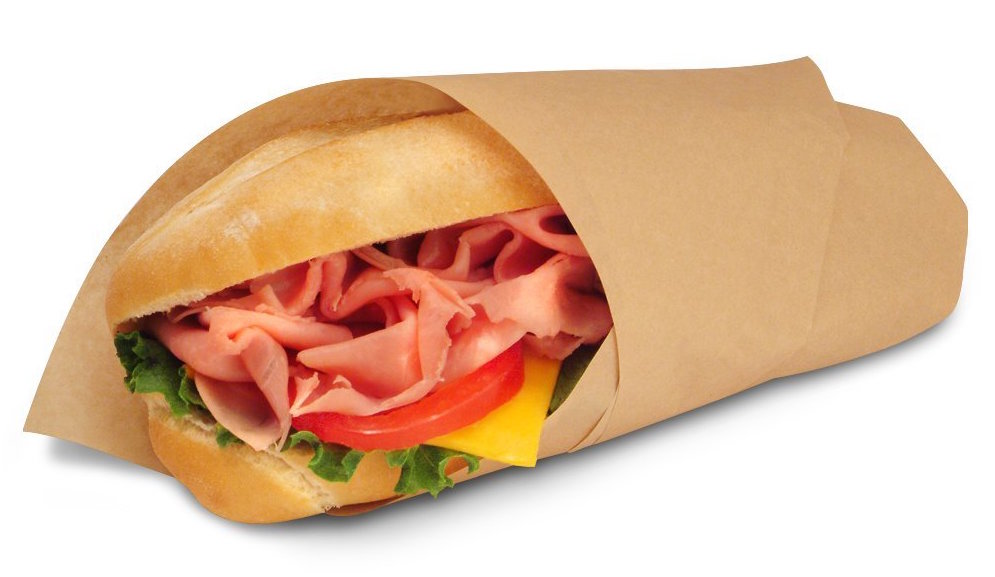
She was pulling the two halves of a sandwich apart. The sandwich maker clearly didn’t cut it clean through. It was wrapped well, and the paper was protecting the meal from the cold wind.

It’s the second day of Spring, but Winter is not quite ready to let go.

The man was there in his usual spot on the bench. He was in the neon orange snow pants and neon orange jacket. He doesn’t wear this gear every day and the pants only on especially cold days. Usually he just wears a hat, but today his cragged face–one of a not old man but a man who has lived old–was framed by the orange wimple of the hood pulled tight, framing around his face.

He looked up at the woman fighting with the sandwich, his head slightly tilted back with a beatific smile. It’s unusual for him to engage like this. Sometimes he interacts with people imagined, sometimes real. It’s not unlikely that his language is punctuated with hard words spoken sharply. Not today, though. Today he’s wearing a smile of a sweet child happy with his people.

Maybe the woman is his daughter, or his sister or a friend from before. Maybe she is just a kind stranger, and he is reflecting that kindness. Perhaps she was splitting that sandwich and they were going to eat together.

Down to the River

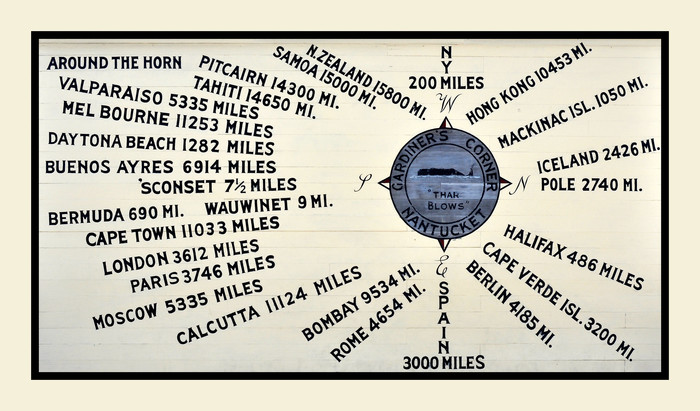
Nantucket, the center of the world. A compass and mileage directory.

People stay where they’re from. So people who leave are different.

It’s easy for those of us who have left the farm to look back at those rooted through a long lens. They aren’t like us. And we aren’t like them.

We pretend we don’t understand them, but, without much effort, we could. Since they are us, and we are them.

I grew up in what is now a desert of empty boxes of buildings that once housed three shifts. Of wide boulevards that once moved those shift workers and now cracked by weeds pushing through concrete. The factories and roads are being reclaimed by nature.

Then there is the other nature. The nature of expectations. People, most of them men-people, were expecting to fill those three shifts. Like their fathers, uncles and even grandfathers did. The work was a grind, day-in day-out in a noisy factory, but you earned enough money to raise your family, an awesome health package, a little cottage near a lake and a minor discount on next year’s model. You married your high school sweetheart. You went out with the guys after shift. You did your part.

But now, instead of a cold one on your dock, you’re the protagonist in a Springsteen ode.

And even The Boss doesn’t get you, anymore. He lives in Greenwich. He takes his daughter to dressage competitions. Is that a sport? You played hockey, in the neighbor’s backyard that they flooded after you got your new skates at Christmas.

You never or just barely had a chance at those high-paying factory jobs. You stuck around, waiting for an industry comeback. Instead, the unskilled and semi-skilled jobs that came back paid less. So yeah. You’re disappointed. You’re willing to work hard. But jobs moved across oceans where people get paid pennies and there aren’t all the rules about health and safety and smokestacks that drove work away. The import side of the equation? People from countries not where your people are from with a dollop of terrorism and fear.

Crashed expectations crash into reality.

Those who left are judging those who stayed. Don’t lie. We know them. They are us. And we are them.