Big Juicy

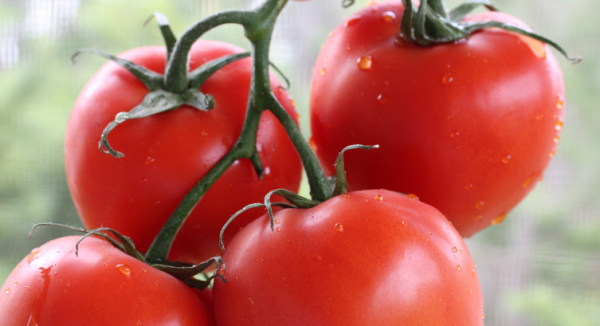
Tomatoes on the vine. Damn, they look good.

I had my eye on that tomato. I wanted it, but I wanted both of us to be ready.

I don’t know that I saw its flower. There were a bunch of flowers that late spring. They were little yellow stars against the deep green of the vines. I didn’t hone in on one or the other as they twinkled in the morning sun. I was just happy to see them get off to a great start.

The flowers soon disappeared and were replaced by little grape sized globs (or maybe globes?). Tomatoes-in-waiting. Where I am doing the waiting. Waiting for tomatoes. I’m encouraging them, too.

It’s funny how the flowers all appear at, or at least near, the same time, but the indivitual spheres take off on their own pace. Like a race.

So from the undifferentiated yellow flowers springs a free-for-all of vegetables. Some grow fast, some grow in clumps and some hang out by themselves. Sunning themselves, supping on the morning dew, and growing.

The tomato I am watching is not only the biggest, but it’s the one that starts blushing. As it changes from the waxy green, it first looks like a bruised face. Like it was in a fight and the fleshy part of it’s chin took a punch. The discoloration evens out, and it is orange. There is a ring of yellow at the top, near the vine, but the rest of the tomato is more carrot than zucchini.

This is NOT the time to disturb it. The contrast, especially next to its still-green sibings, makes it look red. But it’s not. It’s orange. A rainstorm moves the progress along. Now, when you cup it in your hand, the tomato starts to feel less hollow and more heavy. It passes from orange-red to red-orange. But it’s not done yet.

I very gently and very slowly wiggle the tomato against the vine. It’s umbilical cord is holding fast. Not yet.

The next day was brilliantly sunny. The tomato is definitely red. Any hint of orange is gone as is the yellow-orange ring at the top. I brush away the nub left from the dried up flower at the bottom of the orb. The green vine looks even darker and lusher next to the deep pomodoro red. I test the vine. The vine releases the fruit into my hand.

I draw the tomato to my face and breathe in the core side. It smells a little pine-y with a hint of what might be a whiff of hops, like cascades hops. The top definitely smells green, grassy green. It’s warm from the sun.

The tomato is much heavier than it looks. As I compress my fingers around it, it gives in. You can feel the moisture just inside its waterballoon self. The red walls, though, breathe back. There are no indentations left from fingers.

I bring it into the house and give it a perfunctory run under the water from the faucet. I put two pieces of bread in the toaster. I take the serrated knife and cut off a thin bottom and then gently saw back and forth to make a bunch of slices that I place on the mayonnaised bread. A twist of the pepper mill, a sprinkle of coarse salt and the frills of the outside green flounce of romaine finish it.

I bite in and the wet of the tomato spills down from the corner of my mouth and soaks my chin and my hand.

Did I tell you it was still warm? From the sun?
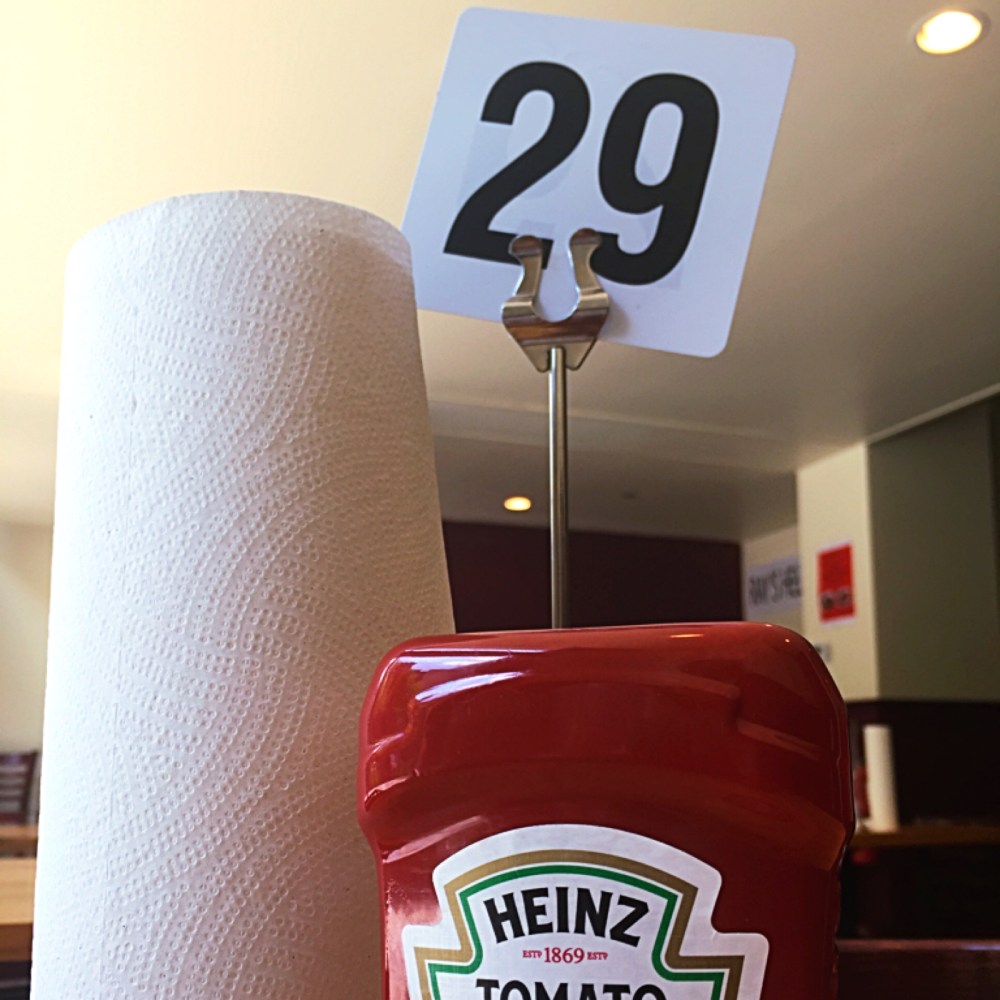
Is That It?

Generic ketchup and roll of papertowels at the most nondescript restaurant.

It’d be hard to imagine a more generic joint. More generic than a hospital waiting room. More generic than a 70’s bus station. More generic than an underfunded rural elementary school. More generic than hundreds of cookie cutter houses along tracks of a former dairy farm.

The color palette is unremarkable. The tables are a blond shellacked wood. The red brown chairs look like they were purchased at a hotel overstock sale. The walls are a yellowy cream. The lighting does nothing to enhance the color. It is neither bright nor dull. There is a maroon border around the wall. It’s almost the same color as the chairs. Almost. Must be a standard issue. No color matching.

Even more generic are the walls. There is nothing on them. No posters. No velvet paintings. No year at a glance calendars. No neon. No Christmas lights. No tchotchkes. Not even an official occupancy sign. There was, however, a fire alarm. A generic one.

There’s a shellacked table that’s pulled up next to the counter. It has a row of tabasco bottles, a row of yellow mustard bottles and a row of ketchup bottles. There is also a pile of napkins. No napkin holder, just a pile of napkins. There is a plain sign with the menu. It’s not even hung. It sits on top of the shelacked table next to the counter and leans on the yellowy cream wall. On the other side of the counter is a soda fridge. Like at 7-11. Or at a 7-11 knock off.

Oh, and that counter? It is more like a small bar in someone’s basement. It’s maybe four feet long with a cash register. It’s all yellowy cream colored. It disappears into the walls. If there wasn’t a very big man in a black shirt behind it, you likely would not see it. You’d just think a cash register was levitating.

And another thing, this is a hamburger shoppe. They sell hamburgers and fries and shakes (and half liter sodas from the self-serve cooler). But it doesn’t smell like meat or grease or grill or onions. It really doesn’t emit any smells of food or of cooking. It smells of nothing. Do they even cook here?

Maybe I should have left, but I decided to get a burger. To see if this place was real or if it was like the fake town set up for the bad guys to raid in Blazing Saddles. I picked a soda out of the cooler, paid my money, took my number and sat down in front of the window at the generic table with a generic roll of plain white paper towels and a bottle of ketchup.

The big man in the black shirt brought out my hamburger in his hand. It was in a nondescript gray–or is that an ugly khaki?–clamshell box that was good for composting. I thought that maybe this same guy also cooked the food.

Anyway, the moment of truth came as I opened the box to see a good looking sandwich. The bottom bun was soaked and soggy from the beef juices. And the burger itself tasted fine. Not amazing, but a few steps above generic. But evaluating the entire experience, and adding the $7.99 before tax for the burger to the calculations (I am not including the soda price), I’m left without anything to draw me back.

In fact, the memory is becoming less clear, duller and fading. I hope that I remember to remember that this place isn’t memorable. But I bet that I’ll forget and stumble back into this unremarkable scene.

Staggering Through

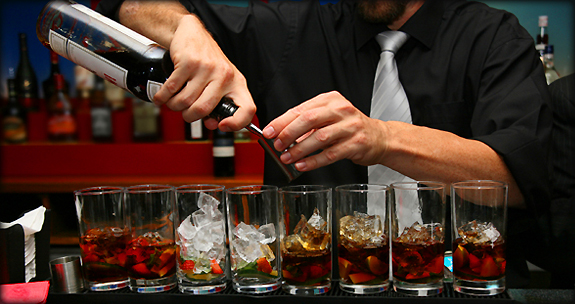
Boozing it up. Eight tumblers filled with cocktails.

Actually, the worst thing about people being drunk is they don’t know that they’re drunk. Wait. Let me take that back. The worst thing about people being drunk is that they don’t want you to know that they’re drunk.

This is super not okay when they want to prove to you that they are okay to drive. Like those times when they insist that you give them back their keys. Ugh! Let’s just make a rule right now to keep those keys.

But I want to talk about when they’re not driving.

For some reason, drunk people don’t want you to know that they’re drunk. But, let’s face it, they are too drunk to effectively cover up that obvious fact. Yet, somehow, they think they are sneaky.

Drunks speak super slowly. Not because they don’t think you understand them. They just want to be clear and they know that they are not clear. The state of not speaking clearly is also called called slurring. Drunks somehow think that if they slur their words more deliberately, nobody will notice they’re buzzed. It doesn’t really work that way.

Another thing drunks do is try to walk straight. Emphasis on the try. You can watch them concentrate on catching themselves. They forcefully put one foot in front of the other. They might walk a little bit to the left and then the overcorrect and lurch right. Drunks hope that nobody sees their corrections. In fact, they believe that they are slick enough that you don’t see the sudden straightening that then veers off to parts not yet known. They think that their overcompensations are invisible. But, they are not.

The second worst thing that drunks do is act like buttheads. While this behavior is not as bad as driving like a butthead, it’s fairly close.

The feelings of drunks can be both raw and easily tweaked. A friend can go from reminiscing about a joyful event from their youth to careening, in an impossibly rapid pile of tears, about a lost dog, a lost bracelet, a lost love or–and this really hurts–a lost packet of ketchup. Really. Did one need to get bent about a condiment? Definitely the booze talking. Definitely a drag.

Then there is the angry drunk. This can be caused by specific types of booze–say gin or tequila.

The angry drunk can be self-righteous but is more often just plain mad. Mad can be about politics, a difference of opinion over the ending of a movie or about a slight. That slight might be of the imagination or of a single deed that gets distorted into a heretofore unbelievable size. Way bigger than it deserves. Sometimes, the appearance of anger and anger itself can be melodramatically increased via volume of the inebriated. That is, someone sounds more angry than they are, and then they become angry. Silly? Sure, but it happens.

There is no disputing the reaction of the liquored up. It is not wrong. It is not overblown. It is the truth. The truth of that extra glass of wine, mug of beer or shot of liquor. And that truth might be elusive to the drinker. We have to wait for a shot of rationality. At least until tomorrow when they might better be able to admit it.

Sharp Dressed Man

Impala painted in flames. Sticks out.

The man standing on the corner stood out. It wasn’t because he was tall. He was likely 6’2″, or was that height when he was younger. But he wasn’t stand out tall.

It wasn’t his suit. It was a black suit. The fit of his pants was a little off, but that was likely because he was on the thin side. His jacket was fine, and he wore a crisp white shirt. He could have been a musician, but if he was, he played a harmonica and it was in his pocket. He carried nothing that would carry an instrument.

He did have a pile of papers in his hand. No folders. He might be carrying some mail. He likely walked past the train stop because he had today’s Politico at the top of his pile. There’s a newsstand next to the station on the block. His pile though? Not really a notable pile.

He looked over the traffic as he waited for the light to change. His silver white and gray hair was blown about by the breeze. It wasn’t wild. It was anchored a bit by its weight. Although it was fairly fine–not thin–it hung halfway down his back. His beard was much whiter than his hair. It was a clear contrast since his beard was the same length as his hair. It hung to the middle of his torso. His beard fluttered in the wind.

His was a ZZ Top or an elder Duck Dynasty beard. That was unusual. He wasn’t wearing sunglasses, even though it was very sunny. You’d expect sunglasses. His glasses were small, oval wireframes. They were silver or chrome frames.

The light changed and he crossed the street. The late summer solstice sun reflected off his face. Maybe he was an old hippie. Maybe he was a preacher. Maybe he was an orchestra conductor. Maybe he was an old hippie preacher conductor. Or just a guy. Just a guy crossing the street.

Window Dressing

An image of the Andrew Wyeth painting, The Wind from the Sea.

It was likely still gray. Like the light when the night turns over to day, but before the sun does its shine thing. I was reluctantly awake.

That’s not really true. Reluctance is active. I was completely inactive. My state of waking was a passive occurrence. I wasn’t doing awake. I wasn’t encouraging awake. I just was. Mostly.

My eyes weren’t closed. Close is an action verb, too. I wasn’t acting. There were eyelids laying across my eyes. If I was thinking, I would have wondered about slipping back into that other state. Sleep. I could go either way, and, indeed, I was passing between these consciousnesses. I was given to repose.

The motor on the little fan whirred and then receded somewhere far away as I slipped back into sleep. The forced air rushed past my bare shoulder. I moved my hand from underneath my pillow and pulled the sheet up. It wasn’t a waking move as much as a reflex. My hand found its way back under the pillow and my mind back to a dreamscape.

My body warmed fast. Too fast, passing quickly through snug and stopping on roast. My left leg kicked off my blanket and sheet. I dangled my foot over the side of the bed. I raised my shoulder to let the sheet fall away and tucked my foot back under my covers. I cozied into the linens, wrapped with an ambient satisfaction from the thin sheet protecting me from the chilly air.

Temperature fully regulated, my mind left the room and joined a meadow or a garden or a house that I’ve never seen but I know is mine. Interrupted by a pressure drop. It’s my wakeup call. I’m roused enough to hit snooze before I lapse back to that other state. That latent state , where there is only one verb. Is.

Dahlia Dalliance

A deep red dahlia.

Someone brought me flowers.

Why this night? Did I become Ms. Universe? Well, maybe that didn’t happen. There must be a selection board. Or a panel of judges that make that decision. Nope, I didn’t win a pageant.

Did I nail my recital? Taking a graceful final bow, my right knee bent, my toe pointing stage right, my left leg trailing behind; bent at the waist with my arms floating above the air and my head lowered modestly? Nope. I wasn’t even performing.

Maybe I needed some appeasement? I didn’t even know that I was angry. In fact, I was experiencing no offense so there was no need for a spray of apologies. Nothing to forgive.

Perhaps it was a hallmark holiday? Looking at the calendar, the closest festival seems to be Flag Day. And that was a few weeks ago. Even on the personal calendar, there are no birthdays (not mine) or anniversaries (not mine). Nope. Not a marker of a day.

Am I sick, or even more serious, am I dead? Thankfully, no to both of those options. I feel great.

But still, there is a bouquet. It is in my hands, and it is so beautiful that it could have been flowers for someone else. But they were for me. And I am well.

Seeing The Light

The sun is casting long shadows on the deck.

It’s close to the longest day of the year. It is taking the maximum time for the sun to set. The day–or maybe the night–teases us with long shadows in the late daylight. You really don’t know who’s in charge.

Even if there wasn’t so much rain in May, this is the most green and most lush time of year. The greens are a selection from a big box of Crayola crayons. Green. Pine green. Yellow green and green yellow. Olive green. Spring green. Asparagus. Fern. Jungle green. Forest green.

Or the greens are mixed from a palette–there’s a squeeze of yellow, blue, red, black and white in tiny cups. Adding the yellow slowly to the blue and stirring, the swirls of bright disappear into a new color. Adding a little black makes a color that is the deepest green grass and vines. A tiny more black, and it’s the green at the base of those long shadows.

Just on the other side of the borderline of sunshine is the yellower green. Because of the contrast, the normally grass green glows more gold. From there the path to dark is not an evened ombré. There are freckles of sun that break through some of the boughs. There are stripes of yellow laid down by posts that make up a fence. There are flickers of light when the wind pushes the sunbrella to the left. And then to the right.

It’s not yet dusk, but it’s working on it.

At first it’s not clear that it’s there. Your head turns, but it might have been just an eye blinking. It seems like it happened again. Eyes are squeezed shut and reopened to clear your vision.

Then, you know. You begin to scour the patchwork of light and dark. You spy the passing gleam of a yellow dot. Gone. You brain foolishly trains your eyes on that spot. And then you see a glow a few feet away. It’s truly summer. The lightening bugs have arrived.

It’s silly that you didn’t see them since now you see three, wait, four, no that’s more like eight, turning their lights on and off as they pass along the hedges just above the ground. The appearance and disappearance of the light swells and ebbs like shallow breathing. It’s a slow build and drop that happens very quickly. How can it be both?

Fireflies are sweet and clumsy as they approach. Simply put your hand in their path and they will alight on fingers. They show no stress as they crawl across your palm, maybe even lighting up. You almost expect to be able to feel heat, but if there is any reaction, it’s imperceptible. Then the bug reaches the end of your hand and takes off, providing a wink from it’s abdomen.

You follow the path you think it’s on and see one more wink. You lose it as it flies on it’s unknowable path, and joins the dozens of other bulbs randomly blinking on and off as the sun finally sets and it’s now, really dusk and then night.

They have phosphorescence. They create their light from within. Be a firefly.


Shook Me All Night Long

Captain Jack Sparrow, offering, or at least toasting you, rum.

He was fit. In that way that the word is used to describe someone who is teetering on the top, but not yet quite over, the hill. Let’s call him Steve.

Steve was a common name in his elementary school. There were two other “Steves” in his fifth grade classroom and seven in all of the fifth grade. They would be called by their first name, Steve, and the initial from their last name. It would be Steve P., or Steve J. It would not be Stevie because you lost the diminutive form of your name before kindergarten–except with your aunts. It would not be Steven because people were never called by their full given name when he was in fifth grade, or even eleventh grade for that matter.

He was born at the very beginning of Gen-X, but was constantly confused with the Baby Boomers. His musical history was Stones, Zep, Rush, the Eagles and Journey to newer music like Bon Jovi and Genesis. Maybe some Men in Work and The Summer of ’69. For hipness there might have been some Elvis Costello and The Clash. Maybe not, though.

He missed out on grunge. He preferred reciting Jenny’s phone number over and over rather than the rhythmic dirge of, All in all is all we are. All in all is all we are. All in all is all we are. Some of his friends just saw their dads on weekends. He came into an uncertain job market after college but did pretty well. He married the friend of his best friend’s sister. They don’t see their old best friends anymore, except on Facebook, to mark their own children’s proms and, most recently, graduations.

It was hot at today’s graduation party but the kegs of beer were on ice and tented with a tarp to protect the brew as well as the brew drinkers. He had a rocks glass in his left hand and a fifth of an artisan whiskey held by it’s neck and trailing down his leg in his right. He was holding it there like Kanye held that bottle of Hennessy the night he interrupted Taylor Swift with “imma let you finish.”

Steve purportedly brought the fine southern bourbon as a gift for the host. The bottle, however, never left his right hand. Sometimes he’d swap his rocks glass out for a clear plastic cup filled with beer. Sometimes he would offer someone else some of the amber booze. Only to men, though. And with a story about the rarity or the exquisiteness or the origin of this particular distillery, punctuated with the adjective “smooth” or the feature “no-burn.” Sometimes the tale included all of this.

He wore the bottle swinging against his thigh like it was a medal or an honor sash. It was almost like a marker of his own substance or significance. As the bottle emptied, his swagger was incrementally augmented. He stopped offering to share his bottle and stopped pouring it into a different container before he drank it. He was pacing himself, though.

The bright sun was replaced by multi-colored party lights hung from the tent poles, tiki torches–which gave everyone a quick rush when they were lit and burned off that petroleum smell–and the light from the French doors leading back into the house.

He drifted away, just on the other side of the tents where his peers were tipping back beers and refilling wines and sharing pictures on their phones from their recent trips to Italy and Ireland and Croatia. The music was loud and carried around from the back of the house past the rows of trees to the neighbors’ acre lot. They were invited and this level of noise was so unusual and it was two hours before midnight so there wasn’t a fear of a complaint. He was down to an inch and a half of liquor at the bottom of his bottle.

It wasn’t clear which woman in the floral sundress was his wife or which clean-shaven young man in a tropical shirt was his son. Nobody was checking in with him. When the tinder was torched for the bonfire, he moved into the circle with the group of people who were now all old enough to bring their own beer to the party at someone’s parents’ house. He sat down on the almost unstable white plastic folding chair. He put the bottle on the ground between his legs and soaked in youth.

He heard the air release from a beer can and called for one. There was a cringe from within a tropical shirt. There’s his kid. The youth next to the boxes of Miller Lite made eye contact with the oldster before he tossed him a can. Underhand rather than the rocket he just hurled to his buddy on the other side of the circle. You don’t want to bean somebody’s dad. Because no matter where the guy sat in the circle, he was somebody’s dad.

Steve pulled the last of the bourbon and opened his beer. Some in the circle around the fire were laughing uproariously. Steve was earnestly tightroping between hanging with the “kids” and dispensing fatherly advice. He was a father. He really couldn’t help it. But he was more than a little drunk, too, so he didn’t realize that he didn’t really belong in this circle. The youths welcomed him, but this wasn’t his tribe.

And then, the band started with the chords from an AC/DC tune. No, Steve. Not the air guitar. Yes. The air guitar.

Steve’s son’s girlfriend turned to him and whispered, “at least he’s not trying to twerk like Liam’s mom.” It was a small consolation, but the young man was consoled. By that and by the next rocket launch of a Miller Lite.

Floats Like a Butterfly

YellowCloverflower

The sun was coming in from the east at a 30° angle. It palmed my arm with a pleasant, ambient heat, like the warmth from leaning on the radiator on a cold morning. It had just pulled the last chill from the air. The chill was gone, but you knew it was just gone.

The robin darted in front of us. Again. I keep looking for her nest. There must be a nest somewhere because she’s been buzzing us the past few weeks, distracting us from her treasure. She’s very good at the distracting because she has come at us from every direction. I thought her nest was in the eaves in the porch, but that was one of her tricks. I searched the hedges, but couldn’t find it. There’s been nests there before.

I’m thinking that it must be on the other side of the elephantine boxwood–the blob that has grown to overtake the west side of the front yard. Only the feral cats, the raccoons and maybe the hideous possums fit between the oversized shrubbery and the hedge that lines the fence. I hope that the cats don’t get to her babies. I know they definitely get to The Beast, getting inside his head and playing games with his hunter’s brain.

Our gardening is fairly God-driven. That is, whatever God puts there is there. We’ve worked over the years to pull up the invasive vines and in its place, the deity has left what resembles thick grass. She also deposited some small mounds of clover dotted with tiny yellow flowers. Somebody said these were weeds. They are beautiful.

This late spring morning the mounds are dappled with  water droplets. The mini globes reflect the sunshine. Some of some of them are prisms, displaying today’s lesson in the color spectrum. At first I think that The Beast is eating the greenery, but see that he’s browsing the surface of the leaves and petals, lapping up the dew as if it’s puppy nectar.

Just above his big brow, I see the movement of a butterfly. The wings open and close slowly, like a baby’s eyes as she’s ready to doze. The edges of the wings are lined charcoal black, like a magazine model’s smokey eye. Inside the frame is a paisley of bluish black, orange and brown, flecked with gold and pale yellow. The butterfly rises from his perch and floats above the dog’s nose and to the boxwood where it pauses, just for a second. In two more beats of its wings, he’s back and dancing around the head of The Beast who looks up and follows, disinterestedly, with one big brown eye before he returns to sup on the clover.

I follow the butterfly, too. I reach for my phone to capture the exchange but my pocket is empty. Relieved of my documentation duties, I am fully immersed in the slow opening and closing of the wings and the oddness of both floating and turning and abruptly changing directions at the same time.

The butterfly rises above the hedge and flies away.

Shell Game

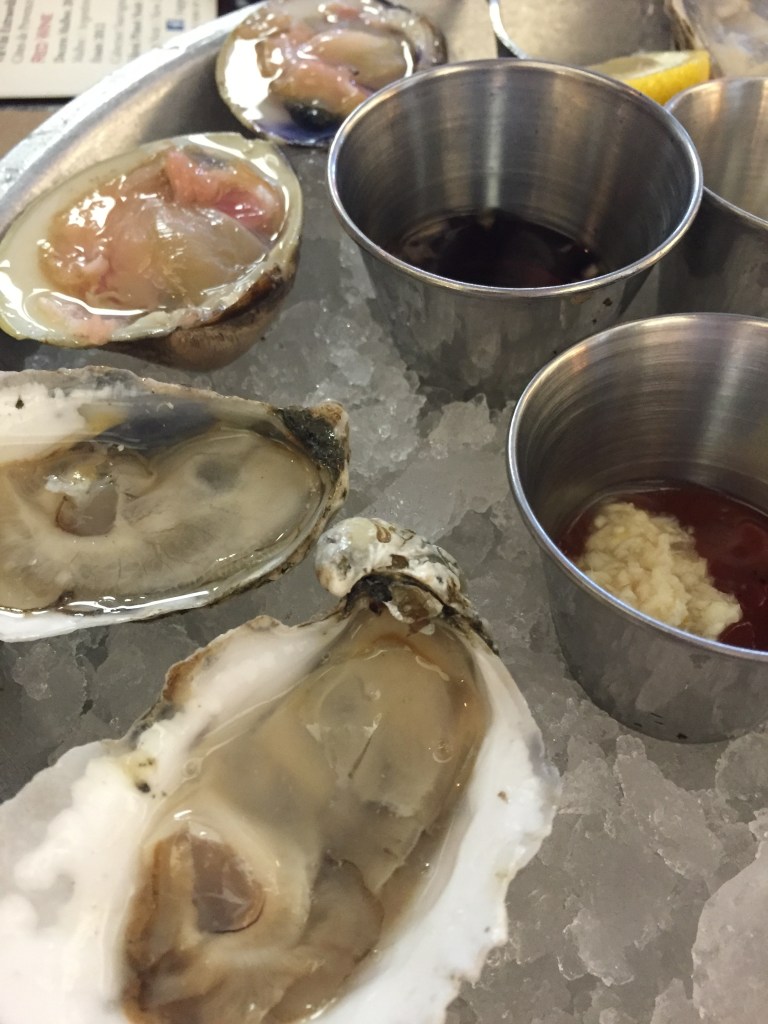
Oysters, and a few clams i the back.

Oysters are of the sea. Of the rough and tumble sandy, rocky, salty sea. Of dark skies and storms that cold boil brackish water.

The chassis of an oyster tell you that they mean business. They are not the perfectly ridged, delicate, ombré fan of the scallop. They are not the smooth, radial, accreted ridges of a clam shell.

No. Oysters look like street fighters, with a rock hard face that has been pummeled into a misshapen mass of cartilage and bone, awkwardly swollen and of many colors. Not all of them, or maybe none of them, a color of health.

It dares you to open it. It is the door to the witch’s house that you step back from because nothing good can be in there.

What a liar.

When I tip the half shell into my mouth and the oyster sides onto my tongue, my brain hears phantom calls of gulls. I almost look up, to squint into the sun, or to push my face into cold sea spray on a clouded day to see big gray or white big birds challenging me for that briny bite.

I taste the entire ocean, thousands of years, hundreds of thousands of years, concentrated in a chewy drop of sweet saline. If they are shucked poorly, I will bite into bits of its shells. I roll the shale to the side of my mouth and pull out the nature.

When they are shucked well, and adorned with a squeeze of lemon and a spritz of sweet-sour-peppery mignonette they are still of the wild sea. Because that is what they are.

Of the sea.