Hate the Player? Hate the Game?

a futuristic arena
Illustration by Helio Frazao
It was an awful game, he learned. It didn’t seem that way at the beginning.

When he first approached the room, it was like an arena. It seemed like it’d be fun. There were three valuable playing pieces, and he had one. He used his piece effectively and in support of the other players whose pieces had more specific functions. It was like being a midfielder playing offense or defense as needed and helping to set up the next plays.

Part of the game was acquiring new players to extend the game. As new players came on, additional playing pieces were added in the arena. The new pieces were only for the new players.

The game was changing. Where he had sometimes drove the play and other times assisted, his piece and his play became more peripheral. He wasn’t in the middle anymore. He didn’t realize it for a good while, but there was a radial force moving him to the edge. He was doing less defending and more standing in a fixed spot. He didn’t feel like he was really playing most of the time.

He was still in the game. He tried to get in on more plays, but the new players and their new pieces functioned autonomously. He now saw that there were other players on the fringes. He motioned to them. The fringe players motioned back, some waving their playing pieces impotently.

A few new players came in. There was some shuffling of playing pieces. A few pieces were split and shared with two of the new players. Dividing the pieces didn’t diminish their capabilities. It seemed that they might even be stronger. Maybe not. He wasn’t close enough to see for sure.

He knew that his piece was less important than it was, but he knew he could still participate in the game. He could use his piece and maybe a fragment from one of the other players’ pieces. The other players, the ones in the fray, acknowledged him. He got a splinter of a piece passed to him as the players on the inside played on.

He looked down and realized that where he stood was a now a level below the main arena. He could climb up before he was eventually forced back. He wasn’t sinking as much as the rest of the arena was rising. He was separated from the other peripheral players. He wasn’t sure how to communicate with them. Maybe they could help each other get back in.

The newer players would sometimes come close to him and he could provide them a power up. But the play was getting away, or maybe he was receding.

He didn’t see it coming, but the wall of the arena next to him collapsed. It collapsed on top of him. He was under rubble and tried to get out. He shouted more and more desperately for the other players to help him. Even to see him. He held his hand above him and hit a barrier. He realized that there were walls around him now and he was closed off, compartmentalized.

He screamed out, “I’m here!” He screamed it again. And again. Another player came near him and asked him what he needed. He shouted “I need to get out of here!” The other player came over and closed the top of the cage. He was trapped, and the other player went back to the game.

Delayed Rights of Spring

stonetable

It seems like it stopped raining. A recently absent companion, the sun, checked in. It was a welcome warmth.

There hasn’t been a single May morning coffee on the back porch. In any regular year, by this time, there’s usually been more than one seating. When the birds are doing their chirp thing. The sun is doing it’s shine thing. The air is doing it’s tickling breeze thing.

There are few weeks in the year that so fully welcome balancing a morning mug and the sports pages. Warm, bright, dry and bug free. With miserable rain every day so far this month, we’ve already lost two of those potential weeks.

Looking across the back porch, though, it’s not just the weather that’s less than genial.

There are still remnants of the last Christmas party strewn in the corners of the deck. Two green solo cups, one flattened, are joined by yellow half smoked cigarettes, empty charcoal gray seedling containers, a ladder, a racoon trap and detritus–including rusted scrapers, bent racks and lava rocks–from the protected charcoal grill and the busted up gas grill. Oh, and the two faded cans of diet Dr. Pepper that somehow did not burst during the multiple freezes since that party. It was a good party.

There are a few planters, some with dirt and some still virginal. Virginal except for that wintering over, anyway. There are some random pieces of wood–in that they really have no discernible purpose on the porch, an empty propane tank and pieces of a windchime that was weathered down. Six iron chairs are stacked in the corner, next to an upturned plastic trash can and an abandoned votive holder. The really nice one that refracts the flicker of the candle onto an evening meal.

The deck isn’t rickety, although it looks like it might be. I would not recommend leaning against the rails, more out of an abundance of caution. I would not recommend walking barefoot, this is from an abundance of splinters picked out of my feet.

It sounds much worse than it is, though. It’s about twenty or twenty-five minutes of picking up and another five or ten minutes to wipedown surfaces. Once the cushions are set on the unstacked chairs and the red and white striped umbrella is planted and raised, all I need to do is find my favorite tablecloth. The sun-bleached green one strewn with large pink cabbage roses that used to belong to my mother-in-law. It has a  five or six inch double fabric border that is a little more green, a little less bleached. It’s square so it gets angled like a diamond to cover most of the round table.

The round table on the back porch is waiting for my red mug and the Sunday paper and my countenance proclaiming spring. Coming soon.

Petals of Metal

3 pictures of a rose cupped in hands, first the flower, then the separated petals then a shredded pile.

She developed her set of techniques originally as self-protection, but she found they served her well in self-promotion, too.

She had always been smart. Not the smartest but an equation of brains multiplied by hard work put her near the top. And while there might be a limit to brainpower, she was fully in control of her effort level. She could do this.

A loving addict for a dad and a mismatched avoider for a mom were the catalyst and the enzyme for recurrent family chaos. They would reject her and she would come back. She strained–because that’s what she did–to make her family work. Really, though, to make it work for her. She wanted out. She wanted to be on the path to good fortune and the life of the fancy. She wanted her parents to be proud. She wanted her parents to love her. She wanted them to want her almost as much as she wanted to leave them.

She wasn’t good at hiding her feelings. She couldn’t hide her terror of rejection. She learned, though, that some people hated to see her terrified. She learned that teachers and bosses and friends and lovers responded with concern to her cocktail of tenacity and anxiety–especially when she served it with syrupy flattery mainlined to their egos. They were happy to tend to her. She asked more frequently. She sat adoringly at their feet, looking up with big doe eyes for approval and favor. She frequently received both.

When her recipe went awry she didn’t check her ingredients or her technique, but blamed the stove for failing her. She learned that if she was self-deprecating, others would fault the stove, too. Sometimes her flopped recipes would work their way out. Sometimes she picked up a new technique. She always picked up a new cookbook. She could find new appliances. Shiny ones that would not fail.

She settled on her mate early. He was weaker than her–but strong enough. It was a child’s relationship from middle-school. They grew up together. He loved her and she encouraged him to need her. She didn’t bother with other men in college. She punched her ticket and decided he was the one. Except for that time they broke up when he lost his mother and he really needed her. She took him back when he was “well.”

When she had children, she loved them the way  that she learned to love. By seeking approval. Sometimes she would look for theirs. Other times she strategically withheld hers. It was an equation, this family thing. You invested, but there was a required return. They were supposed to love her and she would do what it took to make it so–whether it was guilt, or bribes, or mistruths, or silence, or hugs, or praise, or time, or attention. She didn’t know she did this, but her kids did.

When they left her house, one left the slide rule behind and sought no approval, and so sacrificed her mother’s interpretation of love. The other attempted to measure up, but could not find her own peace by trying to patch together her mother’s.

Her mate fell into a painkiller addiction that almost killed him. He found that the numbness he felt with her could be swapped out more pleasantly. When he came back, he moved away for a while. She was angry and lost. She stayed that way. And he stayed away.


Bar None

The Bar.

Brunch was long over by the time he got to the bar. When he walked in, he had to close his eyes for a minute so they could adjust. Although it was gray outside, it was still daylight, and the bar was dark like a bar should be.

He stumbled a bit into the wall. Maybe, though, he was pushed a little as his party crowded into the small square space at the front. There were a few of them and there were already a few in the square.

He wasn’t so interested in his group as they were getting settled. He figured that they would take care of themselves. He looked up at the wall behind the bar, with the shelves of bottles of different shapes and colors. They were mostly the same size, though. He pushed his copper hair away from his eyes. He needed to squint a bit to look at the options.

It was still early, there was room at the bar.  A couple cashed out with the bartender and took their pints to a table. There was more room now.

He wasn’t very tall, so it was a bit of an effort to climb up on the barstool. To make it even more complicated, the stools were fairly light aluminum with tiny backs. They were sturdy enough when you sat in them, but getting into them could be a challenge for the clumsy. The bar itself was old wood, as were the floors, the benches along the wall and the tables. The chairs were a new addition that didn’t make much sense.

He scooched his chair in a bit and put his elbow up on the bar. He glanced at his squad for a second, but they were still disorganized. The bartender came up and moved the Collins glass from in front of him. He looked at her, but didn’t seem ready to order.

He looked down to the darker side of the bar, where people were coming in and out of the kitchen in a very narrow passage. The bar itself had a drawbridge, but the bartender ducked underneath to come through except when she was carrying food. People to his left, around the bend of the bar were looking at him. He didn’t notice them, but they were very interested in him.

After another minute of family kerfuffle, the mom looked around confused and then looked up. He was sitting up high enough that he was almost at her eye level. She looked at the people at the bar a little sheepishly and shook her head. His hipster dad laughed as he scooped him out of the barstool. He grabbed the adorable little sister by the hand and the family disappeared into the restaurant part of the bar.

The people around the bend of the bar were disappointed. They were waiting for him to order. And they were all ready to buy this first-timer a drink.

Not My Beautiful Cake

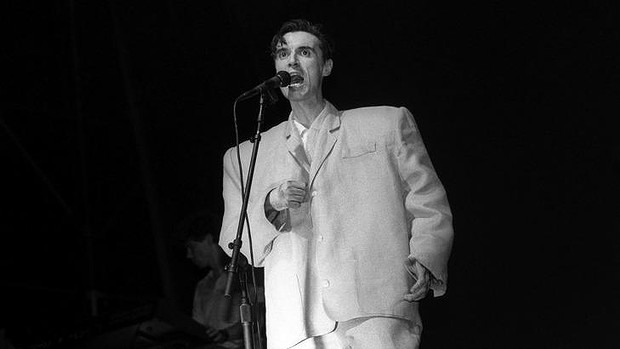
David Byrne from Talking Heads in a very ill-fitting and white suit.

He was wearing a department store suit. While he had the trouser legs hemmed and left uncuffed, the attire would have benefitted from additional tailoring. In lieu of that, he could have selected a suit that fit him better.

That wasn’t something he saw. The suit wasn’t too big. It wasn’t too small. It was the right shade of corporate steel-navy. It was buy-one get-one for half price, so it was a value purchase, too. The label on the inside pocket was printed with a name he heard before, or at least a name that sounded like one he knew. It could be a designer’s name. It was definitely not an Italian name.

His wife didn’t see it either. Although the two of them were on the fussy side, the fussiness didn’t extend to the hang of fabric.

His hair was thinning, but was holding onto its off brown color. Off brown in that it was not black, but it didn’t have the warmth a shade of fawn would have. It was a bit steely, without being gray, like the color of his department store suit with less blue.

He couldn’t see the hairless spot at the back of his head. He was ambiently aware that there was less hair there, but he believed there was some. There was actually a barren spot reminiscent of a secret marshy spot, where all the grasses grow long and somewhat willowy around a water-filled hollow. Except the water here was exposed skin.

His gait was like a flat half-skip. His body jangled jauntily as he stepped but his feet barely left the ground. He balanced a huge plastic cake carrier on his left hand. The bottom of the container was dark blue. There was no cake left, but some icing clung to the inside of the dome and was joined by some chocolate flavored crumbs stuck to the edge and along the bottom.

He randomly baked, mostly cakes, mostly from a box, and brought the goods to share at his office. He’d always add something special to the cake, to make it his own like the coaches tell contestants covering Whitney Houston on a singing show. This time he added instant espresso crystals to the Duncan Hines mix for a mocha-flavor. It was his idea. He thought it was very special and very creative. His colleagues thought it made the cake taste bitter and a little burnt. The double coating of frosting was a counterbalance, but they would have eaten it anyway.

He hurried in his half-skip to the escalator and disappeared down the tunnel to the train that would take him home.

Markers In Time

Entrance to Glenwood Cemetery in D.C.

Lincoln Road heading away from the Shrine curves around like an S up the hill and then curves to the next S–a reversed S that hugs the other side of the hill between the two cemeteries.  It’s a beautiful park on this sunny spring day.

A crabapple tree extends its branches over the iron fence and shades the road. The tree is starting to switch from flowers to leaves. The flowers are like pink painted orbs against the green that is barging in. Just before the first S there is a Japanese-styled garden with a bridge arching over most likely a rock river. This tribute is new. I remember them moving the earth around and creating some moguls before they constructed a pagoda and then the bridge. Mylar balloons tied to one side of the bridge are lurching toward the sky. It seems strange, attaching balloons to the bridge. There isn’t an obvious marker. I don’t think they were from a birthday party–unless it was marking the birthday of someone dead?

Lifesized cement angels herald visitors at the entrance at deepest part of the curve. Well, person-lifesized. I don’t know what the size of an actual angel would be. Anyway, if you were trying to enter the grounds from the north, you’d have to turn your car 270°. Funeral processions always enter from the south for ease and are guided around a large circle with more angels, some blaring trumpets others in thoughtful prayer poses.

This is an old cemetery. The sign says it was founded in 1854. The stones are all different shapes and sizes. There’s some tall ones that look like the Washington Monument. These obelisks are different heights. Is there some status here? There are some twin stones, maybe marking a couple. Some markers are big crosses. There are square crypts that hold families full of remains. There is an old azaela that sits in front of a gravestone and has just about overtaken it. There are tall trees throughout the winding roads of the cemetery. There are lots of low flowering plants.

Modern cemeteries are designed for efficiency. There are no trees and no above ground stones so the groundskeepers can easily cut the grass. The graves are lined up in rows and are navigated to using simple coordinates. Some modern cemeteries limit the types of homage family and friends can leave behind. There is a sameness.

Not at this old cemetery. The grave markings are as different as the people buried here. There are old trees and young ones, too. Somebody is taking care to ensure that there will always be some shade. The grass is mowed, at least from where you can see from the road. Maybe people have to pay a fee to maintain the plots, but none are overgrown.

The leaves on the trees sway slightly and the sun warms the garden. There isn’t a funeral today, but there are a few people coming to visit those who have left them. They have picked a good day to pay their respects and to walk through the garden.


Tonal Morning

carillon bells. They are very big. And loud.

I stand in the front yard waiting for The Beast to accomplish what I thought he was set out to do based on his doleful whine at the front door. He was in no hurry.

It’s not really a cool morning. There’s the backdrop aura of a spring day, but it’s way in the back. In the fore is a damp start. We’re outside in between the rains as I expect it to begin raining again and it had clearly rained not too long before. There isn’t any bite or sting to the air and not really a chill, but some contact with the water vapor that is suspended in the air that is not as warm as the air itself.

The Beast continues to sniff around the yard. Based on his at-the-door antics, I’m a bit surprised that he is being so deliberate and particular. That’s how it goes.

I hear the bells from the church spire. I don’t know the time, so I count the verses. One, two, three. I wait for the fourth, but it’s done, signaling the third-quarter hour. Wheels are hissing on the pavement as cars go up and down Twelfth Street, kicking up the water on the asphalt and whistling it through the treads on the tires.

There are at least three different birds with three different songs in nature’s own Sensurround. One is puncturing the morning with staccato yips. The others are a more melodic greeting of the morning, The Beast and me.

Spares

bunch of shoes.

The lights are really bright in this basement. Most of the fixtures are bright but yellowish. There are two, though, that broadcast the brightest and whitest light. I bet they are new LED lamps. Energy efficiency and all.

The halls are lined with locked black metal storage cabinets. The cabinets are short and tall. Some of the short ones needed to be short because there were mysterious electrical boxes sticking out on the walls above them. There are plenty of mysterious boxes. There are also some short cabinets underneath free wall space. I guess they were all ordered at the same time and somebody didn’t do the measuring.

The tall black metal storage cabinets are deeper than the short ones. These were not all from the same order. There are slight variations among them. Just a few inches in height and a few inches in depth. They were randomly aligned–two tall and fat, one smaller, one taller, two smaller. The locks were also a hodgepodge. I don’t believe that the size of the lock was related to the value of the contents. But that’s just a guess.

The floors in this basement are peculiar. The hall is wide and the deck is primarily cement. There is about three and a half feet of steel in the middle. The steel is textured and bright. When you walk on the steel it feels hollow underneath. I stepped as lightly as I could to avoid the clank caused by my shoes. I preferred to walk on the edges, on the cement. The basement was empty and this made me feel less conspicuous. I didn’t want to sneak up on anyone, nor did I want to announce myself so loudly.

I stopped in the restroom. It was surprisingly nice for a non-public area. Lighting was excellent, no broken tiles, sturdy wooden doors for the stalls. The sinks were pedestal-style. I walked back out into the industrial underbuilding.

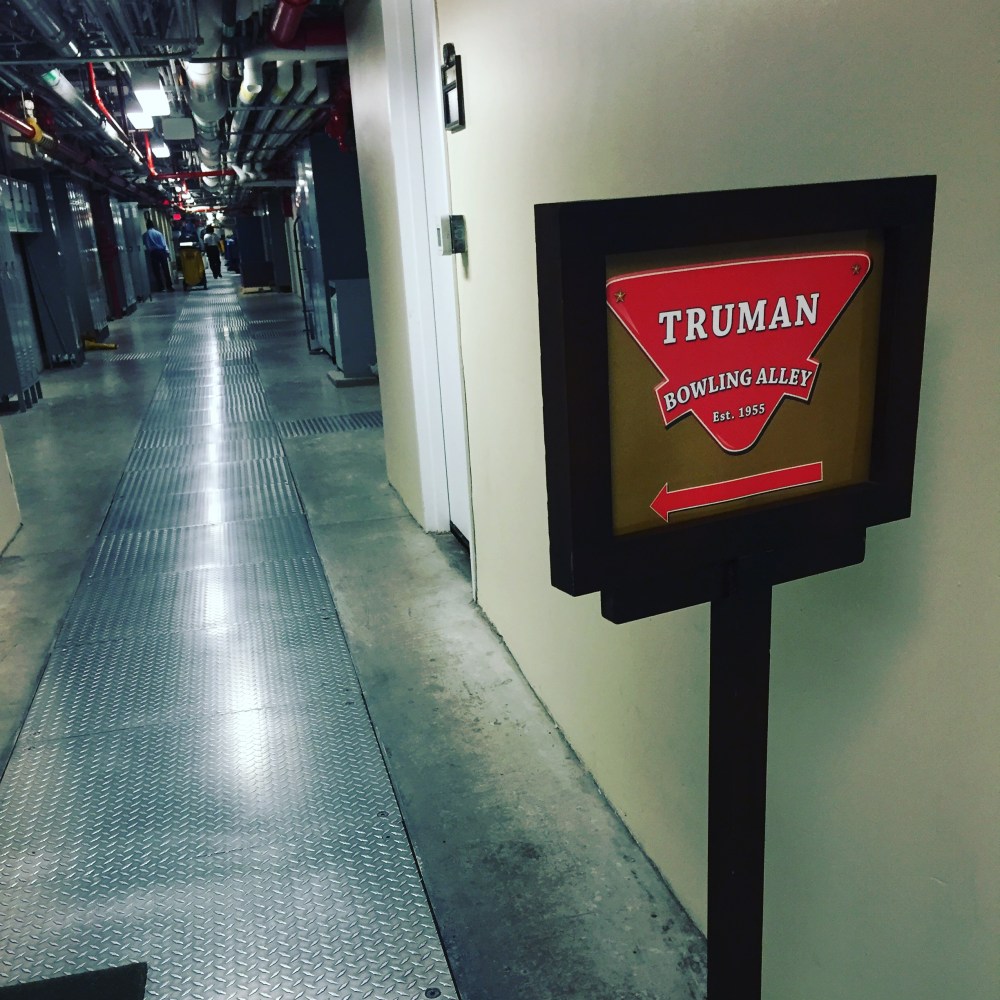
There is no wifi and only an ineffective blip of cell signal so there were no selfies. I waited for my colleagues outside the locked door. To the bowling alley. In the bowels of the White House.
bowling sign in the scary basement.
For those of you at home keeping score, I bowled in the bottom quartile of the bottom quartile. My solo tour of the basement was the best part of my game.

A New Season

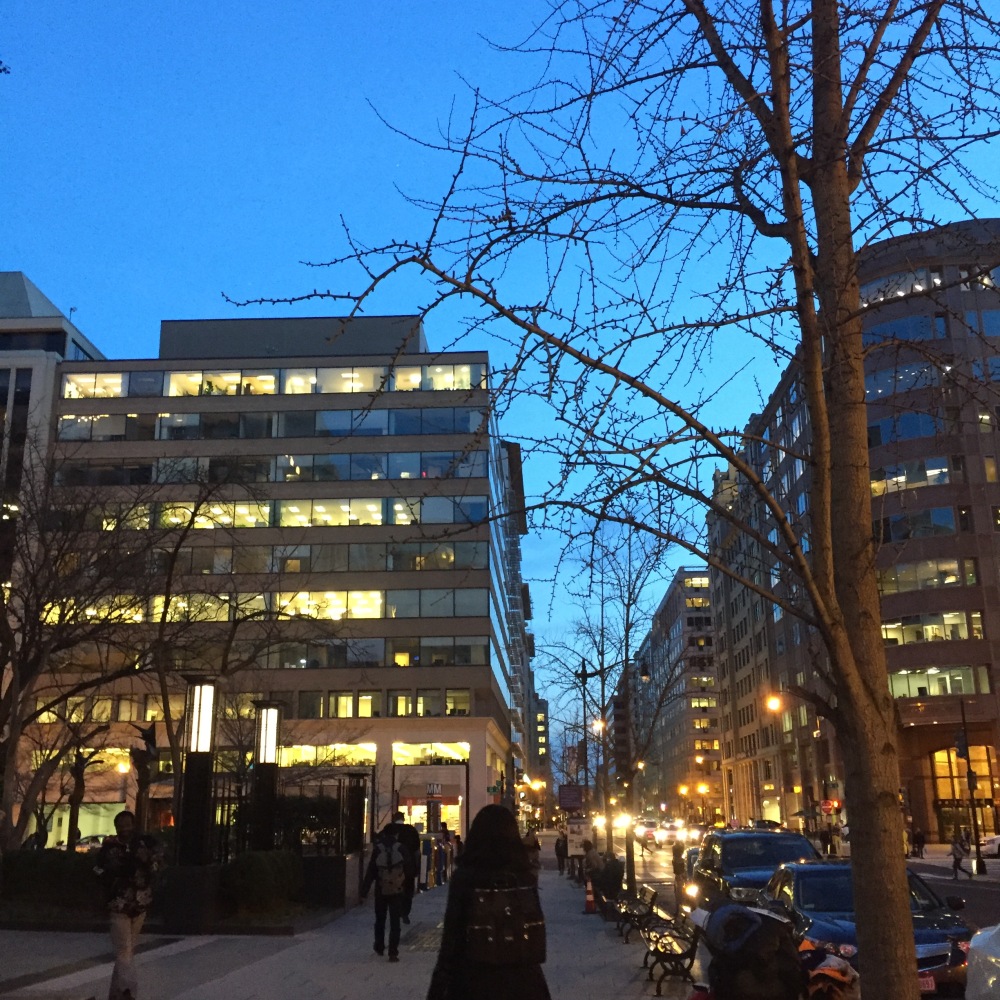
How beautiful is that blue on an early spring evening walking down 12th St to the Metro Center Station?

The newspaper has unequivocally declared winter over and spring sprung. Nothing like laying down the gauntlet to the pernicious weather gods. At least I know where to shake my angry fist if there’s a sleet storm next week.

I, therefore, am a bit hesitant to offer that I, too, feel the signs.

As is my habit, I flew down our building’s Cinderella staircase. I kept my shoes on my feet and stepped out to an unfamiliar feel on the street.

It was not warm warm, but there was a top layer of warm to the expected chill of the dusk. Maybe the sidewalks absorbed so much heat from the sunny day that it reflected back–like one of those propane heaters at a restaurant when you sit al fresco on a mild wintry day drinking your brunch. You feel that it’s cold, but the heat does some kind of inversion or some entropy thing and the heat insulates you top down like an airy feather quilt. No weight but the warmth is held in, close to you.

I drew in a breath to identify the scent of spring. All I got was foul diesel from the bus and the stench of a burning cigarette. So the spring wasn’t yet available in the scent sense.

I got off the train and stretched myself like the dog uncoiling his spine as he steps his front paws off the couch while his back end is still anchored there. This move is usually accompanied by a big-mouthed yawn, sometimes with a high-pitched yawly sound effect.

I’m feeling a spring metabolism, skipping down the steps, flirting with the turnstile as I swipe my farecard, and leaving the train station with my chest out, shoulders back and wearing a silly grin.

The escalator handrail didn’t get the memo. It was cold. But the breeze didn’t bully me in to pulling my collar close to my neck. Instead, I left the moving walkway with my jacket open and my gloves in my bag.

Feeling frisky I turned the corner, like la primavera. Ahhhhhh. Feels good.


Run On Stories

bunch of sneakered feet running

Driving along the parkway I’m imagining the backstories of the runners I pass. There’s a lot of them and I’m driving 35 mph, so I don’t have time to get too deep.

First up a runner I call Twinkle Toes. He’s wearing a matched true blue jacket and sleek shiny running pants with a true blue cap. As he’s running he pushes through to the tips of his toes from the pavement. It doesn’t look wrong, but it makes him look light. That and the sleek pants. In his head he’s repeating Portuguese vocabulary and grammar because he’s heading there for a gig in a few weeks. His personal Rosetta Stone practice is interrupted by Thursday’s meeting that failed. He pushes that away and starts to say the foreign words out loud as he runs.

There were big puddles, almost lakes, on the trail near the Zoo. Runner #2 did a back and forth hoppity hop to avoid drowning in one. Her boo is likely finishing off a second mimosa during brunch. She prefers to run alone but ends up feeling a little lonely when they hook up later, one tipsy and one sweaty. Maybe she’ll cut her run short and join Boo.

The next runner I’ll call Cletus. Definitely was an athlete in school, but more in it for the social side. He’s lumbering along in baggy shorts and bare legs and sneakers that have definitely been used. He has a filthy Giants hat pulled down almost over his eyes. Some untamed ends of dark curls poke out underneath the sides near his ears and above his neck. He forces himself to run at least two times a month. Usually concurrent with a hangover. He shakes the marbles around in his skull and feels like if he just keeps going he won’t throw up. It works. For a while.

Then came along the unrelated dogwalkers. 

The first man I’m naming Thomas is wearing a red, yellow and green tam. His lanky frame is topped by a silver puffer jacket. He’s accompanied by his lanky Doberman, Diesel. They’re stopped on the trail, facing each other having a terrifically animated conversation. They’re laughing about the joggers that didn’t want to run past them but didn’t have an alternative on the narrow path. One guy ended up detouring from the path by trying to run up the slick hill. He slipped and skidded right to Diesel’s feet. Diesel wasn’t impressed and was unmoved. He turned head to the side–as if to provide embarrassment space– as the guy tried to crabwalk backwards up the hill. Thomas gave the guy a hand up, brushed the leaves from the guy’s shoulder and cheerily waved goodbye. Now man and dog are chuckling at the unnecessary circumnavigation.

Next there was a couple with two dogs. I saw them just after the bridge, and I don’t know how they went around the bridge. I guess the path swung underneath it somewhere. The man handled both leashes. One for the big dog and one for the little dog, a common dog configuration. The big dog was hers. When they moved in together, the BigDog started having anxiety issues. It wasn’t just the pooping in the man’s shoe, but it was that, too. Since she loved the dog before she loved the man, they got a little yappy companion for BigDog. Now both dogs crap in the man’s shoe. But he loves her.

It was a cold day, but I spied a grouping of men in short sleeves running towards the boathouse in the shadow of the Watergate. They had military do’s. They stripped down, not even wearing caps, to show off their strength and fortitude to each other. The one called his mom later and complained about his overly macho colleagues. She listened and said nothing. Turns out that she’s distracted by the dark spot on his Dad’s lung x-ray. She doesn’t want to burden her son with the looming unknowns. Not just yet. She tells her boy to wear his hat next time and not to be worried about the others. They wanted to wear hats, too.  I agree with her.

The parkway split away from the path, and so the fuel for my tales ran out, too.