Blinded by Stars

A stylized DC flag with three red stars on the top and 2 red stripes on the bottom. It's u.

Oh, my babies, let’s act like we been somewhere, okay?

There was much anticipation when Michelin announced that it would bring it’s food judgement crewe to D.C. to let us know if we have good food. By awarding stars. One, two or three. Or maybe none. This anxiety started in May.

After Bon Appétit named D.C. it’s restaurant city of the year, the opening up of a series of highly priced and highly sought after dining rooms, and the encroaching hipterization of our fair city (like where do they find all those guys with the well trimmed oil groomed beards–some with black boxy framed glasses and all with plaid shirts–to wait on our tables at the laid back fine-dining halls?) you’d think people would feel confident that D.C. had made it in the foodie category.

D.C. dining is longer an afterthought of stuffy steak houses and seafood restaurants that did the fish version of those steakhouses–side of creamed spinach, anyone? The variety and quality of D.C. fare and the range of locations have definitely been kicked up a notch. Fine dining on First near Rhode Island Ave? Petworth? Brookland? And the former streetwalker circuit near Logan Circle with dozens of fun, interesting and, in some cases, delicious bistros and taverns and counters and bars?

So this morning there was even more anticipation and some anticipatory handwringing. Today was the day that we’d know who “won.” Whatever that means.

And it hit with much hoopla. One chef proudly tweeted his honor early–TWO stars! The rest seemed to appropriately hold off until the official announcement of a dozen restaurants that were deemed high enough on the spectacular scale to be included in a thin blue book. [The Doc has dined at four of these, in full disclosure.]

Some thought that the list was wrong either by exclusion, inclusion or delusion. That the secret society of inspectors just don’t get us and who we are.

But seriously, ain’t no Stay-Puft Marshmallow looking quink can put my knickers in a knot. Let’s maintain our pride. We are a town that is more than the marble buildings on Pennsylvania Avenue.

We are Washingtonians with a baseball team on the way to the World Series (fingers crossed), a football team with an embarrassing name, awesome public libraries, beer and whiskey dive bars, theatre, dance, sixteen art museums, ten colleges and universities (seriously!), a zoo with pandas and a malfunctioning subway system. Also a ton of named neighborhoods where real people garden, have cookouts, argue and fight, walk their dogs, prep for marathons, go to church and make and raise babies.

Eat where you want. Respect yourself. There’s plenty good food in town. All stars!

No Thank You

An empty office chair. The chair is red and it's in a rustic room.

The conference room was crowded. Again. It was always crowded. In addition to having too many meetings, there was frequently too many people in any given meeting. And, to add insult to injury, there were definitely too few conference rooms of substance.

There was enough room around the table for maybe fourteen people. There were an additional eleven or twelve chairs lining two of the walls.

The way conference rooms usually work had senior folks taking the seats at the table and the junior staff hanging out along the edges. Usually is not the norm in this room, though. Many interns and junior staffers read articles telling them it’s important to take their seats at the table. So although they had no substantive role in the meeting–not responsible for any action items, no speaking role and without relevant questions to ask or answer–the table was half-filled with the mute.

This day was like the rest. Musical chairs. Too many bodies for too few chairs.

A young woman walked into the room and stood along the edge. There were three other people posted up along the walls. The meeting was still convening.

One guy who was seated looked up at the late entering woman. “Here, sit here.”

“I’m okay.”

“No, really sit here.”

“I’m good.”

“No. Sit here,” he stood up his full six-foot three-inches.

“Seriously. I can stand. No problem.”

“No, I insist. I cannot accept you not taking this seat.”

He offered because that was what gentlemen do. He was brought up to respect women. To give up his seat. To open doors. To pay for dinner. That was what he was trained to do.

Somehow, though, she, and what she wanted was not part of his training. So it became not about her, and her sitting, but about him and him giving up his seat. And he demanded that she accept his offer of generosity.

I stepped in and said with a smile, “The lady said, ‘No,’ if we heard her correctly.”

He persevered on our young colleague. “I won’t feel right if you don’t take this chair.”

“It’s not about you,” I offered. “No means no.”

He looked at me with a flash of ire that immediately fell away. He meant no harm. He was doing what he was supposed to do. Except he was focused on his own will and his own need, not that of the object of his chivalry. He didn’t know what to do when his offer was not accepted. He had a role. She was stopping him. He had to reset, and he did.

She looked at me with a sense of relief. She didn’t want to fight over not sitting in the chair but felt pressured by him. She stood along the wall, as did a few others, for the duration of the meeting.

Here’s a new rule to add to one’s chivalry equation. When someone says “No thank you,” the correct response is, “Okay.”

Bottom line, if you are forcing your own desire or rules for someone’s benefit who does not share your perception of what they need, back off. Accept their choice. That’s the right thing to do.

Courtyard by Hotel

She stood up and rearranged herself–her slacks, her jacket, her bags and her bones, including all her vertebrae from where she was just perched and up through the base of her neck. She shook out her legs to straighten her knees. She snapped up the front of her vest then yanked the bottoms of her pants. She wanted them to meet the top of her sandals. She was together now.

She was done with her squagle. That’s what they called the bagel-like fare from the corner shop. It was square and had a hole in the middle. She was full after eating a quarter of it. The pigeons nearby eyed the rest. These were very fat pigeons. They were not hungry as much as they were greedy. They made some pigeon sounds and slowly strutted in front of her. The better to catch her attention.

She began to tear her roll into chunks. She tossed the chunks on the bricked patio. Then she wished she could take them back. They were so jagged and ripped. And big. Too big. She wished she had taken the time to more cleanly tear them, and to tear them into smaller, more accessible pieces for the birds.

She reached into one of her bags for another squagle. She carefully tore it in half. She was very deliberate this time. She eyed the middle and split it from the top. She placed one half in the bag to her left. She kept it at the top because she expected to return to it soon.

She looked at the bread in her hand. She pinched off the corner, then picked at it and picked at it until her lap was full of small pieces of bread. She picked a piece up and tried to make it smaller. It was still too big. She frenetically pinched at the edges, trying to make the bread into the specs of flour that it came from. She needed them to be smaller. The birds strutted closer and then flapped their wings, slightly alarmed, as her motions became wilder.

Her head shot up and down like a piston to some internal metronome as her hands plucked at the bread in a frenzy. Sweat beaded at her temples. She reached to unsnap her vest when a gust of wind scattered the tiny crumbs from her dark lap in a swirl. But the pieces were too small for the birds, there was really nothing left.


Dozing

A baby with fat cheeks.

He was definitely still a baby, but was increasingly more independently busy. Increasingly, in this case, used as a multiplier for more. It was happening fast.

Walking was always at top speed so you’d call it running. There was jumping and dancing, too. Words, and sounds that mimicked words, would tumble from his mouth. They would have the cadence of conversation, and likely a meaning that was uninterpretable, for now. He could clearly convey, “No,” usually when admonishing the dog. “No, babau” or whatever he said that meant dog.

It was time for his nap–remember he’s still a baby–but he was using his found power of no on his mother. She needed him to stop being busy for a bit. She had some busy of her own to do. Also, he was tired and she wanted to stay ahead of that.

She lifted him up and gently placed him in the bed. He sat up. She knew if he stopped for a few moments, sleep would win. She stretched out next to him and put her hand on his little back. He turned his head toward hers, lifting his chin so he could see into her eyes. They were just like his.

She saw her reflection in his eyes. She whispered a little hushing sound just above his head. She looked at his big round cheeks, rosy pink in the center dissolving into the smooth, clear porcelain at his rounded chin and his tiny nose. She brushed her hand on his cheek. It was warm, fueled by his little furnace inside. He sighed a baby sigh, and she felt his body relent a bit.

She locked eyes with him. He wasn’t going to let her out of his sight. She thought his eyebrows were perfectly formed, a light brown hinting at auburn framing his green eyes. With those lashes. Those long curly baby lashes coveted by all the women. He blinked. It was starting. He blinked again. She answered with a slow blink of her own.

She loved watching him fall asleep. The long, slow blinks that would get longer and slower until his lids were too heavy and would not flutter open. She couldn’t move too soon, otherwise, it’s back to the coaxing stage. She rubbed his back. He lifted his little hand and placed it on her cheek. Her heart swelled. She knew he was sleeping when she felt the wet, warmth of his perspiration. He would flash just as he fell asleep. And then she, too, was asleep.


Without Character

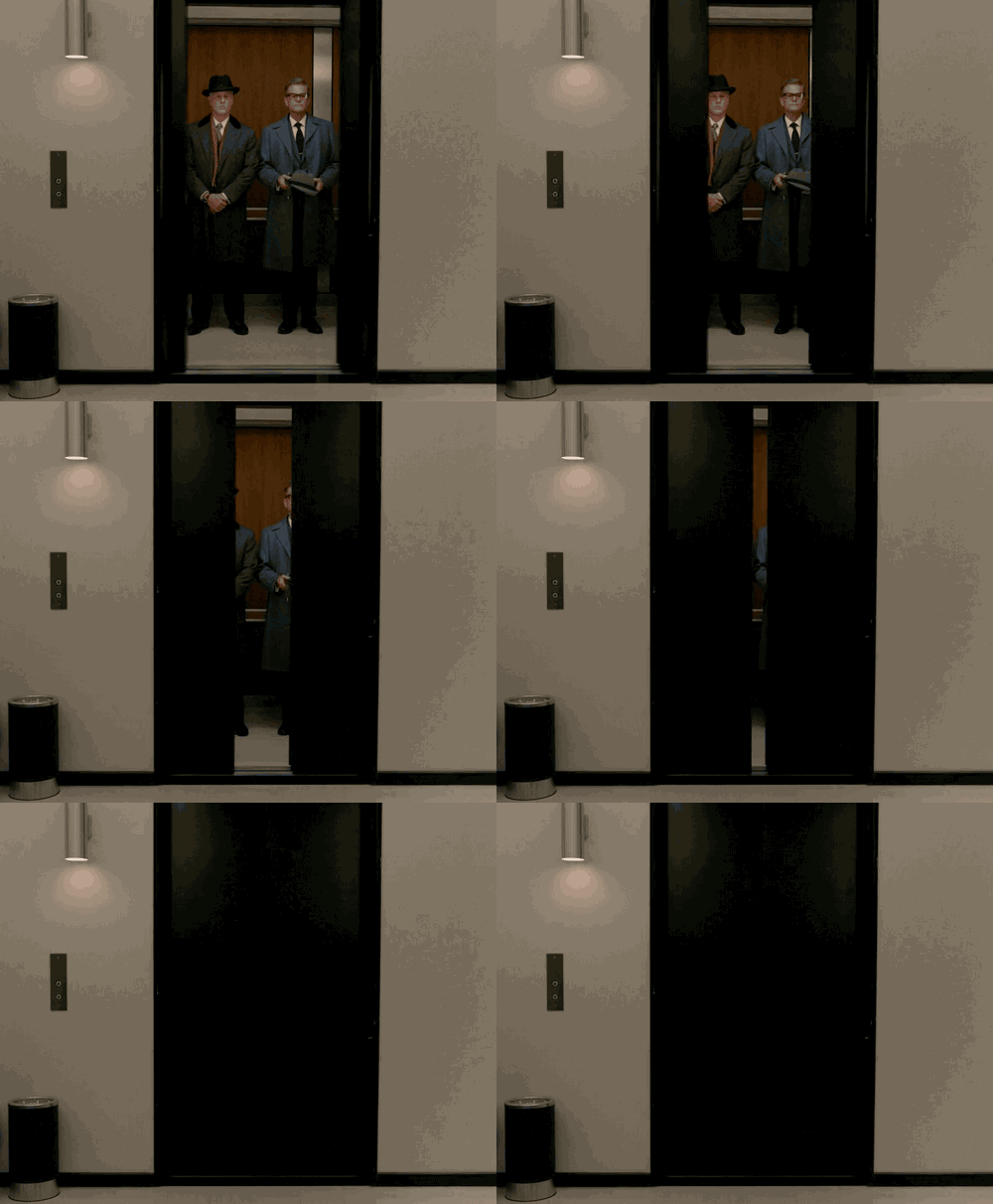
A nondescript elevator with two white guys from the 60s madmen era with fedoras with the doors closing.

There isn’t anything authentic about a convention center. It is the Muzak® of buildings. Taking strains of something that had a soul and stripping it of anything that makes it itself.

After lobotomizing originality, next to be removed is anything human. Voice, words, breath, a pause? All excised. Any instrument that conjures an image of fingers racing along keys, pressing a valve, strumming strings, holding a bow or grasping sticks? Also eliminated.

All you have left is a lowest common denominator tempo barely holding up the weakest strains of a strained melody. And when you hear it, the bleached skeleton picked clean of flesh and blood, you get mad. Because it used to be something.

The worst, most generic chain motel gains charm in comparison to the empty cavern of a convention center with its too high ceilings–in case someone booked a boat show and need to showcase a hundred foot yacht, or maybe a grouping of humvees, a tank and a Blackhawk on blocks for a military show of might. People love getting their pics standing near the turret of the tank. But that doesn’t make the convention center any less bland.

The colors in the convention center do not stimulate the rods and cones at the back of your eyes. Even the use of orange, when contrasted with the old wool blue gray in the carpet, doesn’t jiggle your brain. At best, you mark it as something that evokes the color orange and dully move along.

The chairs in the rooms are not camouflaged. Not really, but they could be. They almost always have a gold or silver frame. This is so you can differentiate among the individual units. I was going to say differentiate among them in the dark, but they would all fade together under light, too. The metal does not shine, though. It does not catch your eye. It is matte. Almost a silent signal.

Even the food in the convention center is without taste. Whether it’s a box lunch, purportedly with an Italian sub or a roast beef and horseradish on pretend ciabatta (it’s just the shape of ciabatta), or a sit down meal at an awards dinner, the food tastes like the food in a dream.

You know that dream. The one where you have an ice cream cone in your hand and it’s dripping a bit on the side. It’s piled with two big scoops. And your dream self puts it in your dream mouth and your real brain registers no flavor. I usually wake up then. It’s the equivalent of a nightmare, I guess. Well the food at the convention center is like that. Even the potato chips.

There are windows around the sides of the building. They are huge plates of glass, and yet there are no streams or streaks of light. It just surrounds the building and substitutes glass for walls with no real contrast. Maybe those aren’t windows. Maybe those spans are just a slightly different shade of wall.

Leaving the convention center, there is an exit with a set of stairs. These stairs are dangerous because you can’t tell the steps apart. It’s just that same Muzak® carpeting that leads you out of the Muzak®-filled elevator and out into the noise and the dark or the light of a real street. Look, there’s a pigeon strutting along the sidewalk! Something is alive.


Et Tu?

President Obama and Laura Bush watch first lady Michelle Obama embracing president George W. Bush at the dedication of the National Museum of African American History and Culture.
Who are the Americans in this picture?

“I, too, am America,” said the president. The President of the United States of America, that is.

He didn’t just say it once. He said it twice, but it seemed like I heard it at least four times. How ridiculous that the democratically elected leader of the free world would say it even once.

But that’s because since he became president, some have been trying to delegitimize him. To say he wasn’t American. That he is other.

I can’t tell you why. I don’t doubt that there are multiple reasons, and I’m sure that different people have different justifications and different combinations of pretext.

But thinking about it, when folks see people as other what does that mean? If they are other, are they not people? Are they animal? vegetable? mineral? monster? Does that make it easier to dismiss that other? To strip from them their humanity, their fears and struggles, their dreams and loves?

It’s pretty easy to be an American, though. In fact, we’ve welcomed people who are tired or poor. We’ve embraced huddled masses yearning to breathe free. We’ve provided refuge to the wretched from another country’s teeming shore. We’ve provided a future to the homeless and those tossed by tempest.

America has work to do in order to live her ideals when it comes to people of color, people of non-Christian faiths, people who have different abilities, people who are poor, people who don’t fit heteronormative beliefs, people of different backgrounds.

But who is that “America?” Is it other? Is it not her people?

I, too, am America.

Ouch.

Poured Out

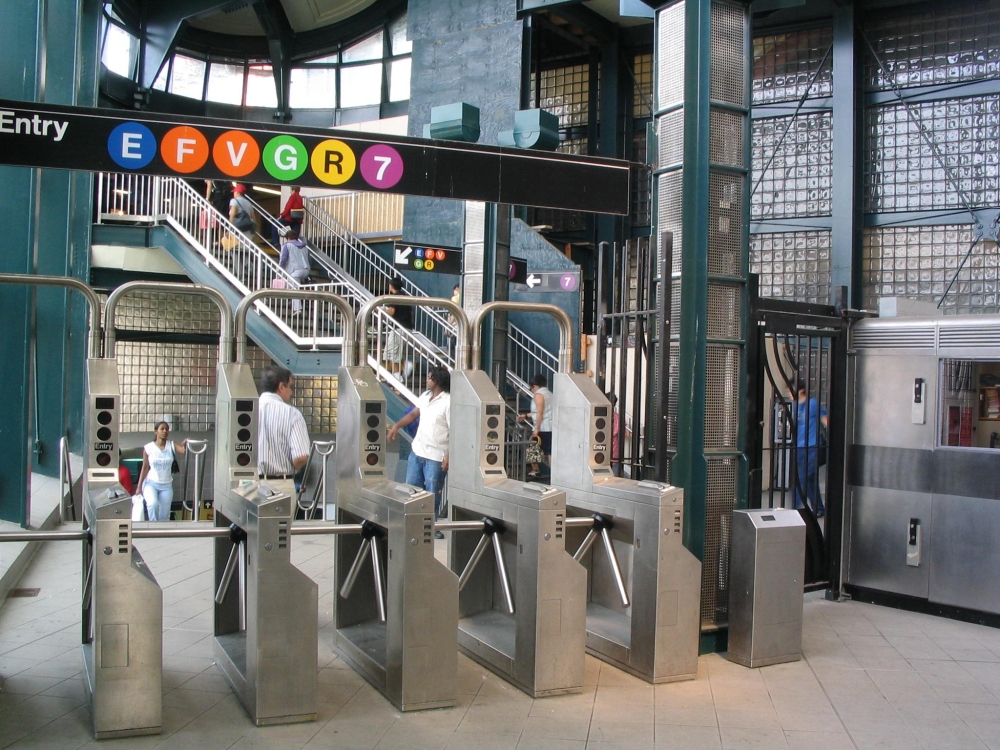
Turnstiles at New York subway stop at 74th station and Roosevelt.

It was his first day on his new job. He wasn’t very good at it.

He always saw himself as an entrepreneur. The business owner. The man who made it happen. Bringing in bank. Making a killing.

This was his first attempt at his own business. He expected a slam dunk. He’d seen others do this work, and they were much less articulate, less attractive and even less orderly than him. They seemed to do okay. He’d do much better.

He stood in the upper level of the subway platform with his khaki flavored jeans, a long sleeved polo and his boat shoes. His brown bangs swept a bit to the side, his lanky seventy-four inches posted up like a beacon.

“Do you have a dollar? Four quarters?”

People looked at him. They thought that he needed a dollar to get on the train, but that wasn’t what he was asking for.

He looked at the people passing by, heading most likely home after a day at museums and festivals and maybe an afternoon tipple. It was Saturday. Nobody was stopping. Nobody even looked at him. No hands went from their pockets to his outstretched hands.

He’d been at this for almost forty-five minutes, and he wasn’t getting any money. He was losing his patience. He stamped his right foot.

“I can’t believe this,” he said, mostly out loud. He directed his frustration to the oncoming passengers by stomping his right foot again and raising both the volume and the pitch of his voice.

“Do you have a dollar? I’m HOME-LESS,” he bleated. He dragged the word homeless out. It sounded whiny and embittered.  He looked like a bro who couldn’t find his frat or someone who was doing a social experiment for his psychology class. People didn’t mark him as needy.

He figured he could make $20-30 in two hours. He saw people putting money in a bum’s cup. The guy didn’t grasp that people commuting on the train to or from downtown were not opening their pocketbooks for every homeless person they encountered.

Some, like him, never give. Some always give. Some give when it’s cold, when someone has a child with them, when someone looks like they need to go to the hospital or whatever tips their generosity scales. There had to be a connection. He wasn’t connecting.

As more people walked by, the guy was getting more resentful. He had been kicked out by his roommates just five weeks into the semester. It was his temper they said. And his awful mouth when he drank. But they all partied and so when things got broken he didn’t understand why they expected him to replace everything. And they were all trying to get laid so he wasn’t any different from them, no matter how that bitch lied. Whatever happened to bros before hoes?

His roommates let him leave his stuff until he found a place. The second night in the park was less of the adventure and more of a drag than the first. And he missed class yesterday and today. But he only had to scrape enough dollars for a bed under a roof for a week. There’d be money in his account at the beginning of the month. Craigslist was the move. Someone always needed a roommate.

This panhandling wasn’t working out. He had forty-six cents. He still had money on his subway card and a few bucks in a pocket. He’d go back to campus and take a shower at the gym. Maybe he could sleep there. He figured he’d stop at the corner store. He had enough for a small bottle. If not, he could sell a few cigarettes to the real bums.

Inaccessible = Unacceptable

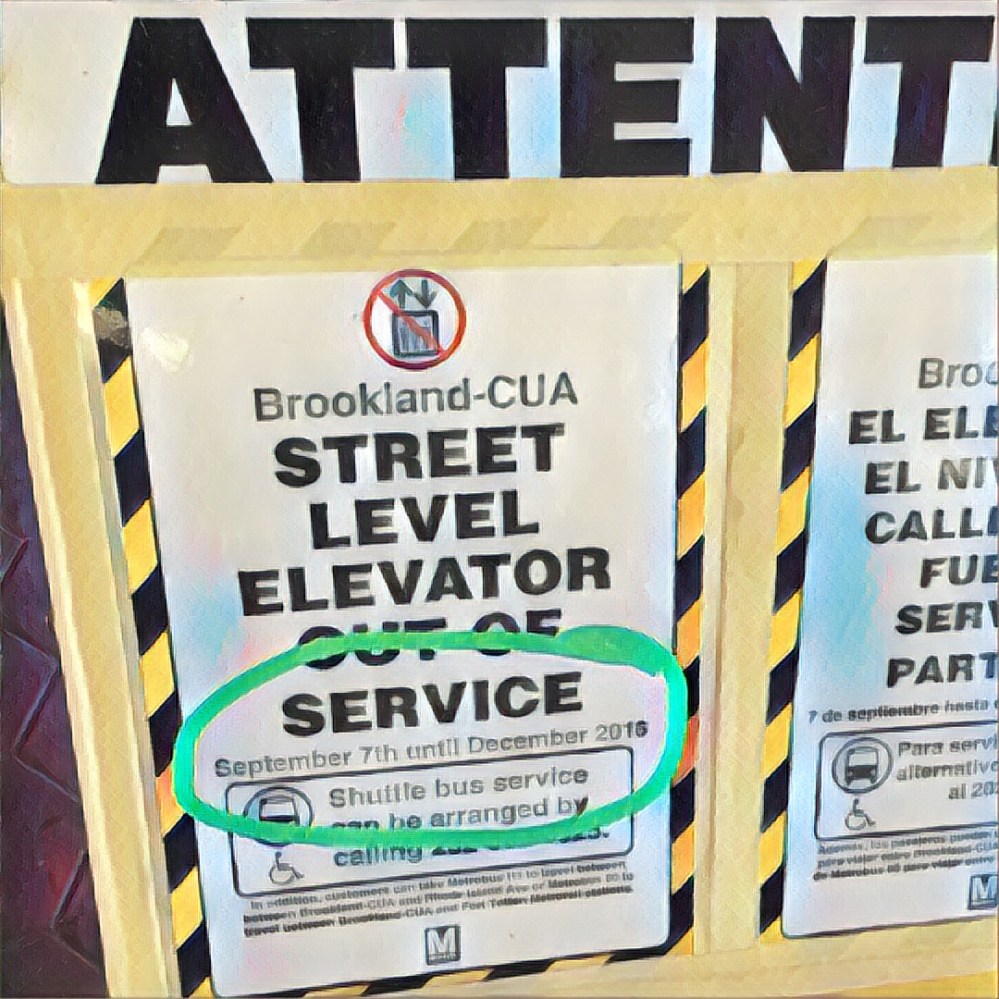
Sign at the metro station telling people who need an elevator to call some body to get them a shuttle bus. But not from this station. MAD!

Dear Metro,

I hope it’s okay that I call you “Metro,” since you have so many names. We call you the train, subway and, when we want to get most official, WMATA.

What is the name that we can call you that will get your attention?

Because if I had your attention, you would know that I am not shocked. I am not appalled. I am not sickened. No, I am angry, with the shutdown of the elevator at my stop.

Do you have any idea that this is the stop for the National Rehabilitation Hospital? For the Washington VA Hospital? For the Washington Hospital Center? Did you know that these major hospitals serve many people who use wheelchairs. That they need to use their wheelchairs to get to their appointments, their therapy sessions, their chemotherapy?

So when you shut down the elevator at the station that serves these hospitals, you are seriously impacting the people trying to access services they need.

I get that the elevator needs to be “improved.” I can even accept that to switch out an elevator takes four months.

Okay, I can barely accept that. If you were building it new, it wouldn’t take four months, would it? And if it takes four months, why is the first month building the walls around it to close it? I only ask because I haven’t seen anybody working on it. But there’s green painted plywood blocking it.

But I’m thinking if I’m in a wheelchair and I have an appointment to see my doctor and I get to the station, I’m stuck. I can’t get out of the station. I have to call a random number on the flyer to transport me from another stop. And I have to get back on the train and go to that other stop.

Do you think that’s okay? Do you think that pasting a paper sign over a “wet floor” stanchion is decent notice? Do you think it’s cool to require somebody to call a number for a ride? Don’t you think that the shuttle should be waiting at the stop? Which stop, you ask? How about all immediately surrounding stops?

This makes me mad because the person in the wheelchair is already put upon by the fact that the elevator is on one side of the tracks. So if you’re coming from the campus side, you need to roll another half mile to get to the elevator. You know, the elevator that’s out of service for four months

Seriously, WMATA, is there any way you could make it harder for folks who need an elevator to get to or from your platform? It’s like you want to fail. Like you want to turn people away. Your accommodation accommodates only in the abstract. In practice you suck. You are not coming within a western state of complying with the spirit of the Americans with Disabilities Act. From 1990. I was there when it was signed. By the President.

The subway could–theoretically–be a way for people with disabilities be more independent. Not this subway. Not at this time.

Please fix this most soonest.</rant>
Sincerely,
DocThink

#unsuckdcmetro

Sign of Time

Sunset from the porch.

Summer isn’t giving up yet. Nope, not yet. The trees are still sporting a full green suit. Daytime temperatures are squarely in the 80°s. Charcoal and lighter fluid scent evening strolls on most nights.

There’s still no requirement for sweaters in the evening. I think we’ll have weeks until that morning when you look at the basil and it is a black-green from the cold.

That said, the earth is still circling on it’s crooked axis around the sun and moving our hemisphere out of summer. While a sweater is not required, it is not unwelcome by bare arms, either.

The peaches and sweet corn are long done and the tomatoes are less heavy. You can plant those fancy lettuces without them burning up or bolting. The pools are closed. The traffic is back to heavy.

But mostly, it’s the day itself. Long days are gone. They’re tucking in earlier and earlier. I wake up just as the sun is chasing out the last shadows, when a few weeks ago the sun shook me awake.

It’s the end of the day that I notice the most. Last week I stepped out of my office into the opening strains of the dusk overture. This week when I walk to the train, I am steeped in dusk. Dinner, that is served at the same time according to the clock, isn’t making it to the table until after nightfall. The candles that were for show are now for light.

I love the fall. I love all parts of it. It might be my favorite season. Except. Except the thieving of my day. Of the shrinking of time. Of the march to the darkness of winter.

But the autumn sunsets are the most beautiful. The oranges are the most orange and the streaks of pink are the brightest against the indigo sky that reaches to infinity. So as the days seem to collapse on themselves, the sky opens up. And soon, I’ll look up and see my old friend Orion who’ll guide me through these months of short days.

Time Travel

Cartoony drawing of a TV with an antenna and a clicker. So old skool.

Time has shifted. Literally.

The idea of a “prime time,” when families sat around a TV to watch the news on one of the three broadcast channels at 6:00 pm, is long gone. Those kinder, gentler Sunday nights when The Wonderful World of Disney came on–and especially that one time they showed Mary Poppins. Mom made jiffy-pop. On the stove. It always got burned. We ate it anyway. I didn’t say she burned it.

Times when the Olympics were broadcast live, and nobody knew the results of the race until we all did. Or we read it in the papers the next morning. We couldn’t endlessly loop an especially spectacular event. It was live that night, maybe an instant replay or two, and maybe on the TV news on one of the three broadcast channels the next night at 6:00 pm. If there was a finals in gymnastics or skating, mom might let us stay up past our bedtime to watch.  If the games were in China, we could only see them during the day.

Quaint.

This changed with advance of VHS and the proliferation of cable channels. You could program your recorder–well some people could–and go to the gym and still catch this week’s episode of  Buffy or X-files.  There was some ear covering at the coffee machines and admonishments to hurry up and get caught up. And there were the cries of misery that echoed in a neighborhood when someone realized they taped over the recording of their nuptials. No one would ever see her say, “I do,” again. And nobody would ever again see Uncle Bobby doing his breakdance version of the electric slide. The 57 channels, then 157 channels meant that there were many options for news and entertainment.

DVRs took away the messiness of tapes, and their rewinding and their clumsiness. People could store many episodes, concurrent shows, and never watch them. There was a study that said that two of five recorded hours were never watched. I bet that it was more like four of five hours recorded were ever watched.

Netflix started making TV seasons available. Admittedly this was external to Netflix, but most of us got the seasons that way. Not too many of us bought the boxed set of Friends. I hope. Netflix’s automatic shipments of discs brought on the binge watch–hungover after a night of Charmed, a lost weekend to the bloody mess of Dexter, whipping through the entire two terms of President Bartlett on West Wing.  Netflix on demand sped up the cycle because you didn’t have to wait for a disc in the mail.

Of course, today, almost all TV is on demand. You can watch last night’s, late night comedy bits as they trend on Twitter in the morning. You don’t have to stay up late. You can watch funny people eviscerate pols on your phone as you brush your teeth before work. You don’t even have to watch the entire program, or skip ahead. The sketches are conveniently broken down. Hell, there are gifs with the best mugging. You share your favorite parts of a scene on social media. If you didn’t see it, your buddy sends you a link right now so you can watch it and laugh together.

So when you think about prime time, that time of cohesion from an ancient past when you have to contemporaneously participate in a broadcast viewing experience, there are very few modern occurrences. There’s the MTV awards, if you think Kanye is going to go off or if Beyoncé is going to do anything. The Super Bowl and World Cup. The final ball drop on Dancing With The Stars. That live production of Peter Pan or whatever ABC Family productions did that I didn’t watch.

That’s it, too. These time-bound events aren’t universal. You might not be a BET fan. You might be all hockey and no NBA. You might just set your phone to ring in the New Year rather than stop a party to all huddle around a TV.

There was a time, I’m told, when families listened to the President peddling patriotic bravery on the radio, “nothing to fear but fear itself.” There was a time when everyone tuned in to see the President take his leave, ” I shall resign the Presidency effective at noon tomorrow.” There was palpable shared fear when another President addressed a mourning nation on 9/11.

Today there are fewer common addresses, fewer addressed directly to the people. We simply pick and choose what we want as we graze our way, on our own schedules, through the buffet of media.