Giving Exactly Zero

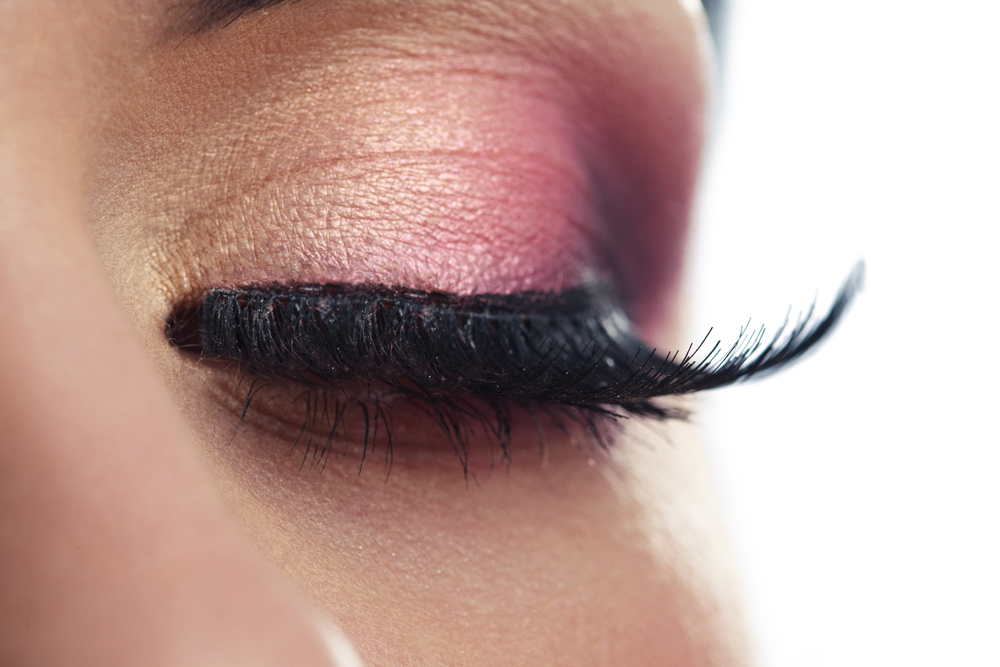
long and luxurious lashes. obviously fake.

She was pretty. Her hair framed her face and the horizon beyond in cascades of copper ringlets. They were very fine. Like a chain that would knot if you rubbed it between your fingers.

She wore a crown, of sorts, to keep her avalanche of hair from overtaking her face.It was likely a stretchy beaded band.  The ornament was a tanned leather, medium brown color. The beads were fashioned together in a star-linked pattern that daisy chained around her head.

She was sitting on a bench on the train platform, sheltered by a billboard. You only saw her when you were in almost directly in front of her, give or take thirty degrees.

She was looking down at the phone she held in her right hand. You could see the light reflected from the glue that attached her long thick very black lashes to whatever lash she was naturally given. There was some black eyeliner to try to cover the glue. It did only an okay job. She had a headphone in one ear, the other bud dangled from its wire, into her lap.

Two fingers of her left hand dangled a lit cigarette. The other three fingers gripped a small paper bag. She brought the bag to her face and you could make out her palm and fingers embracing a cylinder in the sack. It might have been a bottle, but more likely a can. She drew a jolt from the bag, and, while her hand was there, she twisted the burning tobacco to her lips. She drew again.

You couldn’t help but be impressed by her flagrant swilling and smoldering on the platform. This isn’t New York. Consumption is not allowed here.  But she clearly didn’t give rules a thought as she chattered cheerily on her phone call. You hoped she finished her smoke. And you tried to give as little care as she did.

End of the Line

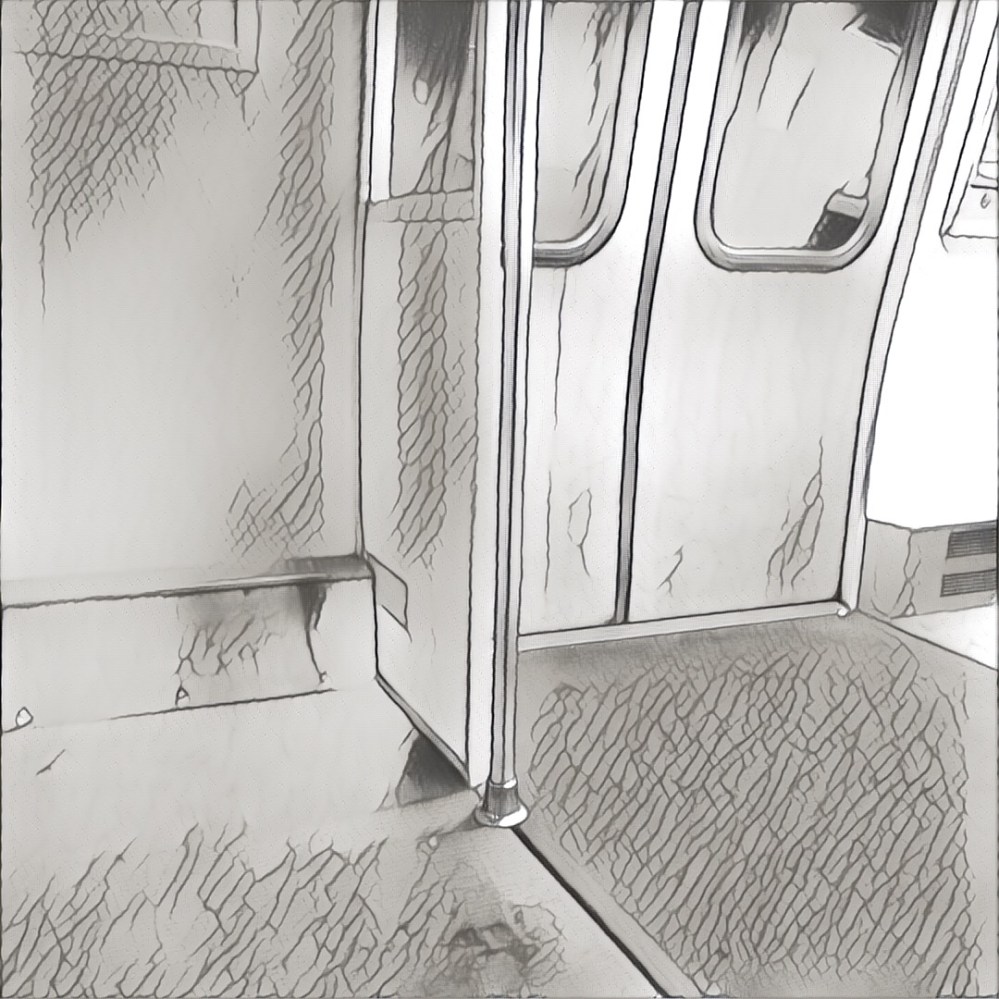
The floor and door of the Metro. It's gross. You should be glad I took out the color.

Dang. This train is filthy. It’s past rush hour and I’m on the last car.

Who the hell thought it’d be a good idea to carpet the floor on a public train? There are stains from spilled cokes™, from ground-in egg mcmuffins®, from a dropped perfume bottle and a misplaced brush from a very shiny nail polish. There are tarry spots from gum, or another sticky substance, that became black from the bottoms of shoes and flip flops, sandals and boots, sneakers and those Dansko clogs that the ER, OR and radiology teams wear at hospitals.

Some of the boots that grind in the grime had spiky high heels or wedges. Some were tanned and open-laced Timberlands spewing street from their lugs. Some were black, steel-toed work boots with the slippery grease from a restaurant kitchen accelerating and accreting the grunge buildup on the floor.

The doors, the ones that open magically and slide into the sides of the train, are streaked with gunk. The lighter streaks are simply slightly less gunky. The windows at the top of the doors are also streaked, but with residue from palms and elbows and some cheeks and chins. There may be marks from fingers desperately trying to force the doors open as they slipped closed.

The doors open onto the platform of octagonal bricks hugged closely together by mortar. It’s odd that the mortar doesn’t show filth. I guess cement doesn’t stain like rayon. It’s funny how the outdoor platform seems to be so much less gross than the inside of the train.

There is no fresh breeze in the train cars. There are no rains to clear away the grunge. There are no melting snows. The inside of the train is inside and gets no relief from the humanity that desecrates it daily.

But I’ve been on the new cars. With the stainless steel exteriors with a hammered finish. With floors of flecked linoleum or some other surface that doesn’t spotlight blotches. With metal grips that don’t show thousands of fingers pressed in to balance against the lurching car. With wider aisles and molded rather than padded seats.

Why didn’t someone think about that before?

Hurricane at the Farmers’ Market

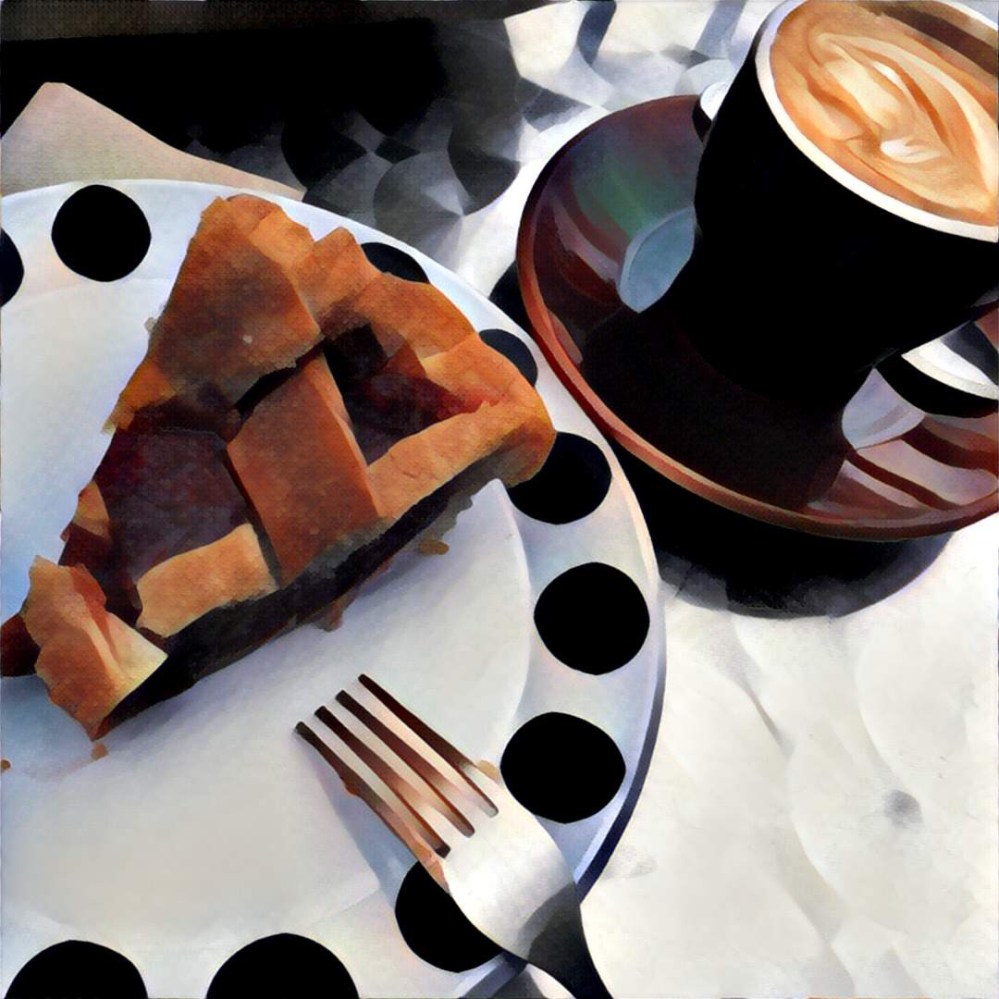
pie and a flat white coffee. the pie is on a cute white plate with big black polka dots around the rim. The table is hammered metal. It was windy. Oh, and there's also a fork.

It was a morning with a warning. Like a movie foreshadowing a foreboding.

Like the hint of wind in the black and white frontspace of The Wizard of Oz. Or the first drips of water in The Last Wave. Or, actually, any time the wind appears in a Peter Weir film. See also, David Lean.

It’s the scene where the wind whips the shore, bends a field of wheat, or makes the hero chase after an important scrap of paper. The paper chased could be a photo of a child, the digits of a to-be relationship or the receipt from an encounter with a spouse that they wished they could take back. And this sub-story drives a key sub-plot. The one that preys on our wish for happy relationships.

This morning, at the farmers’ market, no vendor had a tent. Normally all normally do to protect from the midday sun or to provide respite from a shower. But not this morning. This morning the gusts of wind were like a Sherman tank mowing down anything, and everything, in its path. The covers were no cover against the nature force. The tents were folded next to the tables.

Tables, where the merchants were hovering over their wares with their entire bodies until the winds subsided. Tables where goods that were not sold by the heavy pound were placed on the ground to keep them from becoming projectiles. Tables where dollar bills fought to leave the fingers of either buyer or seller but not from the buyer to the seller. No. These monies were looking to ride the next gust to the next world. Wherever that would be.

The musicians playing in the plaza for tips were sad that their open instrument cases were venues for dollar bills to launch from versus the coffer for their patrons’ contributions. Little kids swaying to the music was nice, but it took someone willing to pay to show their value. They scrambled to find a container that wasn’t missile plastic, but were mostly were resigned to a sadly camouflaged urn that most people would not see as an invitation to financially thank the performers. But if anyone appreciated them enough to seek out the tip jar, the urn would keep and cash in line.

The winds were not consistent. They were sneaky. They would sometimes swirl around–causing strollers to roll and hair to obliterate the view. They would sometimes whisper, tickling edges of paper and lulling people at then end of  a hot summer to believe that there is a balance in the weather. And then it would hit the accelerator and lean on the horn to let everyone know that this is no mere breeze.

Because it’s not. It’s the front end, and will be the back end, of the remnants of a hurricane.

It’s the winds of change. The winds of winter. The winds of war. The warm winds of El Niño, and the butterfly wings that precursor a Camille, an Andrew, a Galveston and a Katrina.

And in the eye of that storm, people picked up tomatoes, drank coffee and ate pie. None of them knowing what would happen next.

Froth and Effervescence

Little boy in a hoodie going all in on blowing

Tell me you never blew bubbles into your milk. I know you did. You didn’t do it to be subversive. Although it was a signal for your mother to shoot you the look. The one that turns you to stone. But her attention was just an added bonus.

No. The reason why you placed that straw in your mouth and blew the contents from your lungs into the milk, rather than draw the milk from the cup to become the contents in your belly, was because it was funny. And fun.

Bubbles are fun.

If you really blew hard and got the bubbles going, there was a chance that you could overflow your cup with piles and piles of milk bubbles. Exciting and fun.

When the tide meets the sand, there are bubbles. Kids kick the spray back into the ocean, and sometimes capture the froth in bright pink or electric green plastic buckets. Wild and fun.

Picking the jar of bubbles out of the basket from next to the chocolate duckies and bunnies on a sunny Easter Sunday meant that you would chase wild and free bubbles in the yard after church. It was good to run off that morning jelly-beans-for-breakfast sugar rush anyway. Distracting and fun.

There were foam bubbles and kiddie bubble bath and piling bubbles on tops of little heads and pictures to see the sweet babe modestly covered in bubbles. I still get a little sad thinking about the small bubble ice bergs floating around in the dirty bath water. It was time to get out. The bubbles were gone. Clean and fun.

While The Doc is not a fan of adult bubble baths (I really can’t stand a bath), I do admit that they look very fun. Watching Margot Robbie explain subprime mortgages in a bubble bath is elucidating and fun.

And she was drinking champagne. Now that’s my kind of bubbles. The better the champagne the tinier the bubbles. But even when they are teeny, tiny–this is good champagne I’m talking about–the little bubbles still have substance that you physically break with your tongue. Chill a bottle of Cristal if you want the best bubbles and the toasty flavor of a great toast. Buzzed and fun.

Even today, I’m happy juicing up the water with my Soda Stream. I pulse the button to see and hear the rush of air making intimate contact with the dihydrogen monoxide. And when it’s done, it makes a flatulent noise. I can barely repress my giggles. Science and fun.

Leaving the train station, at the end of the work week, all I could think about was bubbles. I think I must have seen something floating in the air. I felt like walking through walls of bubbles. I wish that bubbles were everywhere. Light, airy bubbles. Bubbles. Bubbles. Bubbles. Funny and fun.

No Sense

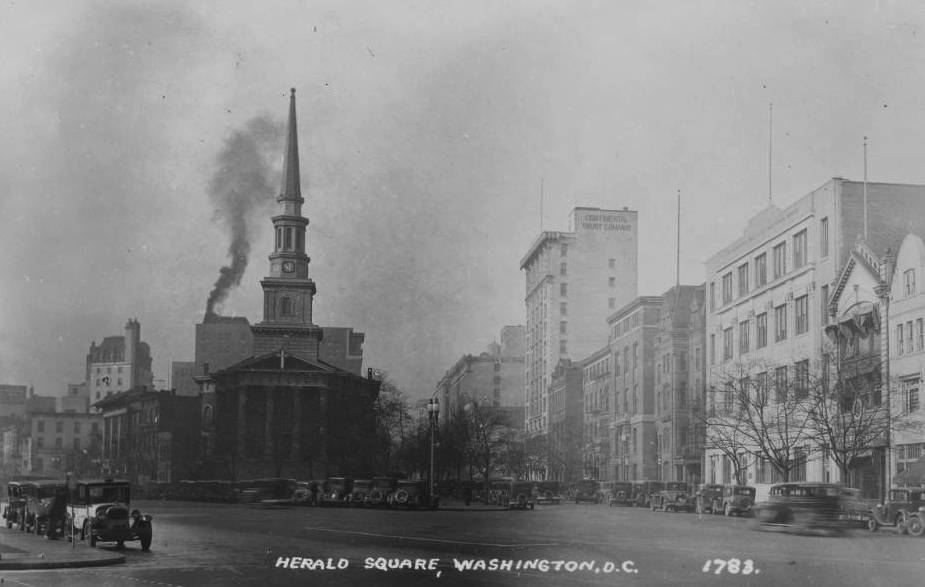
Photo of 13th and H St. at 10:55 a.m. on January 4th, 1931

Her hair was strawberry blonde, more strawberry than blonde. When you looked closely, you saw that she came that way. No off color at the ends. No reverse skunk dark roots. No center part outlined with silver or white.

She had a thick head of hair and bangs flew from her face. Although her cut was not high fashion, the ends weren’t split. Somebody might say she was a ginger with her freckled face and arms, but she wasn’t that fair and her skin held a tan just fine.

Her lips were moving, and she was only wordless in that she wasn’t making a sound, but she was most definitely forming words. Her face was more than sun kissed. Maybe a bit weather worn, too.

Her back was to the building and behind her was an unopened bottle of orange juice and an extra large cup from Chick-fil-A, or Five Guys or some other red writing on a white logo’ed joint. In front of her was a medium sized, clear plastic cup with a ring of green leaves that identified this as recyclable plastic. Maybe it wasn’t even plastic. It could be a corn product. The cup in front of her was about a foot from her mouth making the shapes of words. There was green inside the cup as well as bordering the cup. The green was paper money.

Back to her hair, it wasn’t dirty. It wasn’t matted. It wasn’t higgledy-piggledy. But it wasn’t fresh from the salon, either. Her eyes were closed and the teeth behind her moving lips were a little oversized, but there. She was wearing a dress and black hose. Not sheer hose, but tights. The tights were ripped and ran. The toes on her left foot, the one on top, were exposed. Her right foot, the one on the bottom, was almost completely bereft of cover. There was a thread that looped between two of her toes that kept the rest of the stocking on her leg.

She had no shoes. No shoes on her feet. No shoes near her feet. No shoes near her head. No shoes next to the unopened juice. She didn’t have a bag. Not a purse. Not a backpack. Not a garbage bag. Not a thin plastic bag from the Walgreens.

She was more than asleep. More like passed out. She was sprawled on the sidewalk in the mid afternoon on a busy corner in the business district. She was on her right side with her hands near her chest, her legs pulled up slightly. Her nearly bare feet pointed toward the White House.

It wasn’t unusual for people to sleep on the sidewalk or to ask for money or to live on the streets downtown. But she didn’t look like that. She looked different. Like she was either a new transplant or someone who was lost or someone who was dumped.

A few people paused as they walked by her, looking to see if she was breathing, wondering if she was okay. At least two called to have someone check in on her. This is because as one was describing the woman and her location to the emergency dispatch, Engine 16 was in the intersection, making a left turn. The firefighters stepped out of the big red truck.

The one on the phone told dispatch that someone was here, hung up and felt water welling in eyesockets. She turned her head to the sky and said a prayer, hoping that something was there to catch it.

Busting Loose

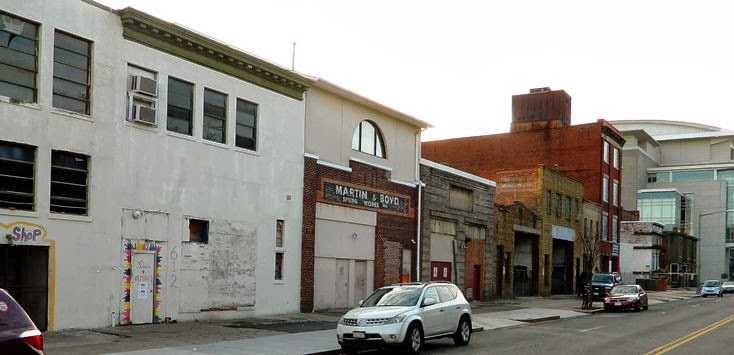
A yet to be "rehabbed" street in Shaw. Around 7th and L, NW. Close to the cop shoppe.

Growing up, a meaningful block was a half-mile long. Nobody walked much, so it wasn’t a big deal, but the distances between stuff were actual distances. Walking three blocks was a mile and a half. Distances were covered in miles per hour, thank you very much.

When I first moved to our nation’s capital, these were pre-GPS days–I know, right?, I pulled out the map to see where I was heading. It was on the other side of the beltway. Using my historical point of reference, I figured it would take about 60-70 minutes. It took me less than 20, and that might have included a little bit of time when I was lost.

Geographically, D.C. is a small place.

Today I told The Spouse that drinks were on me at the hip watering hole that just reopened. I decided to hoof it from downtown. The Spouse hit the pavement from The Mall. It’s a sign of the times that we would even consider walking. Five or six years ago, when the development was in planning, I would not walk that corridor. Boarded up shops, drug deals on corners, and no reason to be there. Nope. Seventh Street was a car route.

I walked the dozen blocks, passing the new convention center, spiffy hotels with five-story atriums, rehabbed buildings, shiny new box apartments, a grocery store with wine and a ton of prepared foods, and a few windows still boarded up. For now.

There were still the few blocks of subsidized apartments, but they’re much less notorious. There was still a cop going back and forth with a citizen. They were being observed by a sidewalk full of the neighborhood a few yards away. Nobody was cuffed. The convenience store was surrounded by folks waiting for the bus. The air included the smell of tobacco and weed. But no piss.

The city was always tiny, but now the walk from the FBI building to the burgeoning condo, bike path, coffee shop and restaurant fueled blocks formerly known as the hood and now known by their hip nicknames was much faster than a cab during Friday rush hour. In less than twenty minutes, office commuters can traverse to the land of brown liquor with artisanal ice, biergartens, craft roasted coffee, dog groomers and hipsters.

These thirteen blocks span less than a mile, not the 6½ that I would have expected in my youth. As the city gets closer together, it gets bigger for some people and increasingly inaccessible for others.

The Spouse remarked on our independent walks through what had been a tough area. I noted that there was new paint and landscaping at the public housing complex across from the shiny new grocery store. The rec center that had an awesome makeover was full of little and mid-sized kids that did not live in the new studio and studio +den apartments with the marble counters and stainless steel appliances.

We don’t want the city to lose the people who have raised generations of families here. Both of us, at the same time, said we really hoped that there was enough room for everyone. I better go call the Mayor.

Coconut Sorbet

A split coconut. That is all.

It was the last, albeit inadvertent, straw. I was walking down the hall—the one with the wood-lite, parquet floor versus the carpeted hall—to get a morning coffee. I think that my short, squat spiral notebook was in my hand. My phone was on top, but surely grasped by at least one finger. Until it jumped.

Like a squirrely, inelegant fish, it leapt from my pond. It somehow gained acceleration as it left my control. Maybe the wind from my gait? Regardless, it breached my hand and clattered to the floor and awkwardly slid, like that odd fish, along the floor. Poor fish. Poor phone.

It had been kinda cracked in a few places before, based on other unwitting tosses. Fissures on the edges, and just along those edges. Not a rupture in the main, and certainly nothing that interrupted function.

This time, it was different.

I picked it up. It had been on the ground many times. At least eighty. Perhaps as many as six-thousand, three-hundred and sixty-two. Somewhere in that range. So imagine my surprise, nay, my shock!, at seeing the sets of intermittent stripes and the faded Kodachrome reflection of what had been my wallpaper of my family affectionally giving me the finger. I swiped, and it seemed to work. I put my notebook and phone on the counter. I got my coffee.

After my minutes with the Keurig and the addition of milk, I retrieved my goods and saw that the phone was worse. Finger swiping had no effect. Pushing down on the screen made it a little brighter, but just a little, and it did not improve the capacitive response. When is the next iPhone release?

I was hoping to get another year from this device and the new ones aren’t due until late September. I need a working phone now. Like literally now. Screen replacement time.

Working downtown in a decently-sized, walking city means you are just scant blocks from a solution. I looked at the clock (not on the phone since that was a disaster) and the google and saw a solution within blocks and within the hour.

I dropped very carefully deposited my phone at the screen repair joint and was promised a fix in forty minutes. Great! I told the nice man, Jeff, who was jonesing for a transfer to this new store, I’d be back after lunch.

I very uncomfortably walked down the street. I would normally open an app on my phone to nudge my brain for food options. Instead I had to go naked. I headed south a block then east. The food trucks had good smelling fried chicken, but you know how I feel about them.

Lightbulb! It’s restaurant week and there is a famous chef restaurant that has a great riff on fried chicken and this was was the summer doldrums that spawned “restaurant week.” Three courses for a sweet prix fixe. I had the time and the price would be right. I was stuck using the DocThink GPS in my head, but fortunately it still worked. The dining room didn’t have a table for me, but there was a spot at the bar.

Somehow, sitting at the blonde wood bar and looking at the special menu, the idea of fried chicken seemed better as an idea. The yellow gazpacho first course seemed to be begging me to have the rare and peppered tuna on some “pepedille.” I know that’s not a word or a food, but the word on the menu was unknown to me. It tasted good, though.

I didn’t chose dessert until after my entree. If there was key lime pie or lemon icebox pie, it would have so been that. Hot lava chocolate goop sounded gross. Something with grapefruit and basil sounded too adventurous. The shortbread cookie thing a bit too pedestrian. So I zeroed in on the coconut sorbet with chocolate and almonds and something I can’t remember.

I’m not generally a coconut fan. Baby Bear, on the other hand, hashtag loves coconut [#lovescoconut]. Maybe I was missing him when I ordered that and a coffee. And I thank you, Baby Bear, because it was good.

As the bartender took away my dessert plate, we both opined on the terrificness, or is that deliciousness?, of the coconut sorbet. He told me that the Boss-Chef ate lunch at the restaurant three or four times each week and always, always, always ordered the coconut sorbet.

He would order one scoop and finish it and always, always, always order a second, which he would also dispatch in it’s entirety. One time, the bartender ordered him a second scoop in anticipation. He was upbraided. The Boss-Chef wanted to order it himself.

We wondered, together, why he ordered first one scoop and then the second. I wondered if it was because he didn’t want to eat melted coconut sorbet? But the bartender didn’t think that was it. It was a pattern, and it was his control over that pattern. Maybe he teased himself to see if he could resist the second scoop? Maybe he wanted to make sure he had the time to finish what was in front of him? Maybe he made up a game that nobody else could play?

I wondered why I would order one, and then the other. I wouldn’t, but it was a decent mental explore. Because the only way I could understand the Boss-Chef was to try and think about what it would mean to me. What are my tics? My sport that only I play for only my known reasons?

He was always challenging his patrons and himself. He said “In cooking, as in love, you always have to try new things to keep it interesting.” I like it when things are interesting. In the kitchen, and in other rooms, too.

He will be missed. Maybe I will go back and order a scoop of coconut sorbet. And then another. For fun.

Peace to you, Michel Richard.  I hope that your gifts are appreciated in this next life as I appreciated them today.
Good Forms

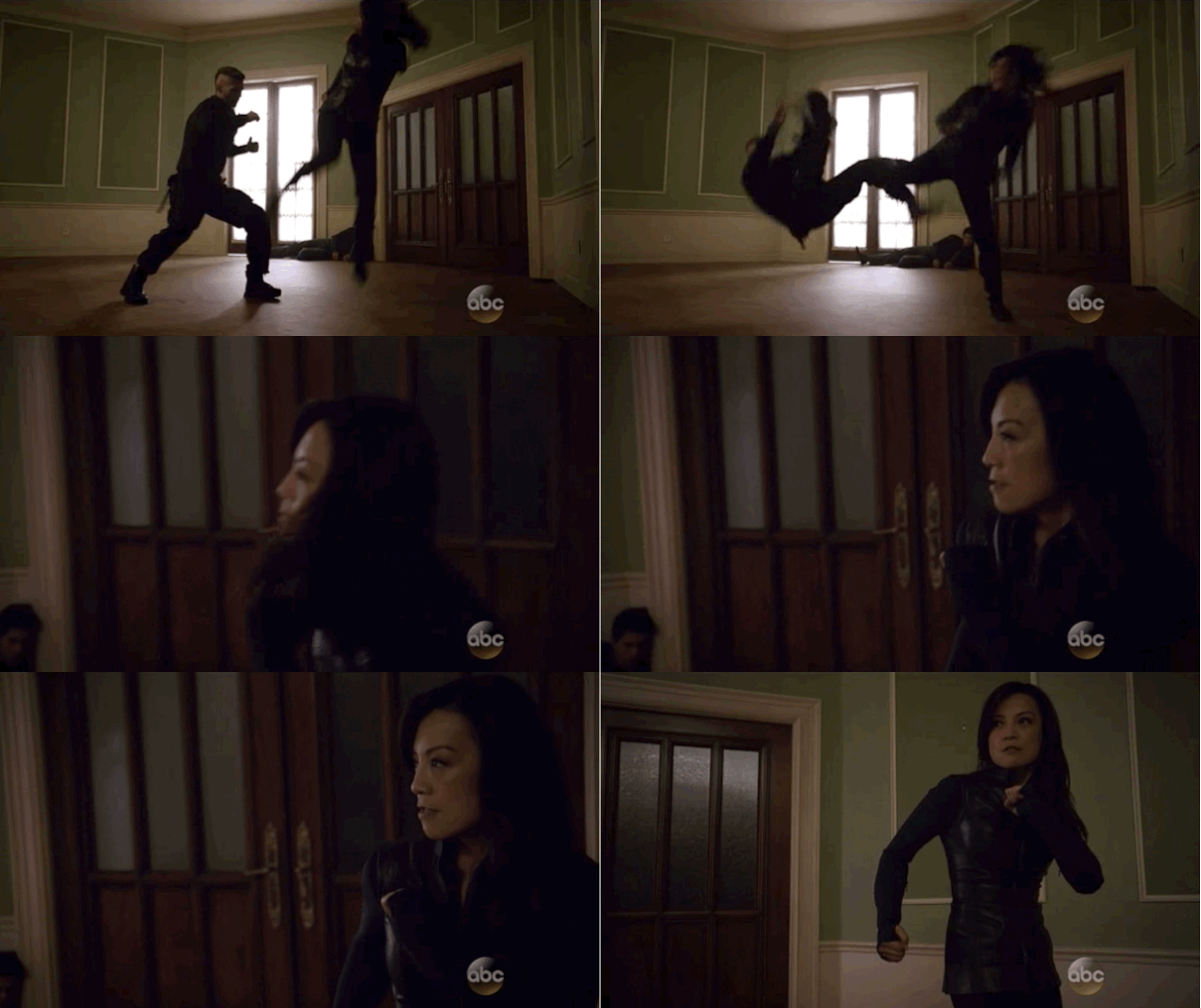
Agent (of S.H.I.E.L.D.) Melinda May uses her mad fighting skills to kick a bad guy. She's not hurt. She's boss.

The smell of french fries crossed the street on its own. It was actually the smell that conjures fries. More like the smell of the fryer. And salt. Not potatoes. The potatoes have no smell.

The lurkers on the sidewalk turned their heads in the direction of the scent. Some looked more plaintively than others.

There were two types of yearners. Some were hungry, either because they didn’t eat dinner yet or because every time they smell fried food they wanted it. There was a subset of this group that were both. They were the most dangerous.

Others looked longingly when the door to the tavern opened. They could almost see the outline of the polished wooden bar. The welcoming stools waiting for a perch. The pours lined up and reflecting off the back mirror. They might be interested in the fries, too. Salt to wash down the spirits.

Yet they remained posted up in front of the dual storefront. There were scores of square feet of glass. There were three short rows of metal chairs closest to the doors of each store. Mostly moms sat in. Mostly dads stood outside.

The moms on the inside might spend time on their phones, but as the weeks of class wore on, they knew each other. They spoke about the trials of homework, mismanagement of time and the concomitant fines, inequities at work/home/country and their pride in their offspring. The dads on the inside were primarily silent but observant. They were tracking the progress of their progeny purposely. They knew the color sequence of the belts.

The few women outside were either sitting in strategically parked SUVs or smoking a cigarette. The outside dads milled around. A group discussed the Redskins practice and hopes for the preseason. The sole–and loud–Cowboys fan was there to be razzed. And he was. The outside moms didn’t track the inside. The outside dads would frequently glance over their shoulders and mark their kids.

The inside parents ensured that all belongings were accounted for, stuffed in backpacks or purses or bags. Most outside moms followed up. The outside dads who limousined the kids every week were on top of it. The dads who were intermittent chauffeurs asked the kids if they had everything. The kids always said yes. Sometimes they were mistaken. Sometimes there was a trip back to the storefront. Sometimes there were later recriminations. Less in the summer. More during the school year.

Just the one dad would take his kid across the street after class. The dad would order a beer he liked. The kid would have orange and cranberry juice with a spritz of club soda, a cherry and a single drop of bitters. They called it his cocktail. The dad and his kid would split a fry. And the kid talked up the bartender and learned to tip, too.

Storm Chased

A mean storm meeting a beautiful evening sky. Run!

It was time to go. She looked along the row of desks to the window next to the wall clock that evidenced the time. She got stuck on the window. She wasn’t running late, but it was dark. She walked past the empty desks to look outside. Everyone in her aisle had already left. Slackers.

Her eyes scanned the sky. It looked like it might be getting ready to storm. Like an August squall kind of storm. In the heat of summer there are spates of mini-monsoons, sometimes four, five or six days in a week. These are expedited events. Storms that when you beat them home, you’re dry. And if you don’t, you’re wading ankle deep through a tiny flash flood roiling at the storm drains at the intersection. The latter is a bit gross.

She shut down her Pokemon session that had been running amiably in the background all day. There were a few pokestops near the office, and someone(s) had been setting lures. No walking but much catching between emails and meetings.

She swiped over to the weather app. It displayed a current temperature of a comparatively mild 88°F. Rain wasn’t forecast for another hour. She’d be home in half that. Quicker if she took in fewer steps and high-tailed it to the closest train station. She grabbed her backup umbrella, just in case. She put it back in her cubby. She wouldn’t need it.

She looked up at the window again and thought better. She plopped the tiny orange umbrella in her bag. It didn’t take much space, and better to be prepared. The app said No. The sky disagreed. She was going with the non-virtual reality.

She optimistically put on her sunglasses rather than her inside peepers. She placed her sunhat on her head–easier to wear than to carry even though she looked ridiculous walking into the premature evening decked in sunwear–and pushed through the two sets of doors to the sidewalk.

She had been out at lunchtime when it was plenty hot. The vestiges of that hot was on the metal and glass of the doors. It rose from the sidewalk through the soles of her shoes. It was still hanging out in the thick air. She turned toward the corner and her hand flew to her head, to keep her wide brimmed straw chapeau from lifting off her head. She turned to a stranger at the light.

“Wow! Now that’s a cold front.” The woman next to her took in the floppy bonnet, looked up to the blackening sky to the west and grinned her agreement as she scurried across the street. The light had changed. All the commuters on the sidewalk were dashing to their next stop. The wind was cold. And pushy. It was a warning.

Her foot reached the sidewalk on the other side of the street. She looked up, again, to her right. The clouds were moving, and getting darker. There was a definite border between the stormy side and the calm side. The stormy side was encroaching, though. There wasn’t a  referee to throw a flag and make it organize itself according to the rules.

She saw the man who spent the day on the street packing up. She somehow knew he didn’t sleep on this street, but she had never seen him leave. The wind was motivating him.

She stopped every eight or ten steps and looked back at the sky. She saw a flicker of lightening and heard the thunder. She mounted the top of the escalator and descended into the subway and boarded a waiting train.

Her car came out of the tunnel. Damn. She was losing the race with the storm. The line of blue sky and fluffy white clouds was behind her, behind the train. Before her was a dark, rumbling and angry sky. Looking over her left shoulder she could see the reflection of sunshine. A caldron of something wicked this way comes to her right.

The conductor warned the people on the about the weather conditions. “Use caution on the platform,” he entreated. She dismounted from the train onto the bricked walkway. She smelled storm. They say it’s ozone. The sky cleared its throat like an old smoker.

It wasn’t raining now, but it just had. People stood at the edge of the cave that opened into the elevator well. She pulled out her little umbrella and released it from it’s little bag. It wasn’t quite raining. Not yet.

She held the umbrella above her head that was covered by her sunhat. Her sunglasses and staw hat looked silly underneath the short-sticked, orange umbrella. Nobody noticed. If they were under the overhang, they were looking up. If they had left the station with her, they were looking to get out of the rain. Some went to the bus bays. Others to the kiss and ride. She and some others walked along the sidewalk to the intersection.

There was a flash and a boom. The lightening and the thunder were concurrent. The storm was here and now. She ran a few steps, and then the rest of the block. She wondered if she could minimize being struck by lightening by running. It couldn’t hurt.

Going home meant going toward the bright part of the sky. Maybe if she hurried–another reason to run–she could leave the storm. Her house seemed to be underneath the clearing. The rain was hitting the cover above her head with more purpose. It was still fairly light. Another flash and another deep grumble from the sky. She skipped over the curb and flew to the next corner. The next flare lit up the street. The thunder was quick to follow, louder, longer and lower than before. She saw her house and squared her gate to be greeted on the porch by a big dog and a man.

He laughed at her sun and rain gear. She closed her umbrella and the sky opened up and poured rain. She was home just in the knick of time.

Close Cover Before Striking

Public handwashing. Not handwringing.

So there’s this interesting new bar and restaurant design. It’s not about tap placement. Well, not  in a traditional view of bar taps, that is.

It’s not about the relative space of standing room to table. It’s not about the frenzy to biergarten-esque shared space. It’s not about $15 craft cocktails with artisanal bitters and homemade tonic. It’s not even about beers that taste like the ripe sweat wrung out of a summer half-marathon runner’s shorts.

Nope. It’s about the john.

In paean to efficiency, privacy and the quagmire of single-sex bathrooms, new joints are opening up with a cluster of individual water closets with toilets and, frequently, baby changing tables, to serve the tail end of customer needs. There are a series of doors, could be two, could be eight, that open into a lobby of sinks, all to better wash one’s hands after doing one’s business.

Gone are the days when The Big Guy and Baby Bear would lament the lack of personal hygiene of their bathroom cohorts. “Doc, the guy DIDN’T WASH HIS HANDS!” (Frankly, I was always pleased to hear this. It made me believe that they were washing theirs.)

Gone because, now, everyone can see the water and soap action of anyone leaving the toilet. I especially like seeing the signs above the sink exhorting employees to do the right thing. Now, we all know. Anyone can see. Hand washing has become more public.

The data was there; three in five folks have observed others not washing their hands after peeing or pooping. And one in four people don’t use soap. Eww.

So now, given the public commons for handwashing, there’s a new way to publicly shame people. Guys, women are watching. Women, we all know. Watch your fellow patrons leave the water closet and see if you can make them wash their hands with your disapproving eyes.

Frankly, you should have been doing this all along. Just wash your hands!