Body Arts

A crazy M. C. Escher print. Wow. The art is amazing!

The housing market fell apart as we were buying our second house. This was most excellent in that we underbid on the property and there were no other players. The poor owners were moving to Delaware, so they were stuck with our offer. It wasn’t really so bad for them, though. They made money on the house, just not as much as they hoped.

On the other hand, we were unable to get a buyer for our old house. We leveraged everything we had to make the new down payment, and then we became landlords.

The first house had been built in the 1880’s. The realtor on that house said it was a decent rental since nothing had knocked it up in more than a hundred years. Seemed right.

I was a bit busy. We closed on house #2 two weeks before The Big Guy was born. Had about enough time to unpack the dishes, set up the furniture and then have a baby.

We needed a signed the lease to buy the new house. Our first tenants were very nice people. Three young women who were “volunteers” for a Lutheran charity. The charity actually rented the house. The people were so nice, they gave the Big Guy a set of sweet books for his first birthday. They paid the rent on time. I was baby-addled so that was all I required.

When they moved out, our next tenants were a rock and roll band.

If you thought these lovely women were nice, you’d be very impressed with the band. The Spouse would go by the house with the Big Guy who would ask about the dwums and the gutaws. The bass player would take his axe out and let the kid touch it. Even as they were going to a show. They’d be late for the kid.

The band was excited that they had a release on vinyl. They were happy to sell CDs, but pined for the sound of diamond on plastic. I think I bought the LP, but we didn’t have a turntable setup. I wonder whatever happened to that record.

Although I was only six or seven years older than they were, we were the people with the baby that owned the house they rented. That made us old. I guess, relatively, they were right. We were parents. They had parents.

One day they came over to our house for something or another to sign. As always, they were generous with their affection to our boy. He had many questions.

Big Guy: Where are your instwuments? [please substitute the “w” sound for every “r.” Makes for a more realistic and cuter dialog.]

Singer: Awww, we left them at the house. Sorry.

Big Guy: That’s okay. [walking around to the bass player, climbing on his lap and tracing the colorful full sleeve on his right arm] Why you have dwawings on your awm?

Bass Player: These are tattoos. They tell stories. This is about where I’m from, this is a bird that flies to far away lands, and this part symbolizes my sister.

He looked up at me, a bit embarrassed.

Bass Player: Sorry.

I knew that he was worried that the old landlady would disapprove of the tattoos and his sharing of his disreputable marks. He was concerned that I would think he was a bad influence on somebody who could not yet make the “R” sound.

Me: Sorry about the tattoos? They don’t bother me. My dad has them. Down both arms.

The Bass Player was quite surprised and not just a little impressed with my wickedness. The Big Guy slid off his lap, walked around to the other side of the table and sidled up next to the singer.

Big Guy: So, where’s your cawtoon? [translation= cartoon; also, his interpretation of the word tattoo]

Singer: [using his index finger to pull the V on his v-neck tee below his left pec] Right here. See this “V”? It’s my wife, Victoria’s initial. She is tattooed right over my heart.

The Big Guy nodded knowingly and approvingly in his three-year-old way. But actually, it was like he did understand.

The drummer was looking for attention.

Drummer: So, where’s my tattoo?

Big Guy: [emphatically, but kindly] You don’t have one.

The mates quickly exchanged looks. The Drummer especially was bemused. Everyone else was amused.

Drummer: Hmmmm. You’re right. I don’t.

I think that the smart Big Guy then gave everyone a hug and went to brush his teeth.
Gardenia of Eden

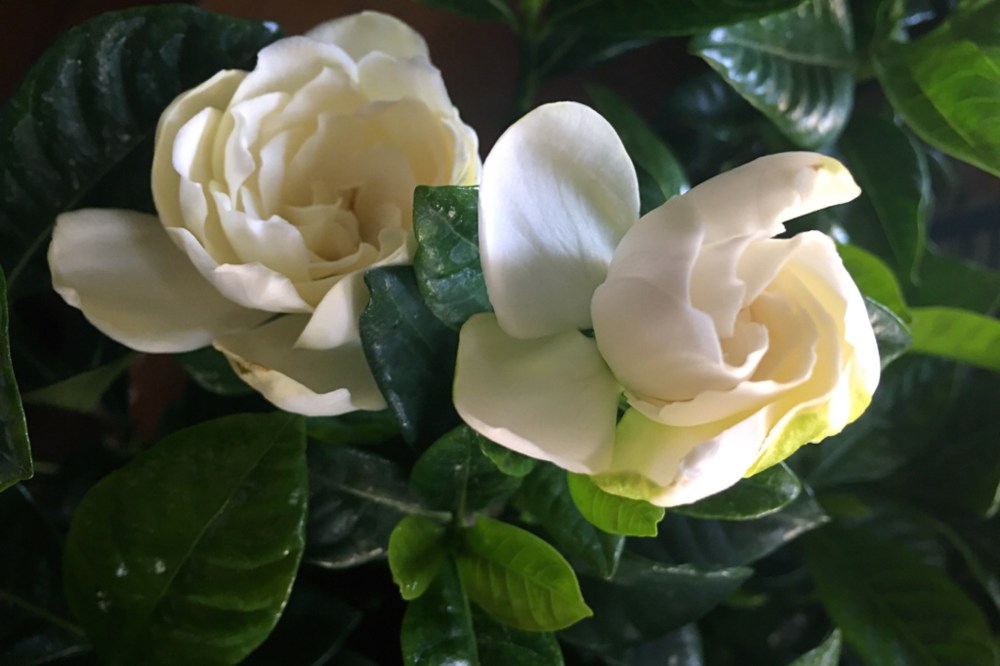
Gardenias. Pretty, no?

Holidays–including the made up Hallmark ones–are different for each of us.

I, for example, do not care for either Halloween or New Year’s Eve. Dressing up like a hot dog or a bird or a sexy fill-in-the-blank has very low appeal to me. I don’t like to be scared. I have too active an imagination to participate in the paranormal without imperiling my ability to walk upstairs when it’s dark. Forget the basement.

As far as NYE goes, there’s always too much anticipation for too little payoff. It’s supposed to be a magical night, but it’s more like a worn card trick than disapparating at an electrified finger snap. Increasingly holding up through midnight is a challenge for my peer group. It’s yawn, clink, kiss and goodnight.

You can like those holidays if you want. There are others that I really like alot–Thanksgiving, Christmas and Fat Tuesday, for examples. You, of course, have your own feelings about those.

Mother’s Day is one that confounds me. It’s a holiday of expectations.

I remember going to see my Grandmother when I was little. I have memories of sometimes dutifully and other times ardently creating cards or noodle necklaces or tissue flowers for my own mother. There was my own first Mother’s Day and the yearly boon of my own either dutifully or ardently crafted gifts. There were flowers sent to my mother and the Spouse’s mother for a number of years until one, and then the other, left us.

Mother’s Day photos and wishes fill up my social media streams. As the middle-aged people take over The Facebook, I’m seeing pics of our mothers from when they were younger than we are now. Glamor shots from their high school yearbooks or square prints from your baby albums with you nestled in your 20-something mother’s arms or bouncing on her lap. I see your eyes, your smiles, your chins and your noses in your mother’s sepia or faded kodachrome face. I see generational shots with long lost greats next to your baby whose grown cap and gown picture you posted this past week.

I feel the losses that you are posting about not being able to call her, or about her looking down on you from heaven or simply a “miss you.”

Absent is the other feels of people who don’t have moms, who aren’t moms, who have lost their children, who hate their moms, who are estranged from their families. There’s waiting by moms to be acknowledged by their kids. The dawning recognition that this will be another year that your family fails to recognize this day–and a lurking envy of people you see with breakfasts in beds, brunches and bunches of dozens. It’s like bittersweet jam, this Mother’s Day thing.

Last year, Baby Bear and I went to see The Avengers: Age of Ultron for Mother’s Day. We bumped into one of his old classmates leaving the theater with his mother. They also saw The Avengers, because what else says Happy Mother’s Day like a super-hero movie? This year the Bear is almost two-thousand miles away.

Yesterday I picked up a gardenia plant at the grocery store. It was a pretty unusual find next to the blueberries. Gardenia’s were my mother’s favorite flower. She would tell of her dates buying her corsages, and, if it was a quality guy, he’d have a gardenia. One year, for Mother’s Day, we bought her a gardenia bush. The scent from the flowers was intoxicating. It only delivered two blooms, but they made me dizzy.

I smelled the gardenia before I saw it with its dark green leaves and bright white flowers. I breathed it in, got a little woozy and put in it my cart. It seemed to me that I was buying a gift for my mother. I bought myself some flowers, too.

Today I got up and watched the yelling shows. I padded around in my pajamas until the afternoon. I made a second pot of coffee. Before The Big Guy went to work, he asked me for a date. We’re going to see Captain America. Because what else says mother’s day like a super-hero movie?

Have a happy day, no matter your position on moms or this greeting card holiday. And, for us, it’s Team Cap, mom and apple pie all the way.

Fell Asleep Beneath the Flowers

Sherlock Holmes experiences a ridiculous dream.

Window down and the sun warms my elbow as the deep throated scream of a mouth organ asserts itself from the public radio Saturday blues show. Cue the dissolve for a flashback.

[Insert the the strums of a harp interrupting the bass groove. I’m shaking my head violently back and forth, trying to immerse more fully in the memory and erase that damn, incoherent harp.]

It feels like a day for a street festival in Ann Arbor. We’d sit on a paint-peeled porch as the sun was passing the noon mark. We didn’t drink in the morning. Our beverage of choice recipe included plenty of ice, many cans of frozen lemonade and Popov. Our people would gather with the supplies. Sometimes someone would get cocky and bring the Smirnoff. The one with the extra proof.

I don’t think the person who lived at the house with the porch had the blender. I’m sure that we left it there. I’m pretty sure that it was a yard sale find.

It’s a miracle that we didn’t burn that motor out. It’s not like it was a will-it-blend? Vitamix model. No. It was a lowly Oster that probably once belonged to a graduate student. We stuffed it with ice cubes and frozen lemonade and enough vodka to make a slush. We didn’t want to dilute the liquor too much. The ice should have been too much for that cheap blender. But it wasn’t.

Ann Arbor is small enough that the porch could be central. We could get back easily in between bands and when our cups were empty. Or we could just do the brain freeze downing of the slush and leave the cup behind. This method was optimal for dancing, if not for responsible drinking.

We’d find the schedule on a poster plastered on a wall or in the student newspaper. Someone or two would pour over the schedule to optimize our band selections–avoiding the bluegrass and making sure we hit the reggae cover band–and so we would know where to meet up if we were separated.

The best music was the blues. There were old bands and young bands. The young bands were usually made up of white kids who grew up in suburbia and had instruments and listened to Cream, the Stones and others in the British Invasion. They discovered that there was an entire history behind that music. That it originated many generations earlier. There were also the old bands. They were usually more diverse, and had traveled along the circuit from bar to bar. They were done with the circuit and now stayed closer to home. They played when they could. They had day jobs.

When we were lucky, when the sun went down there were bands that were still playing the circuit that would come through. They’d be in the bars after the festival wound down rather than on the street stages during the day.

We’d all be salty and gritty from sweat. Hair would be amuss. Sandaled feet filthy. Maybe someone needed a bandaid. Occasionally someone would bow out due to a sun stroke or bad meat*.

We’d try and get there early enough for a table. We’d order pitchers of the cheap beer. And we’d stand close to what would stand in for a stage, listening to people 10 or 20 or 30 years our senior playing the blues.

We didn’t understand the blues ourselves, but we felt that chord progression. We incorporated the growl of illicit sex–either the cheater or the cheat-tee. Sometimes we couldn’t tell exactly who was wronged. We’d feel the rhythm section through our feet and sometimes the bass would explode directly from our hearts. The thud of the bass drum and the hiss of the snare would knock us woke.

We would stand in front of that stage and sway. We’d sing. We’d dance. We’d make out. We’d feel it. We’d pitch a wang dang doodle all night long.

The tiny snug bars didn’t have dressing rooms or green rooms. The bands would come in, set up and play. They didn’t have a quiet space. For breaks they’d go outside to smoke, get someone older than us cheap kids to buy them a drink. They’d fade into the crowd or hang out near the dumpsters behind the joint. Once, I met up with Koko Taylor in the ladies room. There was a line of cocaine that disappeared from the restroom vanity. Gatemouth Brown and Bobby Blue Bland held services from those risers that stood in for a stage. There were guitarists, horn and harp blowers of renown. We didn’t know.

The bar was dark. It stunk. The floor was sticky. We didn’t tip for shit. We were just college punks, drunk, dirty and loving the blues. And, in festival season, we’d get up the next day and do it again.

What a beautiful day.

[Next time I do a memory, I’m going to fall into the pensieve rather than do the Gilligan’s Island dissolve to the next scene.]

* a euphemism for being sick from drink.  

Petals of Metal

3 pictures of a rose cupped in hands, first the flower, then the separated petals then a shredded pile.

She developed her set of techniques originally as self-protection, but she found they served her well in self-promotion, too.

She had always been smart. Not the smartest but an equation of brains multiplied by hard work put her near the top. And while there might be a limit to brainpower, she was fully in control of her effort level. She could do this.

A loving addict for a dad and a mismatched avoider for a mom were the catalyst and the enzyme for recurrent family chaos. They would reject her and she would come back. She strained–because that’s what she did–to make her family work. Really, though, to make it work for her. She wanted out. She wanted to be on the path to good fortune and the life of the fancy. She wanted her parents to be proud. She wanted her parents to love her. She wanted them to want her almost as much as she wanted to leave them.

She wasn’t good at hiding her feelings. She couldn’t hide her terror of rejection. She learned, though, that some people hated to see her terrified. She learned that teachers and bosses and friends and lovers responded with concern to her cocktail of tenacity and anxiety–especially when she served it with syrupy flattery mainlined to their egos. They were happy to tend to her. She asked more frequently. She sat adoringly at their feet, looking up with big doe eyes for approval and favor. She frequently received both.

When her recipe went awry she didn’t check her ingredients or her technique, but blamed the stove for failing her. She learned that if she was self-deprecating, others would fault the stove, too. Sometimes her flopped recipes would work their way out. Sometimes she picked up a new technique. She always picked up a new cookbook. She could find new appliances. Shiny ones that would not fail.

She settled on her mate early. He was weaker than her–but strong enough. It was a child’s relationship from middle-school. They grew up together. He loved her and she encouraged him to need her. She didn’t bother with other men in college. She punched her ticket and decided he was the one. Except for that time they broke up when he lost his mother and he really needed her. She took him back when he was “well.”

When she had children, she loved them the way  that she learned to love. By seeking approval. Sometimes she would look for theirs. Other times she strategically withheld hers. It was an equation, this family thing. You invested, but there was a required return. They were supposed to love her and she would do what it took to make it so–whether it was guilt, or bribes, or mistruths, or silence, or hugs, or praise, or time, or attention. She didn’t know she did this, but her kids did.

When they left her house, one left the slide rule behind and sought no approval, and so sacrificed her mother’s interpretation of love. The other attempted to measure up, but could not find her own peace by trying to patch together her mother’s.

Her mate fell into a painkiller addiction that almost killed him. He found that the numbness he felt with her could be swapped out more pleasantly. When he came back, he moved away for a while. She was angry and lost. She stayed that way. And he stayed away.


It’s Complicated

Low hanging fruit, specifically apples with a little dew, being picked off the tree.

It’s easy to say it’s easy. If you just blah blah blah, it would be fine. We seek the low hanging fruit, pilot programs to show how this can work and non-specific, non-tactical theories of change that will magically change the game. We dally at the edges, expecting the fundamental change to seep in. As if.

The problems, the big crazy stuff that we’re hating, that hold us back, that fuel anger and frustration, isn’t at the edges. While there are absolutely things to improve–or things to make us think we’ve improved–there are fundamental challenges that are hard to figure out.  The problems and the work are structural or we don’t know the interdependencies or the effort is unfathomable. What needs to be fixed isn’t at the edges. It’s in the middle of this huge mother-f’ng Gordian knot.

Our problems with water in our cities and counties is compounded many times by the decay of the water system and our lack of investment. Chronic underfunding, disagreements on jurisdiction and responsibilities and multiple years of delayed maintenance are behind today’s fire department call to Metro. I won’t try to unravel the geo-political scene, but suffice it to say, it’s knotty.

Like the Biggest Loser, we didn’t get to our current state of excess overnight. There is an accretion of decisions and circumstances and responses to those circumstances that begot today’s environment. And, like we have recently learned, austerity and starvation is not a solution. At least not in the long run.

Advocating platitudes like making government small, putting the Constitution first, or supporting “traditional” values (whatever tradition that calls to mind) doesn’t fix tough challenges caused by a globalized and interconnected economy, disenfranchisement that feeds disgust and polarization or technological changes that are getting in front of our ability to intellectually and ethically integrate and manage them.

We need to recognize our penchant to operate under Parkinson’s Law of Triviality; that we waste time on trivial issues or arguments while the critical problems remain unaddressed and unresolved.

We need to be smarter, more thoughtful, more creative and more flexible in creating a shared future. We need to be realistic and play a long game because it took a long time to get here. Enough of the quick fix. What’s quick doesn’t fix.

Truly, if it were so easy it would be done already. We have real work to do.

Cuppa

Morning coffee in a big red mug surrounded by the morning paper.

The coffee has been a little thin. Not necessarily weak, but, if I were being truthful, I would admit that it was a bit weak, too.

The grind for French press is fairly coarse. You don’t want the coffee to be powdery, which leads to sludgy brew. Depending where you have it ground, sometimes it presents like the tiny pebbles in sand. Sometimes the bean fragments are smaller, more like pepper shards out of a loose pepper mill. I’ve not done a double-blind study, but it seems to taste better with the slightly finer, but not too fine, grind.

Making the coffee has a few steps that I approach more like washing a car than a tea ceremony. You’ll understand better in a minute.

First, you measure the coffee and put it in the pot. I have a huge scoop so I don’t have to count so much. Sometimes I can loose track of the scoops and then I either have to pour it out onto a plate and start over or say three Hail Mary’s while praying that there is enough. I never worry about too much, it’s only too little that would be the jolt. Or, more accurately, the anti-jolt.

Second, you add the water. I always used filtered water. Although that likely becomes much less relevant in month three and four of the two-month rated filter.

Back to the coffee. The water should be just below a boil. So, after the water reaches the boiling point you need to wait a bit as it cools. The wait can range between me chanting “one thousand one, one thousand two,” as I’m patiently standing next to the kettle, all the way up to to a few (ten? maybe 15?) minutes if I forgot that I started this project. That happens. Mostly on weekends, but sometimes during the week if I get involved with a first-thing-in-the-morning Buzzfeed quiz. Which Disney villain are you? or How many of these 90s songs can you name?

Sometimes I preheat the pot. This usually occurs when I realize that I didn’t wash it yesterday and I have to wash it for today’s coffee. I shake out the dregs, pour them down the sink and rinse the pot with hot water. Very hot water. That preheats the pot, as if by design.

Third is the timing. Those of you with a drip maker or a fancy machine are unconcerned with timing. Your appliances finish all by themselves. With the French press, your coffee floats around in the water to flavor it for an optimal interval. I think it’s four minutes. That’s my goal, anyway. Usually one of three things will occur. I will set the timer and respond at the ring, I will set the timer and ignore it because of some minor distraction, or, I will forget to set the timer and contort my brain to imagine the lapsed time. The timing is actually very important to the taste. I just don’t usually get it right.

Fourth is the plunge. This is pure technique. You need to corral all the floaty grinds under the mesh net and push them to the bottom of the pot. There is sometimes resistance–not always. It’s like an air bubble somehow forms and as you continue to push the plunger down, the pot burps and very hot liquid comes shooting out of the spout. I’m usually lucky and the spout is pointing away from me. Sometimes, though, I get it in the chest like someone yelling, Good morning!

I’m a little sloppy on the plunge so I usually take the first cup. This is the one with grinds that escaped the mesh and washed above the rubber seal when I was not paying any attention. When this happens, I am glad for the grind with the large chunks. You can more easily chase them around the rim of the cup and scoop them out with a spoon. When I’m very sloppy, I get the tea strainer and pour into another cup. When I’m very sloppy and very lazy, I just add milk and go about my business focusing on not focusing on the grains. I’ll spit out the gravel later. Or, if I don’t, I call it fiber.

The coffee I drank this gray morning was amazing. It was perfectly hot and a bit syrupy to balance the goodness of bitter. It was the earthy, composty Indonesian coffee that’s my favorite. It tastes of a little dirt and a little acid, flavored with what tastes of chocolate and maybe maple–or is that dark cherry?

Someone else plunged it this morning, though. Someone who is a much better scientist than I. Someone who made a beautiful cup of coffee for me this morning. No grains. No spills. Just love in a mug.

Now, THAT’S a good cup of coffee.

Spoiler Alert!

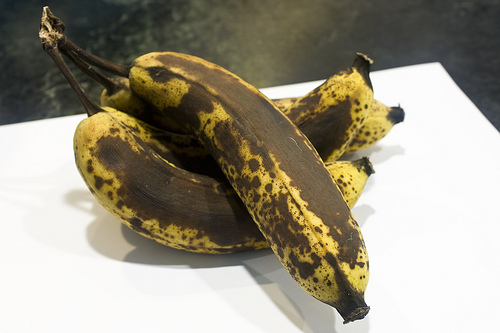
Three or four pretty ripe bananas. Not quite spoiled, though.

I asked the Big Guy if he watches Game of Thrones. He said he has, but not yet this season. And before I could form another word, he said he knew what happened. It wasn’t like I was going to tell him–although I heard about it, too. From the innerwebs.

He wasn’t concerned that I would tell. He just wanted to release that part of the conversation. Anyway, he said he doesn’t care about spoilers. He’s amused that fans get worked up. For him, the value of GOT is not plot–he says it’s all predictable and not that compelling. He watches it for the way it looks, the world created and the acting.

I met up with some friends who were in town from the middle of the country. We got together for a beer after they finished their Lincoln tour. Actually, the “Lincoln Assassination Tour.” The tour routes around a small circle between the White House and Fords Theatre and the house where he died.  In two hours they covered a mile and a half. They loved it.

The guide made it worthwhile. He was incredible. He told layers of stories with intricate and interesting details about Lincoln and the Civil War and John Wilkes Booth and probably some medical stuff, too. They definitely recommend it, and might even do it again. Even though, without a doubt, they knew how the story ended.

There definitely is something about being surprised at the reveal that Darth Vader is Luke’s father. Even more of a twist–perhaps even a twisted twist after Leia planted one on his lips–when we learn that Luke and Leia are twins. But while you can only be surprised that first time, you can still enjoy Mark Hamill’s lousy acting when he overacts his reaction. You can even find yourself licking your lips in anticipation of his howling, “Nooooooooooo, nooooooo.”

I have read and reread the Harry Potter books and have watched and rewatched the films. I don’t like them any less on return. In fact, I reread them and rewatch them because I DO enjoy the story. Knowing the plot frees me from frenzied page turning and lets me focus on the characters, their relationships and motivations and the themes of loss, friendship and power.

Frankly, not knowing how a bad movie turns out doesn’t make it any better. It’s still a waste of time. Actually, if you knew how it ended you might throw in the towel earlier and keep that time for yourself.

The topic of spoilers came up when I recommended that the Big Guy watch a hysterical White House video. I couldn’t tell him about it. I could, but then it would ruin it. Jokes are like that. You can spoil a joke. That is wrong. We agreed on that. You either tell the joke, or you don’t. Sure, you can retell a joke, but it’s never as funny as the first time.

Now a STORY, on the other hand…

Do the Mashed Potato

An erupting volcano. It looks hot. And dangerous.

When my mom would get mad, she would use her words–occasionally at a deafening volume. Usually, though, just at an extremely loud volume.

I really can’t remember exactly how she would get wound up. In my memories, she could blow at any time. She didn’t go zero to sixty. She was more like a rocket launch, minus the countdown. Or maybe an exploding mountain top that exposes roiling lava in a crater. Perhaps there were some seismic gurgles or telltale belches of ash, but we were too young, and then too self-absorbed, to predict the eruptions. We weren’t scientists with well calibrated instruments. We were the simple natives that managed the fallout as it occurred.

My dad was the usual target, but when the moon was right, nobody was excepted. The moon was a character in the drama. Her blasts seemed to be tied to hormones. Dad would stand in the garage and warn us before we’d walk into the blast furnace, whispering that she had her period.

Once she was on, it could be days before it was safe. She’d be so primed that the slightest slight could train her sight your way. When she’d blow, we would be very quiet. Don’t poke the bear.

This day the Goddess of Yelling was present. I think Dad was mowing the lawn. We were goofing around in the other room. Since we were kids, and we heard it all the time, we could sometimes be oblivious to the conflict. When we were called into dinner, we brought our foolishness with us.

Mom was yelling at Dad out in the back yard. We were laughing around the table. I threatened My Older Sib with mashed potatoes on my fork. She laughed and loaded her own. She drew it back. I dared her with a raised eyebrow. Her hand slipped and the potatoes catapulted past my right shoulder and landed with a horrifying plop on the rug in the next room.

Horrifying in a way that spawns shrieks of laughter that we could barely contain–but we had to because Mom was walking toward us. But worse, she was walking in her stocking feet toward the potato landmine. Oh God, if she stepped in it, we would be dead. We started to giggle. She didn’t know why we were laughing but she was not happy. She turned her ire to us.

I am sure she asked, in her outside voice, why we were laughing. We, of course, could not tell her. We were both terrified and dangerously amused. One step to her right and she would find out for herself. She was so angry that she started to stomp from one foot to the other, like the angry troll underneath the bridge that the Billy Goats Gruff crossed.

The closer her small white-socked feet came to the potatoes, the more excited we got. Not in a good way and not in a way we could control. “What was so funny?!?”

Big Sib burst out laughing. She had a clear view of our mother and her foot almost touched the food. I turned around and desperately started a long tale of what happened at school. Something in this train of thought had to be funny.

Most fortunately, she wasn’t interested in my narration and the the mad-hopping slowed. She turned, and we held our collective breath as her foot hung in the air over the mashed potatoes piled on the carpet. Everything seemed to stop, except for the giggles that we had to choke back down to their origin. Do. Not. Laugh. It is almost over.

She moved her foot forward above and then past the floor food and stepped away. It was over.

I don’t remember where she went, but I know that we had to remain at the table until the coast was clear. A furiously whispered argument followed on who would defuse the bomb. Big Sib thought it should be me. Her argument was that it was my fault since I, in the parlance of children, started it. I, on the other hand, was sure that it was her responsibility since she was the one who lost control of her fork which was the actual cause of the almost-disaster. Bottom line, neither of us wanted to get caught while cleaning it up.

As was typical, we likely came to the solution of sending in the rookie–the Youngest Sib. The logic was that she was least likely to get in trouble. Mom, at that time, usually spared her the venom. In fairness, she caught her share years later.

So goes my story about mashed potatoes. You know how you grow up and sit around with your folks and come clean about your childhood misadventures. Didn’t happen with this one.

Mass Hysteria 

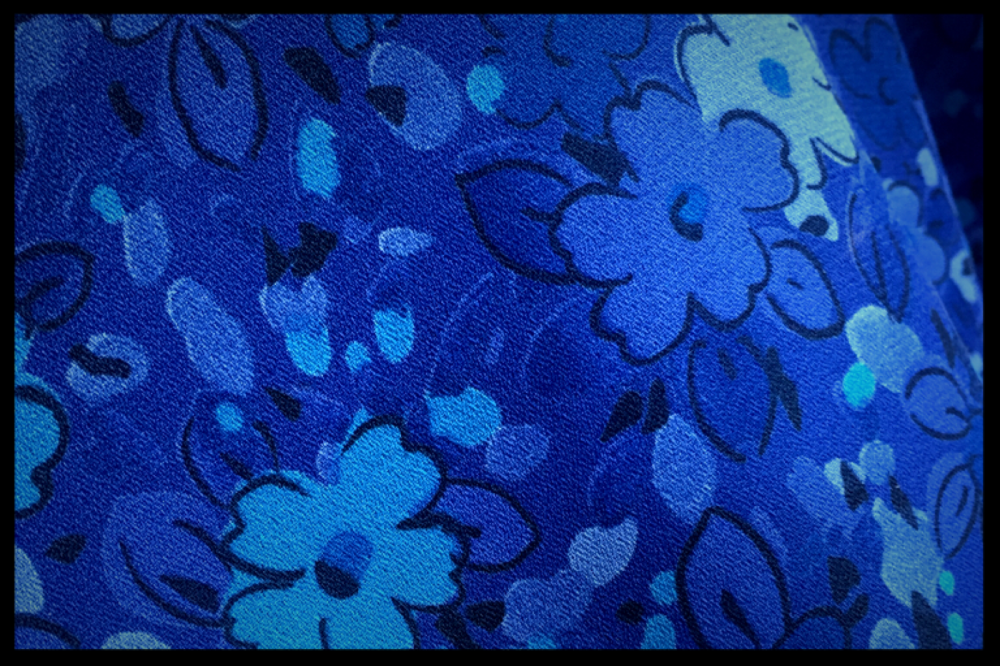
Fabric from an old dress.

I haven’t been to church for a while, and the few recent times have been for solemn services. This Sunday, though, was to celebrate a small friend’s First Holy Communion. It was quite the spectacle. I hadn’t been to a full on social media mass before. And let me tell you, it was quite something.

Each child walked the aisle solo, the next one not to follow until the consecrated bread and wine were downed. There was a literal wall–three deep–of moms, dads, aunts, sibs, godmothers and other amatuer photographers stacked to the right of the altar. Most were filming on their phones. You could tell it wasn’t still photography by the way they held the phone sideways and circled it as if they were casting a spell on the children winding around the pews. I hope that they captured the kids as they hesitantly tasted the wine for the first time and scrunched up their noses and puckered their mouths and maybe even gagged. There was also tagging and filter-adding.  I hope there’s a hashtag, #firstcommunionsofinstagram.

I haven’t been to church for a while, but some things remain the same. Like the priest who has the worst flow I have ever heard. Think of your grandma or her sister rapping, if that would be bad, this guy is worse.

There is a Catholic tradition of chanting and sing-song prayer from the celebrant. There is a rhythm. The fact that the words are less important than the cadence doesn’t usually distract from understanding what’s said. This priest, though, has no pattern, rhyme or reason in his warble. I couldn’t understand his odd and random inflection–both tempo and tone. It was as if he was reading a language that he himself didn’t comprehend and was enunciating sounds that could be words–but he’s not sure. He might as well be speaking Latin. I don’t think he was.

I haven’t been to church for a while, but stepping into the sanctuary I was reminded of being part of this community. This very church community. I walked down that long, long aisle on the arm of my father. We pushed the double doors open with a great flourish and grinned like goofs as we swaggered past friends and family until he kissed me and I joined my partner. There were baptisms and communions and confirmations for my own boys. In between those sacraments, we would spend our Sunday mornings on the left side, toward the front, singing along with the choir.

There may have been an inebriated Midnight Mass or two, Christmas pageants and fellowship–which was code for donuts. We would wish each other peace and hold hands across that long, long aisle during prayer. As a not-so-great Catholic, I was there for the sharing and to scrape out some grace for the week. My typical prayer was for patience.

I haven’t been to church for a while. When my dad died, I stopped. I tried. The first time, when the choir sang a song from his services, I fought back tears. I clamped down on those raw, sad feelings. The next few times were no better. It might be a reading, a song, a prayer or the ringing of the bell that would crush my heart. I couldn’t think about the readings or the prayers or the songs without sorrow seeping from my eyes. My only solution was to think of something else, like snow if it was summer or a crab feast if it was winter.

It pulled me away from the fellowship of Sundays. Spending the time thinking about a shopping list or the agenda for a Monday meeting separated me from the community. That made me sad, and destroyed the value of going. But, if I didn’t keep the lid on my sorrow–the sorrow that was triggered by the going–I would expose what I wanted to keep to myself. I don’t want to share grief. It’s mine to take out when I feel that I can.

So, I haven’t been to church in a while, but I went today. It was chilly and rainy. I chose it to be spring, so I pulled out a dress with blue flowers. As I put it on, I realized that I wore this dress to The Big Guy’s First Holy Communion a long time ago. I went a bit late. I held my umbrella high and walked more around than through the puddles. I was surprised that, in the back of my mind, I was hoping for peace.

When I walked into the church vestibule, I felt the burden of sad. I sat in my old spot on the left side. I saw my friends and their families. I listened to the jarring and discordant priest. It was so unpleasant that I was distracted and almost angry. I tried to block the sound and just focus on the words and take meaning from them. The tears leaked out. I thought about barbeque or one of the President’s jokes about Congress. The water subsided. It was an uneasy peace. It doesn’t get easier, at least not yet.

Bar None

The Bar.

Brunch was long over by the time he got to the bar. When he walked in, he had to close his eyes for a minute so they could adjust. Although it was gray outside, it was still daylight, and the bar was dark like a bar should be.

He stumbled a bit into the wall. Maybe, though, he was pushed a little as his party crowded into the small square space at the front. There were a few of them and there were already a few in the square.

He wasn’t so interested in his group as they were getting settled. He figured that they would take care of themselves. He looked up at the wall behind the bar, with the shelves of bottles of different shapes and colors. They were mostly the same size, though. He pushed his copper hair away from his eyes. He needed to squint a bit to look at the options.

It was still early, there was room at the bar.  A couple cashed out with the bartender and took their pints to a table. There was more room now.

He wasn’t very tall, so it was a bit of an effort to climb up on the barstool. To make it even more complicated, the stools were fairly light aluminum with tiny backs. They were sturdy enough when you sat in them, but getting into them could be a challenge for the clumsy. The bar itself was old wood, as were the floors, the benches along the wall and the tables. The chairs were a new addition that didn’t make much sense.

He scooched his chair in a bit and put his elbow up on the bar. He glanced at his squad for a second, but they were still disorganized. The bartender came up and moved the Collins glass from in front of him. He looked at her, but didn’t seem ready to order.

He looked down to the darker side of the bar, where people were coming in and out of the kitchen in a very narrow passage. The bar itself had a drawbridge, but the bartender ducked underneath to come through except when she was carrying food. People to his left, around the bend of the bar were looking at him. He didn’t notice them, but they were very interested in him.

After another minute of family kerfuffle, the mom looked around confused and then looked up. He was sitting up high enough that he was almost at her eye level. She looked at the people at the bar a little sheepishly and shook her head. His hipster dad laughed as he scooped him out of the barstool. He grabbed the adorable little sister by the hand and the family disappeared into the restaurant part of the bar.

The people around the bend of the bar were disappointed. They were waiting for him to order. And they were all ready to buy this first-timer a drink.