End of the Line

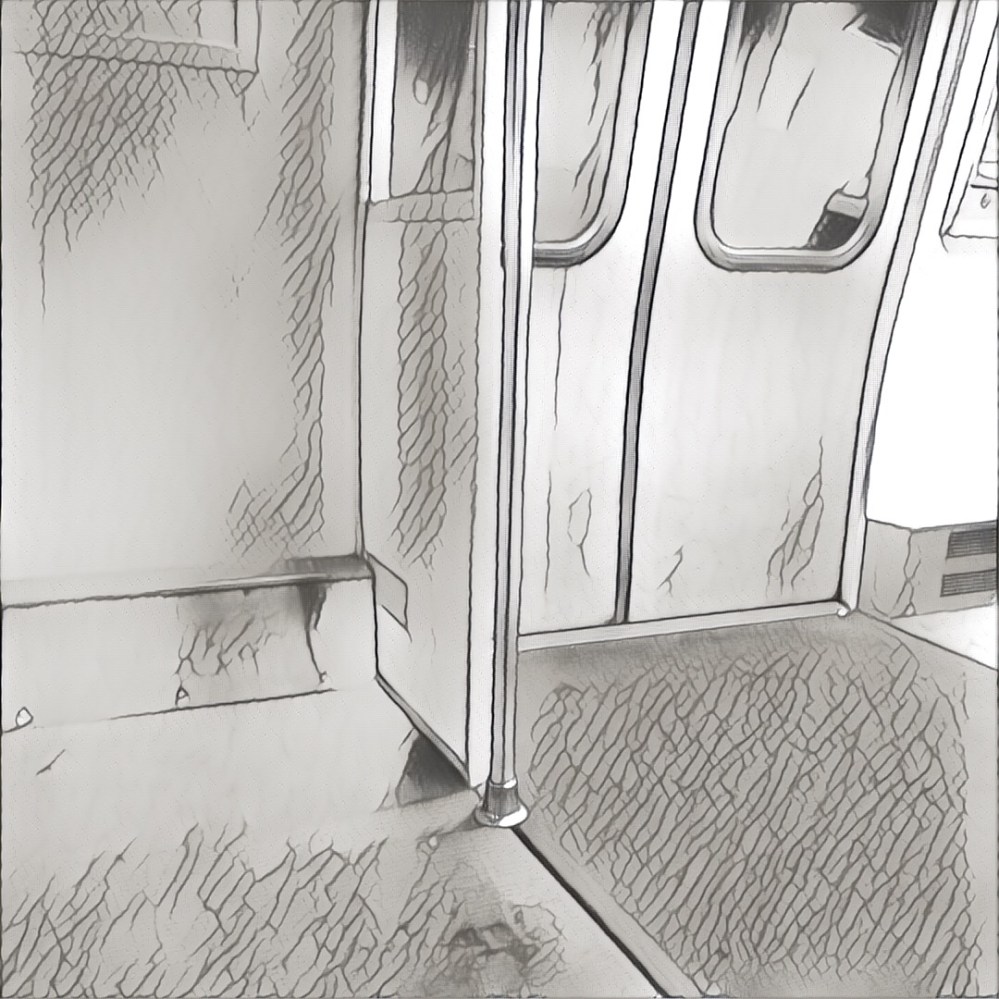
The floor and door of the Metro. It's gross. You should be glad I took out the color.

Dang. This train is filthy. It’s past rush hour and I’m on the last car.

Who the hell thought it’d be a good idea to carpet the floor on a public train? There are stains from spilled cokes™, from ground-in egg mcmuffins®, from a dropped perfume bottle and a misplaced brush from a very shiny nail polish. There are tarry spots from gum, or another sticky substance, that became black from the bottoms of shoes and flip flops, sandals and boots, sneakers and those Dansko clogs that the ER, OR and radiology teams wear at hospitals.

Some of the boots that grind in the grime had spiky high heels or wedges. Some were tanned and open-laced Timberlands spewing street from their lugs. Some were black, steel-toed work boots with the slippery grease from a restaurant kitchen accelerating and accreting the grunge buildup on the floor.

The doors, the ones that open magically and slide into the sides of the train, are streaked with gunk. The lighter streaks are simply slightly less gunky. The windows at the top of the doors are also streaked, but with residue from palms and elbows and some cheeks and chins. There may be marks from fingers desperately trying to force the doors open as they slipped closed.

The doors open onto the platform of octagonal bricks hugged closely together by mortar. It’s odd that the mortar doesn’t show filth. I guess cement doesn’t stain like rayon. It’s funny how the outdoor platform seems to be so much less gross than the inside of the train.

There is no fresh breeze in the train cars. There are no rains to clear away the grunge. There are no melting snows. The inside of the train is inside and gets no relief from the humanity that desecrates it daily.

But I’ve been on the new cars. With the stainless steel exteriors with a hammered finish. With floors of flecked linoleum or some other surface that doesn’t spotlight blotches. With metal grips that don’t show thousands of fingers pressed in to balance against the lurching car. With wider aisles and molded rather than padded seats.

Why didn’t someone think about that before?

Hurricane at the Farmers’ Market

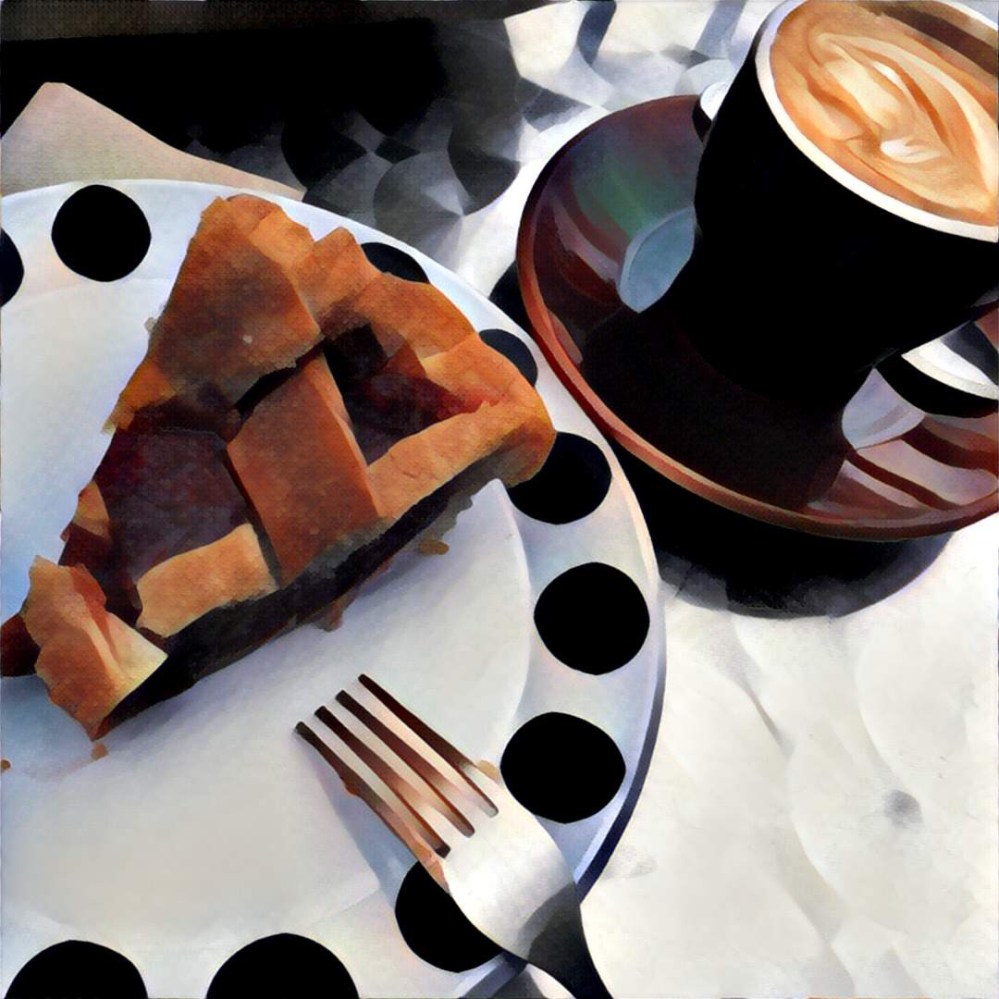
pie and a flat white coffee. the pie is on a cute white plate with big black polka dots around the rim. The table is hammered metal. It was windy. Oh, and there's also a fork.

It was a morning with a warning. Like a movie foreshadowing a foreboding.

Like the hint of wind in the black and white frontspace of The Wizard of Oz. Or the first drips of water in The Last Wave. Or, actually, any time the wind appears in a Peter Weir film. See also, David Lean.

It’s the scene where the wind whips the shore, bends a field of wheat, or makes the hero chase after an important scrap of paper. The paper chased could be a photo of a child, the digits of a to-be relationship or the receipt from an encounter with a spouse that they wished they could take back. And this sub-story drives a key sub-plot. The one that preys on our wish for happy relationships.

This morning, at the farmers’ market, no vendor had a tent. Normally all normally do to protect from the midday sun or to provide respite from a shower. But not this morning. This morning the gusts of wind were like a Sherman tank mowing down anything, and everything, in its path. The covers were no cover against the nature force. The tents were folded next to the tables.

Tables, where the merchants were hovering over their wares with their entire bodies until the winds subsided. Tables where goods that were not sold by the heavy pound were placed on the ground to keep them from becoming projectiles. Tables where dollar bills fought to leave the fingers of either buyer or seller but not from the buyer to the seller. No. These monies were looking to ride the next gust to the next world. Wherever that would be.

The musicians playing in the plaza for tips were sad that their open instrument cases were venues for dollar bills to launch from versus the coffer for their patrons’ contributions. Little kids swaying to the music was nice, but it took someone willing to pay to show their value. They scrambled to find a container that wasn’t missile plastic, but were mostly were resigned to a sadly camouflaged urn that most people would not see as an invitation to financially thank the performers. But if anyone appreciated them enough to seek out the tip jar, the urn would keep and cash in line.

The winds were not consistent. They were sneaky. They would sometimes swirl around–causing strollers to roll and hair to obliterate the view. They would sometimes whisper, tickling edges of paper and lulling people at then end of  a hot summer to believe that there is a balance in the weather. And then it would hit the accelerator and lean on the horn to let everyone know that this is no mere breeze.

Because it’s not. It’s the front end, and will be the back end, of the remnants of a hurricane.

It’s the winds of change. The winds of winter. The winds of war. The warm winds of El Niño, and the butterfly wings that precursor a Camille, an Andrew, a Galveston and a Katrina.

And in the eye of that storm, people picked up tomatoes, drank coffee and ate pie. None of them knowing what would happen next.

On Watch 

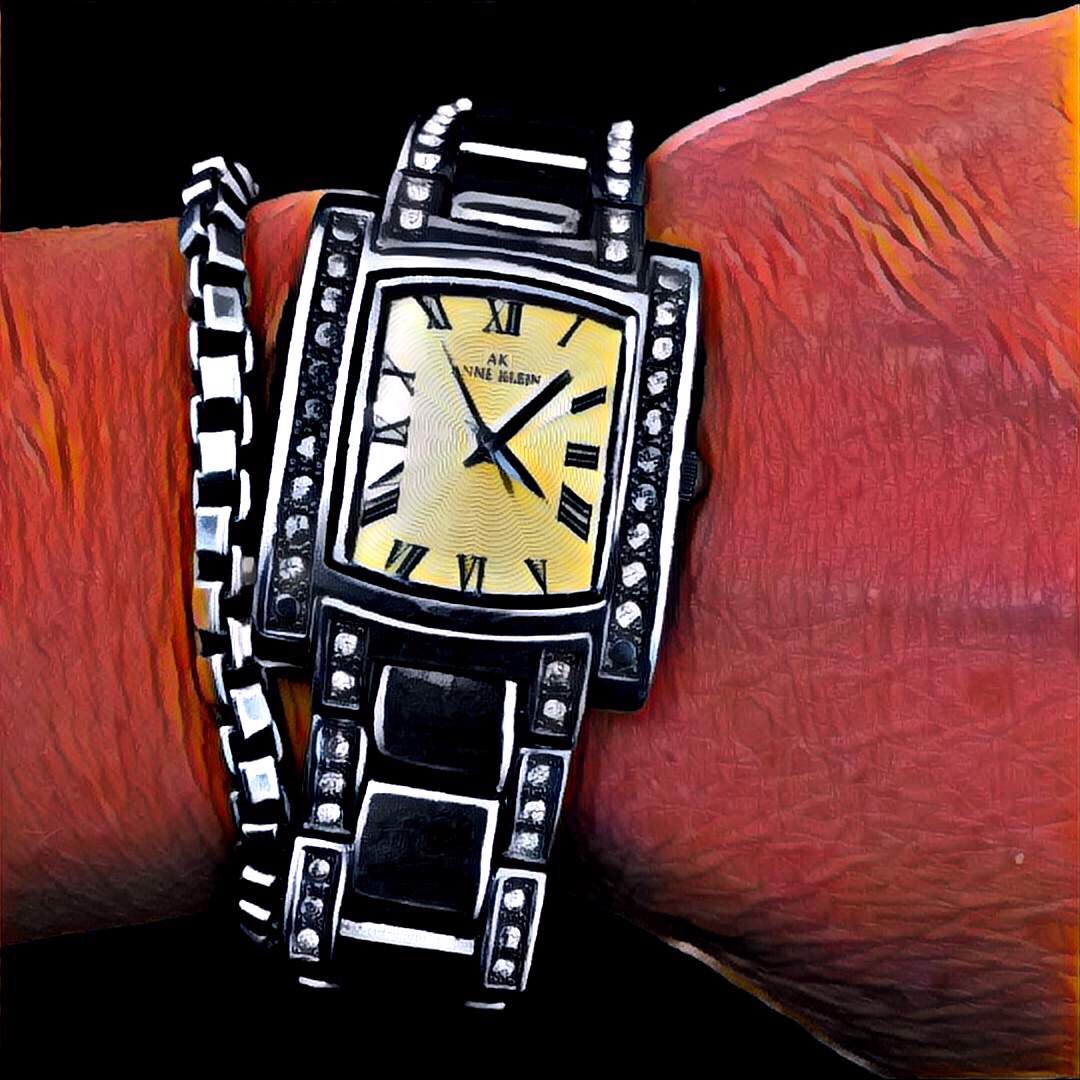
The second hand makes another sweep around the face. It started on the 10 and made its way around in a circle. It almost imperceptibly paused at each second on its journey. 

Observing it, watching it go through its paces, hitting each of the major twelve numbers and the stutter step at the five markers between the numbers, makes it seem like it takes a long time. Does it?

Did it really start on the ten? Did it even start? Was it always just clicking along? Of course it started and it could stop. That’s why you wind it or change the batteries. But it keeps going. Even when you’re not looking. 

Storm Chased

A mean storm meeting a beautiful evening sky. Run!

It was time to go. She looked along the row of desks to the window next to the wall clock that evidenced the time. She got stuck on the window. She wasn’t running late, but it was dark. She walked past the empty desks to look outside. Everyone in her aisle had already left. Slackers.

Her eyes scanned the sky. It looked like it might be getting ready to storm. Like an August squall kind of storm. In the heat of summer there are spates of mini-monsoons, sometimes four, five or six days in a week. These are expedited events. Storms that when you beat them home, you’re dry. And if you don’t, you’re wading ankle deep through a tiny flash flood roiling at the storm drains at the intersection. The latter is a bit gross.

She shut down her Pokemon session that had been running amiably in the background all day. There were a few pokestops near the office, and someone(s) had been setting lures. No walking but much catching between emails and meetings.

She swiped over to the weather app. It displayed a current temperature of a comparatively mild 88°F. Rain wasn’t forecast for another hour. She’d be home in half that. Quicker if she took in fewer steps and high-tailed it to the closest train station. She grabbed her backup umbrella, just in case. She put it back in her cubby. She wouldn’t need it.

She looked up at the window again and thought better. She plopped the tiny orange umbrella in her bag. It didn’t take much space, and better to be prepared. The app said No. The sky disagreed. She was going with the non-virtual reality.

She optimistically put on her sunglasses rather than her inside peepers. She placed her sunhat on her head–easier to wear than to carry even though she looked ridiculous walking into the premature evening decked in sunwear–and pushed through the two sets of doors to the sidewalk.

She had been out at lunchtime when it was plenty hot. The vestiges of that hot was on the metal and glass of the doors. It rose from the sidewalk through the soles of her shoes. It was still hanging out in the thick air. She turned toward the corner and her hand flew to her head, to keep her wide brimmed straw chapeau from lifting off her head. She turned to a stranger at the light.

“Wow! Now that’s a cold front.” The woman next to her took in the floppy bonnet, looked up to the blackening sky to the west and grinned her agreement as she scurried across the street. The light had changed. All the commuters on the sidewalk were dashing to their next stop. The wind was cold. And pushy. It was a warning.

Her foot reached the sidewalk on the other side of the street. She looked up, again, to her right. The clouds were moving, and getting darker. There was a definite border between the stormy side and the calm side. The stormy side was encroaching, though. There wasn’t a  referee to throw a flag and make it organize itself according to the rules.

She saw the man who spent the day on the street packing up. She somehow knew he didn’t sleep on this street, but she had never seen him leave. The wind was motivating him.

She stopped every eight or ten steps and looked back at the sky. She saw a flicker of lightening and heard the thunder. She mounted the top of the escalator and descended into the subway and boarded a waiting train.

Her car came out of the tunnel. Damn. She was losing the race with the storm. The line of blue sky and fluffy white clouds was behind her, behind the train. Before her was a dark, rumbling and angry sky. Looking over her left shoulder she could see the reflection of sunshine. A caldron of something wicked this way comes to her right.

The conductor warned the people on the about the weather conditions. “Use caution on the platform,” he entreated. She dismounted from the train onto the bricked walkway. She smelled storm. They say it’s ozone. The sky cleared its throat like an old smoker.

It wasn’t raining now, but it just had. People stood at the edge of the cave that opened into the elevator well. She pulled out her little umbrella and released it from it’s little bag. It wasn’t quite raining. Not yet.

She held the umbrella above her head that was covered by her sunhat. Her sunglasses and staw hat looked silly underneath the short-sticked, orange umbrella. Nobody noticed. If they were under the overhang, they were looking up. If they had left the station with her, they were looking to get out of the rain. Some went to the bus bays. Others to the kiss and ride. She and some others walked along the sidewalk to the intersection.

There was a flash and a boom. The lightening and the thunder were concurrent. The storm was here and now. She ran a few steps, and then the rest of the block. She wondered if she could minimize being struck by lightening by running. It couldn’t hurt.

Going home meant going toward the bright part of the sky. Maybe if she hurried–another reason to run–she could leave the storm. Her house seemed to be underneath the clearing. The rain was hitting the cover above her head with more purpose. It was still fairly light. Another flash and another deep grumble from the sky. She skipped over the curb and flew to the next corner. The next flare lit up the street. The thunder was quick to follow, louder, longer and lower than before. She saw her house and squared her gate to be greeted on the porch by a big dog and a man.

He laughed at her sun and rain gear. She closed her umbrella and the sky opened up and poured rain. She was home just in the knick of time.
Trickle Down Effect

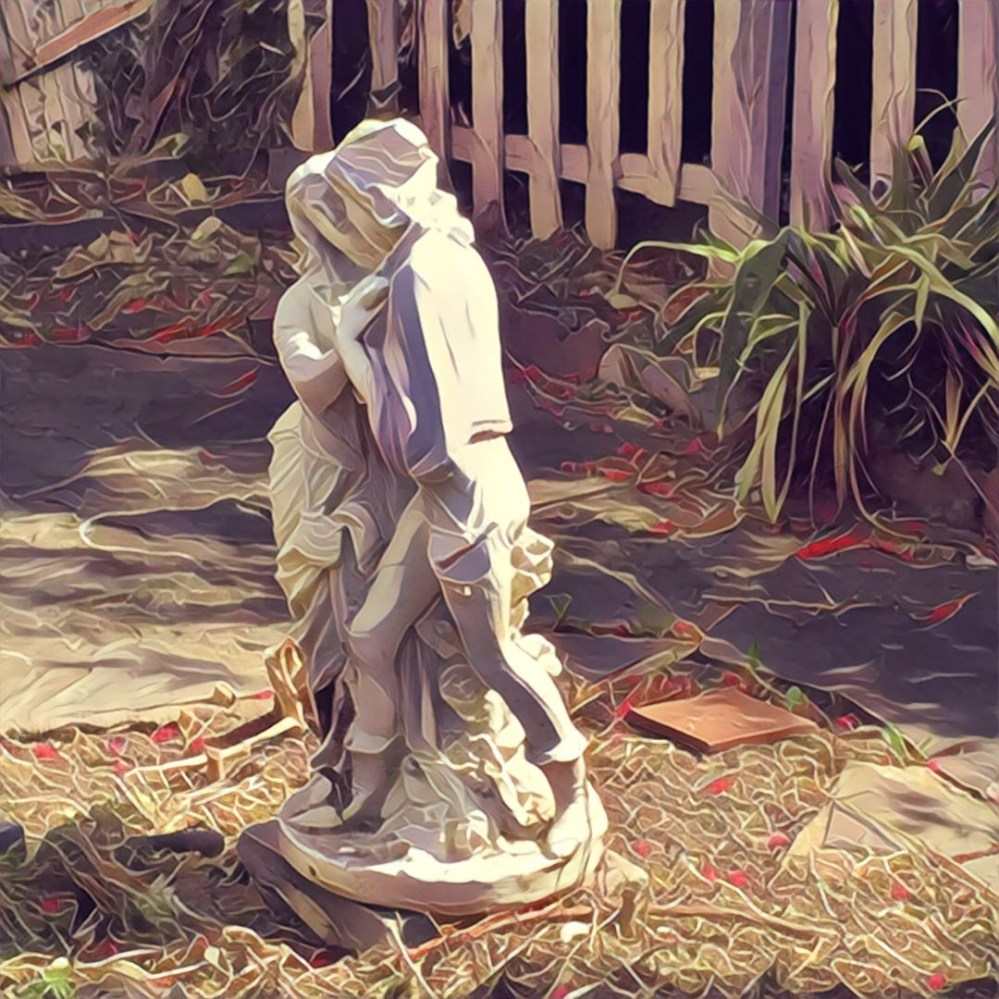
Here is a pic I took of a garden statute in someone's yard as we were taking too long a walk on too hot a morn.

Drip. Drip. Drip. But not fast. Very slow.

Well, the first drip is slow. It creeps along the bridge ever so reluctantly. You almost feel it, but then you don’t. You’re not sure until it’s about two-thirds the way down. Then it snowballs a bit. That’s kind of funny because snow is the opposite of what you’re experiencing.

As the saline solution reaches the end of the bridge, at the tip, you feel it accumulating. It isn’t really heavy, in a way that it creates pressure. It’s more like a swelling. It is amassing. Gaining enough mass where you can begin to see it if you almost cross your eyes. It is becoming a drop. A bead of sweat. That will drip. Right off of your nose. And you’re not working out. You’re just going about your business.

It’s 91°F and the humidity is 60%. This calculates to what is called a Heat Index of 102°F. The other phrase for Heat Index is Feels Like. In this case it feels like it is too hot and your body is leaking.

The water is almost hanging from your nose. It feels like that minute as the Olympic divers stand on the edge of the platform, facing away from the water and just before they hurtle themselves in the air in twists, turns, pikes and tucks to meet the water. Their hands are clasped together as in prayer, but they use this spear to slice into the water for a splash free entry.

But you? Your hands are no help. They’re otherwise occupied. You’re hand deep in dirt, or you have two hands on the leash, or you’re carrying two bags of groceries and a twelve pack. You can’t brush the water away, even though it is annoying you. You both don’t want it to drip and can’t wait for it to release. You won’t shake your head to get rid of it.

Turns out you are now waiting for it. It’s an uncomfortable, yet delicious, anticipation. You stand still because you know it’s so close. So ready. You lean your head a bit away from your body and watch the pearl fall.

You lose sight before it hits the ground, but the next bubble is already beginning its slide. You brush this one away, either using the back of your hand or at your shoulder. But it doesn’t matter. The drips are backed up like O’Hare after a wind shear. They will come one after another now.

Your hands are still occupied, but you somehow reach for the key to step into the dark, cool house where you will splash your face with many many many drops of cool, salt free, water and dry yourself off. A sigh of relief will slip from your lips. You shake your head.

A Dish of Tomatoes

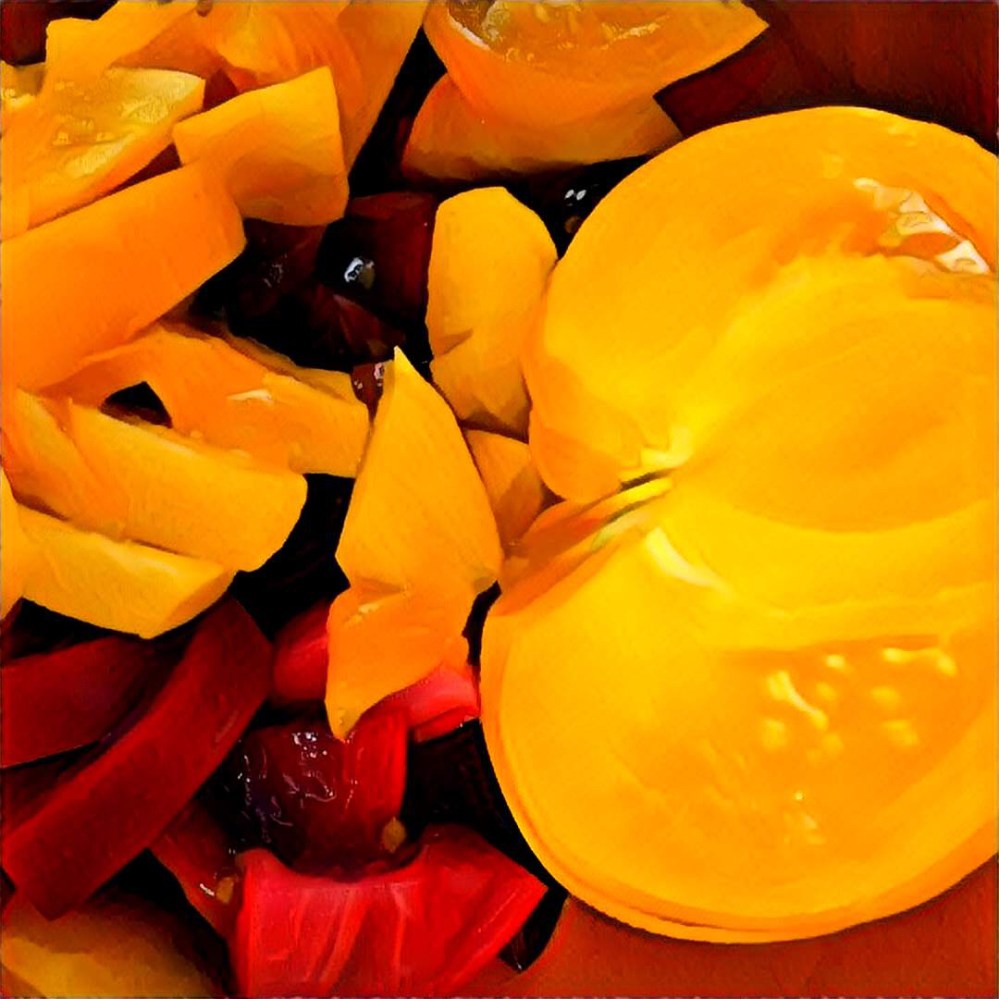
Yellow and red+green heirloom tomatoes.

They were special tomatoes. Heirloom, as if they were passed down in the family. But it is actually an excellent ploy to extract more dollars per pound for tomatoes that look much less than perfect–in color, shape and demeanor. They are supposed to taste extra good, but in that way they are just like other tomatoes. Sometimes they taste good. Sometimes, not so much.

These were nicely ripe. They were heavy and felt fluid-filled. The tomato would give to pressure from a finger, but return to shape almost immediately. Holding it, it was heavy. Bringing it to the nose, it smelled of itself.

It put up some resistance when I put my knife to it’s skin. It swelled slightly under my hand and then ceded with almost a sigh. Gently sawing the surface, it soon gave way beneath the flesh to a wet, almost gelatin middle, flecked with seeds. After cutting in half, I removed the top of the core then went to work, sliding the knife again and again, making irregular cuts for the salad. The cutting board was filling with juice that I tried to capture by scooping the pieces onto the knife and dropping into the bowl.

There was a big yellow tomato and a red tomato with green. I topped them with swirls of extra virgin olive oil, a scant tablespoon of sherry vinegar, a few turns from the pepper mill and coarse salt. I stirred and let it sit on the table to let the juices ooze out. The better to dip the crusty bread in and get every last drop.

crab soup

crab

Well damn. Could that crab soup be any better?

It was creamy. But not floury. The worst is when you can easily identify the thickening agent. When you taste the flour, somebody failed. Worse would be a thickening and flavorless and thick cornstarch. But this soup did not make that mistake.

Flour needs to be a part of the fat, incorporated, with only thick and no interruption except to add feel. The fat could be butter. It could be olive oil. Or another oil. The flour needs to be heated, maybe taking on a color, and cooked. Flour tastes lousy. A mouthful of fatty thickness? Yes. That’s it. And cream. Yes, add cream.

The soup was sweet from the flesh of the crab, but you could taste the honey from the sherry. The sherry wasn’t just sweet, but nutty. And the butter wrapped around all of it–to fill your mouth.

That’s what I shoveled into my mouth. It was crazy. I didn’t need to eat it so fast. But it was just that good.

Composition

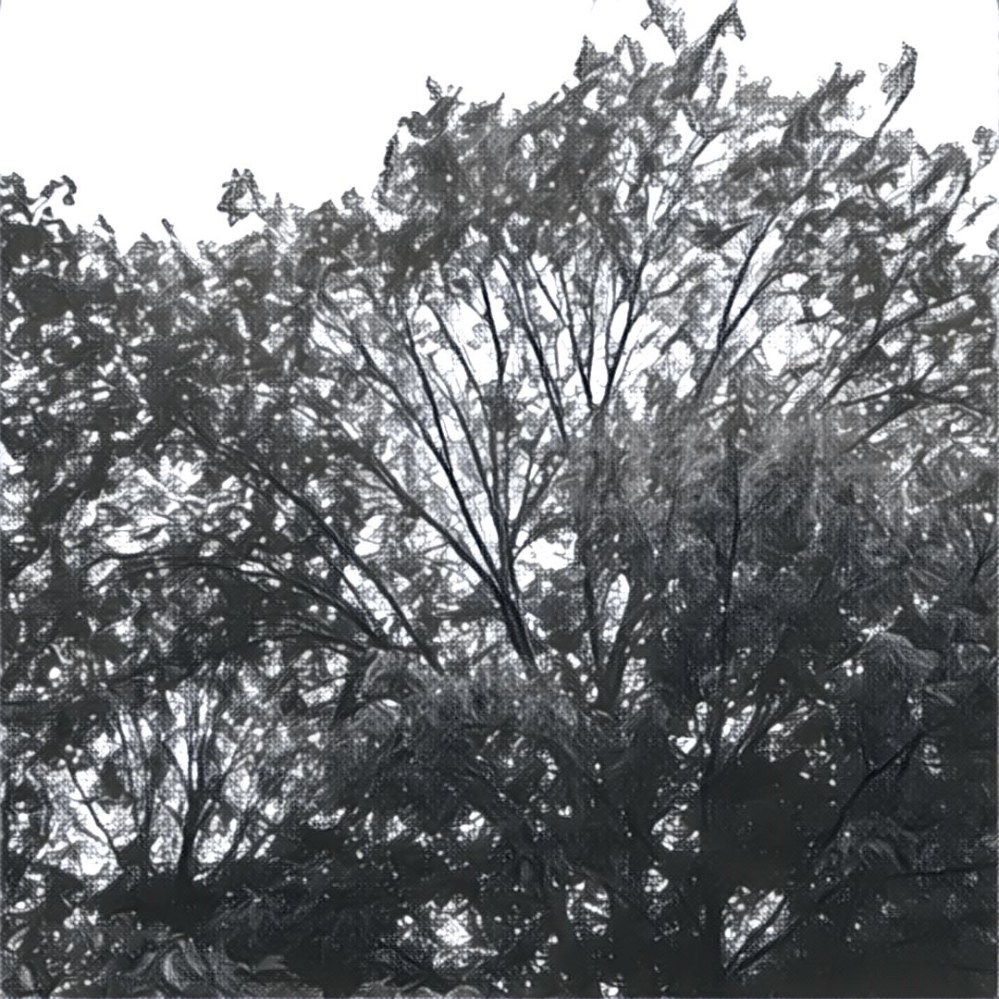
Did you know that this was a picture of trees with the sun breaking through before it was stylized into a b+w picture of trees with a source of light?

I’m taking a little break tonite. Not from thinking, but from composing the thinking.

My day was full of thoughts. Some were validating, but, and more interesting, some were apple cart tossing.

The challenging thoughts were mostly in my favor. That is, when I proved myself wrong, I was questioning myself when I was on my own side of the argument. Not that this did me well. Thinking, again, I guess it did. The tough thinking was aligned more with my values versus the logically correct bare logic. In my mind, pure logic needs to be evaluated against results. No matter what they are.

Like, earlier today The Spouse and I went back and forth about a judicial nominee. The nominee was exactly right in his logical application of the law that the tabloid was calling Mr. Potential Judge out on. And the Mr. Potential Judge was exactly wrong on the human impact. Logically, and intellectually, sound–but wrong.

Sometimes equal is not fair. And that was the issue with the judicial analysis.

I want to write about the dozen, or maybe only half-dozen, dilemmas I had today. But instead I will write about the unabashed joy of deliberation, of contemplation and of equivocation. Because sometimes we need to think more.

After all, I’m the Doctor of Thinkology.

Room Temperatures

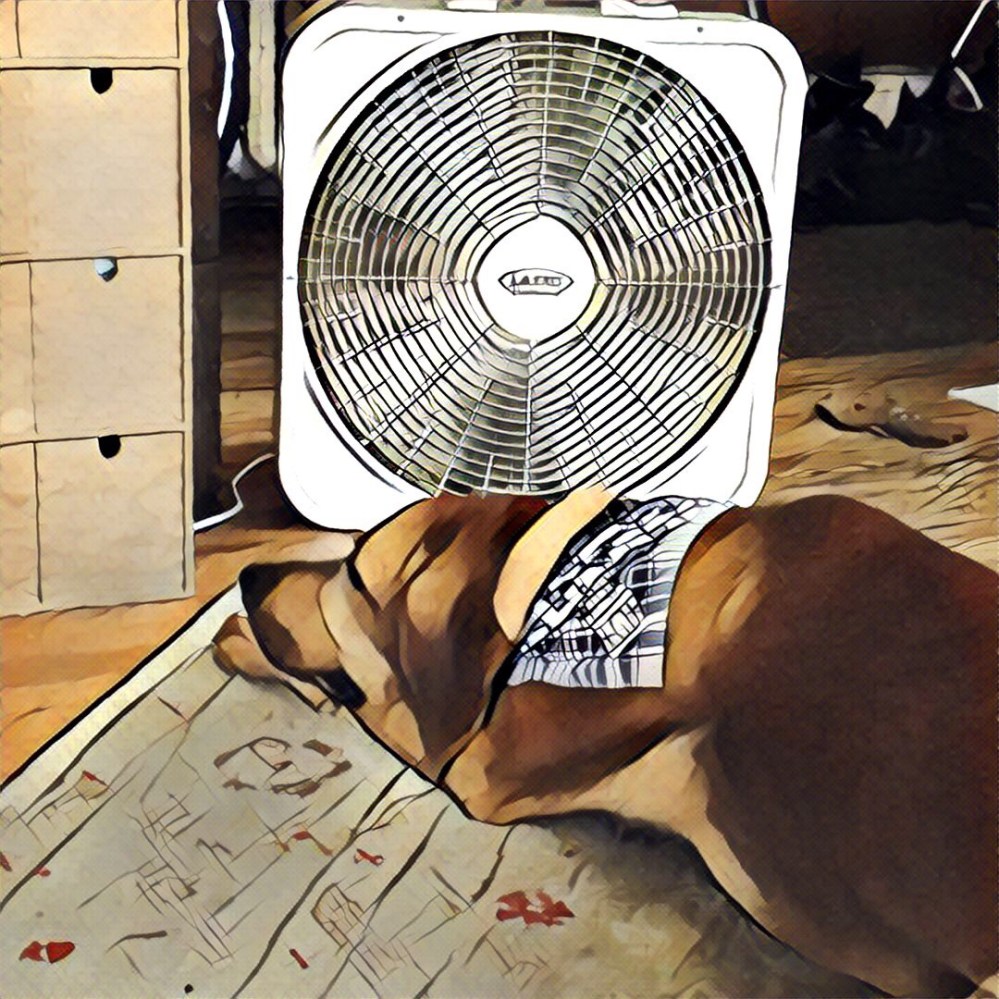
A very hot dog takes advantage of the box fan.

The house is unnaturally cool. Blankets get pulled up around chins. The hot coffee feels good going down. There is always a hoodie nearby for the overzealous chill. You could even imagine baking–if that was what you did. If it was a blueberry pie, that would be good.

Opening the door on a 97°F day isn’t a shock. Walking through the threshold, the wet heavy air forms a drape, a drape that is transparent to the eye but has the heft of thick velvet curtains. You need to almost push the air away, except it doesn’t resist.

The humidity is supra-tropical and the air is moving around. For skin cooled by the AC, it really isn’t as bad as expected. Stepping off of the shady porch and into the sunlight is a bigger contrast. The sun squinches eyes, even those behind sunglasses. It doesn’t caress the cool skin as much as press on it. But it doesn’t press hard.

The heat is forgotten for the first five blocks, until the the last of the chill, that last chill left on your forearms, gets dispersed into the air. The cool becomes hot, too.

The heat begins to press harder on skin. It closes up your nostrils, making it harder to breathe. It squeezes out beads of water along the hairline, at the waistband. Water begins to drip from under arms and beneath chins from throat to chest.

The heat seems to make gravity more grave. It pushes down on thighs as they work to bring the feet up to propel to the next block. It would be easy to slow down, but that would mean staying in the heat. No slowing down, but no speeding up, either. Additional exertion would be too punishing.

The last turn to the final block is a mental relief but a physical trial. Cheeks are flushed and radiate fire. The dull throbbing from your head that started two blocks earlier becomes all consuming.

The key turns in the lock. The door opens and the arctic blast starts your revival. The moisture on all skin surfaces begins to evaporate in the dark, cool house. The pounding in your head gets worse as you slump onto the couch. You stand up to switch the fan to “high” and flop back on the couch, facing the fan with your eyes closed, wiping your face with your shirt.

Your head hurts, but as you watch the swelling of your feet subside and feel the ring twirl around freely where it had been stuck on your sausage finger a few minutes ago, you lay your still pulsing head on the pillow, and reach for that hoodie.

Air Valve

A pile of sugar in a spoon. It might be a teaspoon, but it's hard to be exact.

Dear lord. It started with a misplaced sip of water. The bubble started from my throat, or maybe it’s my gut. Either way it builds to a very tight wad of air until it bursts a few inches below my chin.

Damn. Did I just get the hiccups? I wait to see.

You don’t really know if it’s the hiccups until the second one. I mean, you can feel that it might be, but, until you get the rhythmic spasms, you hold hope that it isn’t going to stick.

My chest almost tightens and the air explodes. Some of the air shoots out of my nose in a very uncomfortable fashion. It’s almost effervescent, but not nicely so. Effervescent in that citric acidy way that burns your nostrils. A subset of the air from my tight chest, almost concurrently with the nose release, reverses back down and erupts in my esophagus just above my stomach. This is also not pleasant.

There’s a burst of belchy air that escapes from my mouth. This is the part I really hate. The air doesn’t as much escape as expel through my lips at a disturbingly high speed. This happens via some unknown muscle in the back of my throat. This muscle curls onto itself. It creates a very tight spring, and when it lets go it shakes the top half of my body. I am not exaggerating. I visibly convulse a bit.

The air rushes through my voicebox on the way to my mouth to create a squeaky “hic” sound. A sound that seems so silly and gentle. But that sound belies the violence of the air jetting out.

It doesn’t hurt. Not at first.

Even though I am alone, my hand rushes to my mouth to excuse myself. It’s just polite to avoid spreading air spewing from your gut across the room.

I wait.

Yes, there. Damn. Although the hiccups are rhythmic, it’s a syncopated beat. A beat without rhyme or reason. Hiccups are erratic and random–except that they will repeat. For too long. Sometimes they’re fast and furious, but more often they tease you into thinking that they are over. Until they are not over but instead causing pain in your chest and your throat.

Mind races to the list of cures. A teaspoon of sugar. Or of vinegar. Or hot sauce or honey. Covering your mouth with a paper bag and slowly inhaling and exhaling into that bag. Drinking a glass of water through a paper towel or with a spoon hanging underneath your tongue. Then there’s fright–but you know it’s coming so it rarely works.

Or writing a post about it. Seriously. They are gone. I love this blog!