Scrreeeecch!

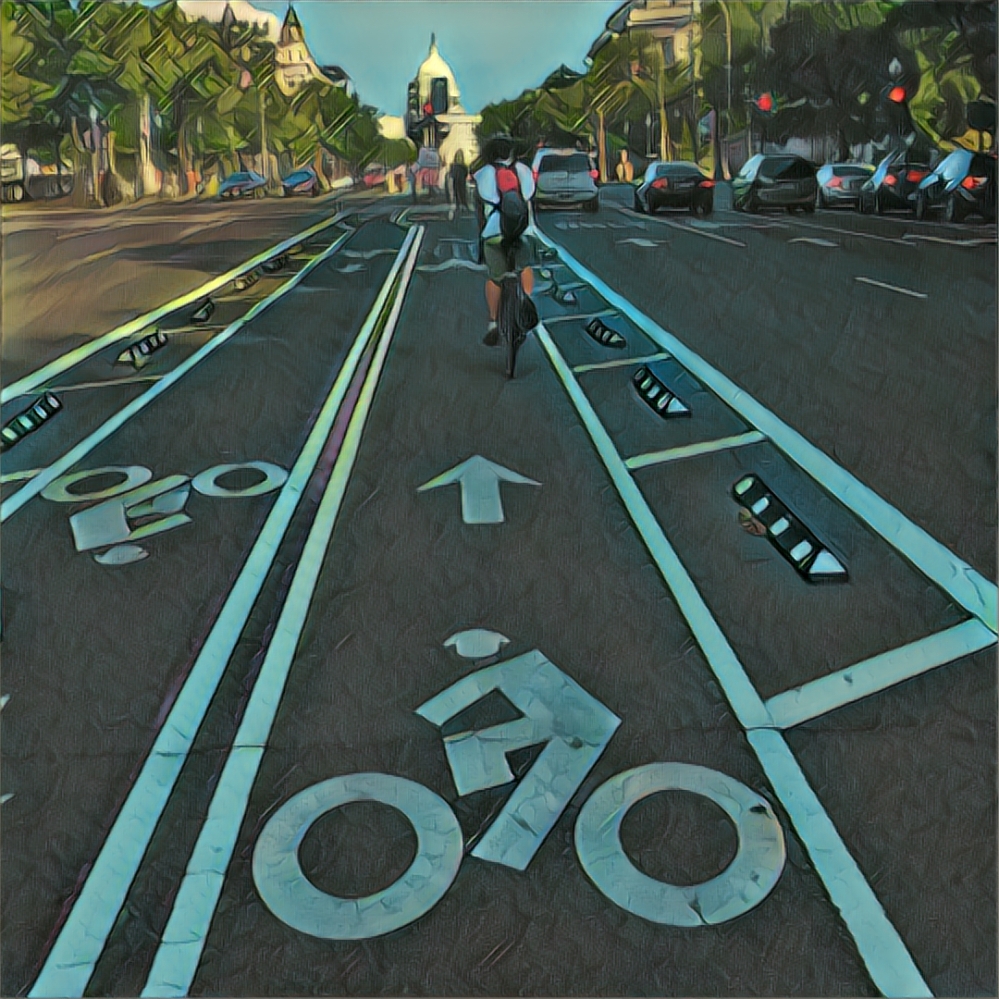
RIding a bike down Pennsylvania Ave with the Capitol ahead.

So I dumped my bike to avoid a big accident. For those of you with a more mortorized view of dumping a bike, it wasn’t that.

We had a glorious Sunday ride down to do an explore of the new museum. Yes, that one. It was a great late summer day with a breeze, sunshine and better than bearable temperatures. The bike path was full of cyclists and walkers. The route is an easy five miles to the museums with minuscule change in elevation. It’s not a work out, it’s like being a little kid locomoting yourself. And ringing your bicycle bell. I did that alot. The bell ringing. The Spouse got a little tired of it.

I felt like I was flying, like when the kids take off with E.T. Didn’t you always think you could do that? I pretended to race, mostly my shadow. I sang songs from last week’s concert. I went down a hill and said, “Wheeeee!” Outloud. I really did. The Spouse gave me a look for that, too. The Spouse is a much more serious cyclist than me. I slow down his vibe. He’s a good sport that way.

I took in the sights along the bike trail. It’s one of the paths that got built next to railroad tracks. For us it’s tracks that run Amtrack, CSX and the subway. Sometimes you can even race a train. They usually win, though.

There are stunning murals along a section of a retaining wall. It looks like they gave five or six artists sections to paint. As you pedal by you can see a style and color palette that somehow flows into the next section, even though the next artist is very different. I wonder if riding your bike past makes it into a moving picture. I’m thinking Muybridge motion studies.

Also, did I tell you I got a new helmet? And I like it?

We locked our bikes up in a secret garden behind the American history museum. Ours were the only bikes. I felt like a Washington insider. Okay, maybe my standards for insider-status are low. No matter. We walked through the construction site of the new museum, but that’s all I can tell you. It’s a secret. Then we rode back home.

We stopped for libations at the pub at the top of the hill at the top of the trail. I’m not kidding, the chips for the nachos were so fresh. And not just because they were good with the hopped beverage. They were special. It was like everything was special on this adventure.

I walked my bike up to the crosswalk so I could cross to the other side of the street and then over the bridge and then the three remaining blocks home. Nobody was coming on the right. Nobody on the left so I stood on the right pedal and pumped my foot down to scoot across the street. As I did, I saw a car coming over the bridge.

The bridge has a decent arch. There’s a light on the other side, but cars come flying if they get a go-ahead green at the intersection. Drivers can’t see you until after they crest the arch. And then, almost immediately, there’s the crosswalk. I didn’t like the future I saw, so as I was accelerating with my right leg, I used both hands to pull hard on the brake levers. Pulling as if my life depended on it.

The mixed messages of stop and go caused my front tire to rear left, almost like a horse. Except I don’t ride horses, so this simile might be overdone. But my bike did throw me. Fortunately, it tossed me to the sidewalk. Out of range of the car coming over that bridge. The driver sped by without seeing me.

There were cries of concern from the restaurant’s patio. Two women came to the edge of the space to see if I was hurt. I was a little scraped up. One of them thought that I should take a breather. I told her I was fine. Because I was. Better to have a skinned elbow and knee than to be hit by a car, I always say.

I dusted myself off to witness a most obscene exhibition of road rage. A group of five or six students were walking in the cross walk–the one with the metal sign in the middle reminding drivers that they must stop. A driver jumped out of his car and began yelling and cursing at them. He left his car door open and delivered an over-the-top berating, jumped into the path of one guy and body blocked a young woman. I thought she would melt on the spot, or turn to stone. The people on the patio were no longer looking at me. They were wide-eyed at the new spectacle. Busy afternoon.

I was shocked out of my absorption with my own bike dumping experience. Looks like someone was going to get hit with a car. Overall, I’m glad it was the undergrads being pummeled by  angry words. I adjusted the front tire of my bike and gingerly made the three minute trek home to ice my elbow.
No Sense

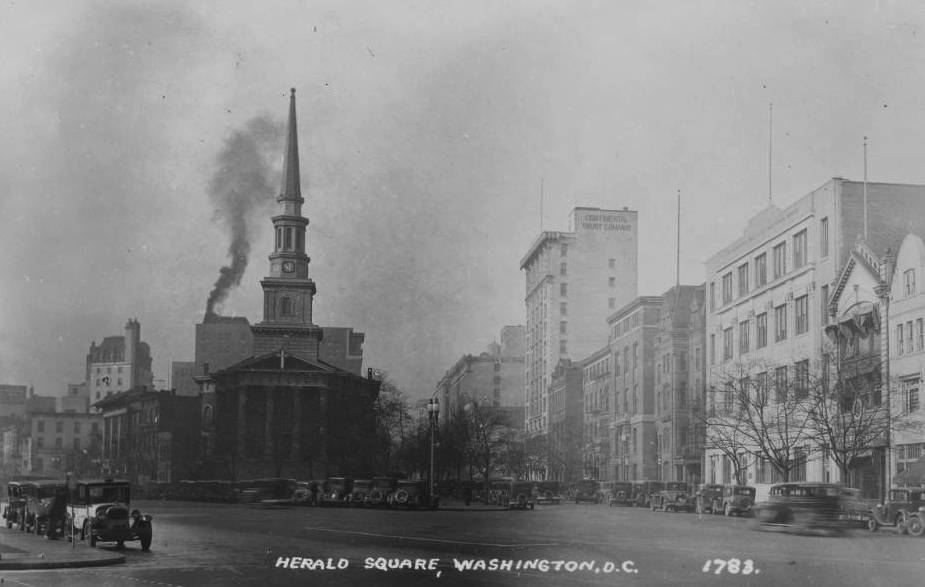
Photo of 13th and H St. at 10:55 a.m. on January 4th, 1931

Her hair was strawberry blonde, more strawberry than blonde. When you looked closely, you saw that she came that way. No off color at the ends. No reverse skunk dark roots. No center part outlined with silver or white.

She had a thick head of hair and bangs flew from her face. Although her cut was not high fashion, the ends weren’t split. Somebody might say she was a ginger with her freckled face and arms, but she wasn’t that fair and her skin held a tan just fine.

Her lips were moving, and she was only wordless in that she wasn’t making a sound, but she was most definitely forming words. Her face was more than sun kissed. Maybe a bit weather worn, too.

Her back was to the building and behind her was an unopened bottle of orange juice and an extra large cup from Chick-fil-A, or Five Guys or some other red writing on a white logo’ed joint. In front of her was a medium sized, clear plastic cup with a ring of green leaves that identified this as recyclable plastic. Maybe it wasn’t even plastic. It could be a corn product. The cup in front of her was about a foot from her mouth making the shapes of words. There was green inside the cup as well as bordering the cup. The green was paper money.

Back to her hair, it wasn’t dirty. It wasn’t matted. It wasn’t higgledy-piggledy. But it wasn’t fresh from the salon, either. Her eyes were closed and the teeth behind her moving lips were a little oversized, but there. She was wearing a dress and black hose. Not sheer hose, but tights. The tights were ripped and ran. The toes on her left foot, the one on top, were exposed. Her right foot, the one on the bottom, was almost completely bereft of cover. There was a thread that looped between two of her toes that kept the rest of the stocking on her leg.

She had no shoes. No shoes on her feet. No shoes near her feet. No shoes near her head. No shoes next to the unopened juice. She didn’t have a bag. Not a purse. Not a backpack. Not a garbage bag. Not a thin plastic bag from the Walgreens.

She was more than asleep. More like passed out. She was sprawled on the sidewalk in the mid afternoon on a busy corner in the business district. She was on her right side with her hands near her chest, her legs pulled up slightly. Her nearly bare feet pointed toward the White House.

It wasn’t unusual for people to sleep on the sidewalk or to ask for money or to live on the streets downtown. But she didn’t look like that. She looked different. Like she was either a new transplant or someone who was lost or someone who was dumped.

A few people paused as they walked by her, looking to see if she was breathing, wondering if she was okay. At least two called to have someone check in on her. This is because as one was describing the woman and her location to the emergency dispatch, Engine 16 was in the intersection, making a left turn. The firefighters stepped out of the big red truck.

The one on the phone told dispatch that someone was here, hung up and felt water welling in eyesockets. She turned her head to the sky and said a prayer, hoping that something was there to catch it.

Busting Loose

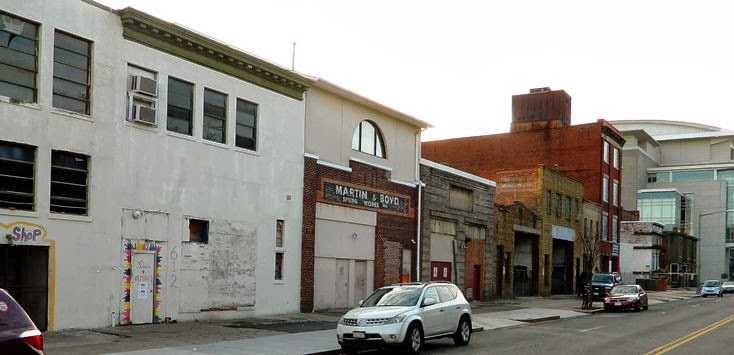
A yet to be "rehabbed" street in Shaw. Around 7th and L, NW. Close to the cop shoppe.

Growing up, a meaningful block was a half-mile long. Nobody walked much, so it wasn’t a big deal, but the distances between stuff were actual distances. Walking three blocks was a mile and a half. Distances were covered in miles per hour, thank you very much.

When I first moved to our nation’s capital, these were pre-GPS days–I know, right?, I pulled out the map to see where I was heading. It was on the other side of the beltway. Using my historical point of reference, I figured it would take about 60-70 minutes. It took me less than 20, and that might have included a little bit of time when I was lost.

Geographically, D.C. is a small place.

Today I told The Spouse that drinks were on me at the hip watering hole that just reopened. I decided to hoof it from downtown. The Spouse hit the pavement from The Mall. It’s a sign of the times that we would even consider walking. Five or six years ago, when the development was in planning, I would not walk that corridor. Boarded up shops, drug deals on corners, and no reason to be there. Nope. Seventh Street was a car route.

I walked the dozen blocks, passing the new convention center, spiffy hotels with five-story atriums, rehabbed buildings, shiny new box apartments, a grocery store with wine and a ton of prepared foods, and a few windows still boarded up. For now.

There were still the few blocks of subsidized apartments, but they’re much less notorious. There was still a cop going back and forth with a citizen. They were being observed by a sidewalk full of the neighborhood a few yards away. Nobody was cuffed. The convenience store was surrounded by folks waiting for the bus. The air included the smell of tobacco and weed. But no piss.

The city was always tiny, but now the walk from the FBI building to the burgeoning condo, bike path, coffee shop and restaurant fueled blocks formerly known as the hood and now known by their hip nicknames was much faster than a cab during Friday rush hour. In less than twenty minutes, office commuters can traverse to the land of brown liquor with artisanal ice, biergartens, craft roasted coffee, dog groomers and hipsters.

These thirteen blocks span less than a mile, not the 6½ that I would have expected in my youth. As the city gets closer together, it gets bigger for some people and increasingly inaccessible for others.

The Spouse remarked on our independent walks through what had been a tough area. I noted that there was new paint and landscaping at the public housing complex across from the shiny new grocery store. The rec center that had an awesome makeover was full of little and mid-sized kids that did not live in the new studio and studio +den apartments with the marble counters and stainless steel appliances.

We don’t want the city to lose the people who have raised generations of families here. Both of us, at the same time, said we really hoped that there was enough room for everyone. I better go call the Mayor.

Something Fishy

Sign for Grand Jury Room.

Twenty-one of twenty-three grand jurors were present. The jury room had two rows of chairs stacked theatre-style in a windowless room. The “stage” was below. There was a chair for a witness and a desk and chair for the court stenographer in the bottom of the bowl. Two juror chairs were empty. Someone was late and someone had a dental appointment.

The novelty and the importance–the grand part–of serving on the grand jury had long since passed for most of the jurors. They’d grown tired of the legion jump outs by police who would testify that they found a small plastic bag filled with a green herb-like substance that later tested positive for weed. Actually they always said marijuana.

They were weary of the multitudes of weapons charges. Each case included charges for carrying the gun (pistol in law enforcement vernacular) without a license and possesion of unlicensed ammunition, too. The jury knew the charge by it’s acronym, CPWL. The charge was read then repeated by the officer on the stand and then read again. If there were two weapons, the second weapon charge was read, repeated and read again, too. And, of course, the ammo charge. It was curious, and then annoying, that the same person was charged for unlicensed ammo on a per gun basis.

This particular jury, Panel 3, spent many hours having testimony “read into” them. This entailed a lawyer reading transcripts from interrogations in front of a prior jury that did not sit long enough to indict. These cases were murders and more complex investigations. Panel 3 did not end up voting on most of them, either. Toward the end of the Panel’s internment, the Assistant US Attorneys–that’s what they call the prosecuting attorneys in D.C.–would use them to get testimony on the record. And this evidence would become a new transcript that would be read to a future jury. Seems like the jury never got the entire story. Just a cog in the wheels of justice.

The Assistant U.S. Attorneys initially intimidated the jury. Ten days into their service, however, Panel 3 realized their powers. They were no longer cowed by the process. They learned that as soon as the foreman closed the door, nobody from the outside could open it. They were a secret citizens panel, and they might be talking jury stuff. Or they might just need to take a break from the never-ending repetition of drug and gun cases. Yes, once again, there was enough evidence to indict. It’s a low bar. Yes, already. And again.

Or they kept the court officials out because they needed a respite from that extra arrogant attorney that pretty much everyone wanted to punch in the neck. He was lucky they closed the door. They might have been lucky, too, since there were many people who worked for the court, who protected the staff and who carried pistols with permission and legal ammo. The court guards might not defend that extra arrogant attorney, though. He was just that vilely arrogant.

On this day a man was called in by the bailiff. The man was very tall and skinny. He was likely in his early sixties and wore a straw hat with a bright sash above the brim. This was only two days after jury duty had been canceled because of a foot of snow. It must have been his good hat.

The man was extremely agitated. He definitely objected to being there. He looked at the people in the juror chairs and he was angry. He was angry before he sat down, and he was angry as he was sworn in.

He abruptly pulled his arm away from an imaginary hand on his elbow. He glared at the officer of the court who restrained him with a raised brow. He reluctantly agreed that he would tell the truth and said he understood that he was under oath and the penalties for being untruthful.

“I don’t even know why“–he hissed the why–“you all bring me all in here,” came from beneath his chin. He wanted to say it much louder but his better angels were in control.

The jurors knew that this wasn’t about him. A Grand Jury rarely hears from the accused. They knew that he was a witness. He was to give his sworn testimony for the record. This man was a piece in someone else’s puzzle. A puzzle he wanted no part of.

He crossed his long legs and his alligator pressed shoe bounced up and down. He was wearing a tropical shirt, too.

The lawyer asked him about a certain day and what he was doing. He explained that he was just a common guy, trying to make a few bucks. But that wasn’t the question.

It turned out that the man was providing rides for hire in his neighborhood. This was fifteen years before Uber.

He had a big boat of a white Cadillac that he used to squire people on their errands. On the day in question, he was taking a customer to go and get some scrimps.

“Some what?” said the lawyer.

“Some SCRIMPS!” the man shout-snarled. “And why you come and have to bother me about it? I’m just going to get me some scrimps down at the waterfront and someone going with me.”

The case was about the someone with him. And the police arrested him for driving an illegal cab so that he’d talk. But he was just mad.

“I don’t care that you come and get me. Why don’t you just leave it between you and me?” he complained.

“Was that your car?”

“No. You know it won’t my car. I done gave you the registration. But why you gotta go and tell her? Now she won’t let me drive no more.”

“Who’s car were you driving?”

“It’s my wife’s car. But you didn’t need tell her. Now I got her on me and she hid her key. And I’m just going to get some scrimps. It ain’t necessary for her to be called. We coulda just talked about this like some men.”

He really didn’t know much of anything about his partner in scrimps. But he was outraged at the setup and the domestic discord all drummed up, “over nothin.”

He unfolded his long legs, readjusted his straw fedora and walked out. The attorney and bailiff followed him. The foreman almost ran to the door to close it. And Panel 3–made up of an almost perfect D.C. cross section of race, education, income and age–broke into belly laughs, and guffaws, and giggles, and snickers, and shouts, and questions about winter fashion, and yearnings to meet his wife, and chants of scrimps.

All immediately agreed that they would order scrimps for lunch on Friday. It was a unanimous vote. This Panel was a team.


Round and Round and Round

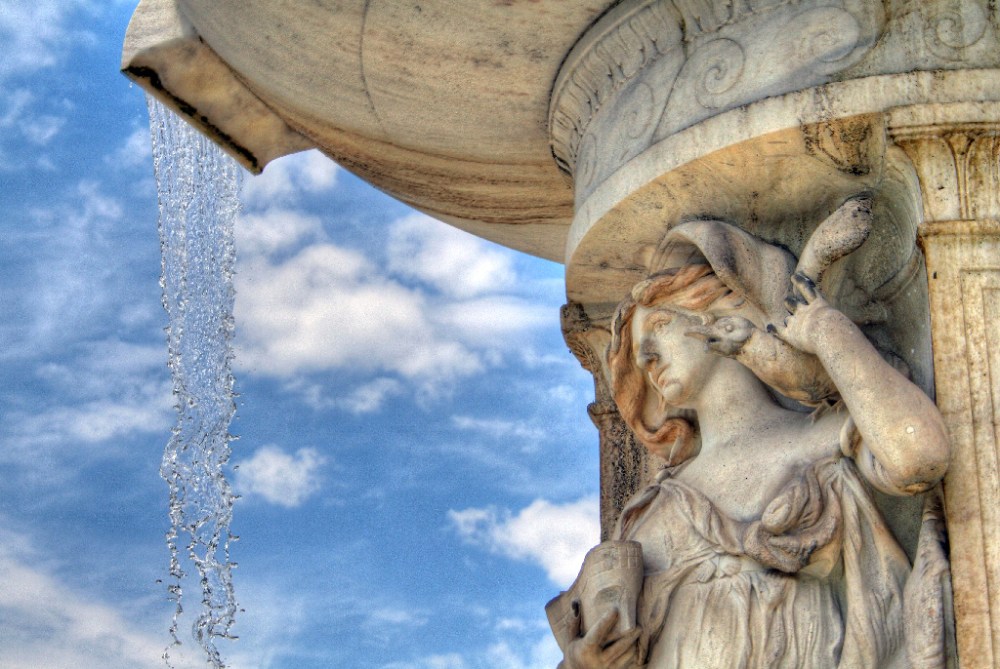
Detail from the fountain at Dupont Circle. It's beautiful when you see it up close.

My initial approach into D.C., was down Connecticut Ave. It included my first traffic circle. But Chevy Chase Circle was nothing like the Circle at DuPont.

At the bullseye of the circle is a huge marble column carved intricately with nymphs. The column is topped by what could definitely be a receiver dish to summon aliens from unknown quadrants of the galaxy. It also functions as a ginormous cistern from which water overflows and splashes into a big round basin below.

But I didn’t see that.

What I saw was a most confusing roundabout. We didn’t have roundabouts where I came from. We had entrance and exit ramps, traffic lights at cross streets and a very odd left turn pattern. Our streets were designed to efficiently move people to and from factories. Not to protect the capital.

Connecticut Avenue off the freeway starts as a typical suburban road and narrows to a tree lined boulevard with traffic lights timed to 30 mph and the signals inexplicably nestled near the trees on the sides of the streets. Where newcomers can’t see them and therefore blow through them.

After driving past old, ivy covered apartment buildings, the zoo and a ridge topping bridge, the road zigs past the Chinese embassy and zags by the Hinckley Hilton to deliver you at the top of the upper DuPont business district. I wrongly avoided the tunnel under the circle and found myself at the “entrance” of the labyrinth. Almost to my doom.

Rolling up to the top of the circle you can see  two rings for cars. The outside ring has access to all ten street openings. Each of these openings have both an entrance and an exit. The inside ring is the express route for Massachusetts Avenue. To round out the picture, there’s also an under the road tesseract wrinkle that allows a clever driver to skip a half dozen blocks at once. But I missed that.

Instead, I merged into the circle and drove all the way around. About four times. It was like a merry-go-round that I couldn’t get off. I wanted to stay on the street I started on, but I couldn’t find it. Not that street. Not that street. Not that street. Wait…was that it? I don’t know. Drive around again. Pass where I came in. Not that street. Not that street. Yikes, did that guy just cut me off? I’m only driving five miles per hour and people are lapping me as they drive off to their destinations. Me? Just making another round.

My window was rolled down, but there was no breeze. My sweaty hands slipped on the steering wheel. I think I knew where to get off this round. No matter what, I was getting off this ride. Made it. Out. As I felt my heartbeat get closer to normal I realized that I had steamed up my glasses with my own humid air.

After that, I did whatever I could to avoid that tangle of streets. I found a good, straight route along Florida Avenue that allowed me to skip the circle. Until that time I walked it.

I had been in DC for two years when I took a job at the DuPont Metro station. It was at the patriotically numbered 1776 building, east of the circle. I normally walked the quarter of the circle to my office until this day. I crossed both rings to traverse the circle itself. It was actually a decent-sized park, with outer and inner walkways, benches, steps, and people playing chess. I walked close to the fountain that was splashing water from the big dish on the top. The wind picked up some of the water as it dropped 15 feet and sprayed it outside the bounds of the sculpture.

I walked around the outside edge and for the first time saw the streets. How they came in and wrapped around and resumed on the other side of the circle. It wasn’t a puzzle at all. From up close it was exact and knowable and smart. It just needed a closer study to reveal itself to me.


Rocking Horse People Eat Marshmallow Pies

This slideshow requires JavaScript.

The British Invasion band called the Beatles first played in the States in Washington, DC. It was in an upside down half pipe called the Washington Coliseum. A half pipe the size of an airplane hangar.

There was some kind of massive snowstorm that forced the lads up to New York via train. My favorite recollection was that of a man who said all he remembered was deafening, high pitched screaming. That and the smell of urine. I guess thousands of the teeny bopper fans pissed themselves in excitement.

To me the “coliseum” is a decrepit old building among many old decaying structures on the other side of the train yard where the Amtrak, Maryland light rail and the subway tracks criss cross and then feed in and out of Union Station.  It was tagged by the prolific Cool “Disco” Dan, as well as by more visually talented graffiti artists.

I had no business on 3rd St, NE so I didn’t see it up close until the our offices moved to the development at NOMA–which is a made up developer’s name to make the industrial area of empty lots, bus terminals, armories, and abandoned warehouses that was the real estate surrounding the tracks north of Union Station into a destination for high-rise offices, apartments, coffee and pet stores and restaurants.

I saw the “coliseum” up close the first time I passed under the bridge, driving along M Street. You could park your car in that rundown cavern for $5. That is an unheard of and remarkable price for DC. I kept driving. The overhead of walking under the bridge from a sketchy lot wasn’t worth $4 to me. Seriously, I paid $9–almost double–to not park there.

Now, that spot, where the Beatles played and the girls peed and the cars parked, is being converted to a very nice outdoors sporting goods joint. And condos, and, I bet, a new fast casual spot that has greens and grains in a bowl with some sauce.

This changes the neighborhood. Not a little. But a lot. And it’s mostly good.

In my neighborhood–two subway stops and a scant three miles away–we’ve had a torrent of new people moving in. I am very happy that people are buying houses and making spaces and creating families. This is what people in my neighborhood have been doing for the past hundred years. Not the same people–since our time on this earth is finite–but people who move in after others have moved out.

So, this moving into houses thing is NOT new. But, somehow, some of the people who move into the houses think it’s new. That, somehow, their being here defines new. And special. Really special.

I would call this attitude gentrification. Know that my neighborhood, that we have lived in ourselves for multiple decades and have been overlapping with other multi-decade residents (some from many decades before our multi-decade gig), was just fine before the newest new people got here.

Don’t get me wrong. We are happy you are here. We welcome you. We welcome you when you move in when you’re still are single. We welcome when you adopt your shelter dog and as you struggle through your training. And we are downright excited when you have babies and are tickled when you stay here when they go to school. And when we watch them go to prom and graduate high school, we know you are one of us.

But know that we have been a close knit middle class ‘hood pretty much forever. Maybe you haven’t lived with native Washingtonians before–I know I didn’t before I had my children–but they did fine before you. You are not the savior of our ghetto neighborhood, because this is not the ghetto and we don’t need saving. We are super happy that the clusters of new apartments and condos and overpriced townhomes have increased the density of our neighborhood so we can support more restaurants and a fancy wine store in addition to the liquor stores that don’t have tastings but have carried decent wine and excellent beer for at least a generation.

And, dearest new people,  if I can give you one piece of advice, as you stroke your long beards and push your running strollers and swing your bikes from your driveway past me into the street, say “Hi!” or at least nod your acknowledgement to the olds and the new’s.

Remember, new people and gentrifiers, we are still a sleepy little Southern town; and those niceties that stitch us together into a community go a long way to ensure that your neighbor digs you out of the snow when you have a new baby and your spouse is out of town, that a neighbor anonymously keeps a watchful eye on your house when you’re away for the weekend, that someone gives the stink-eye to a stranger walking on your porch where your Zulily and Amazon boxes lie, that people who know who your kids are peep on them to make sure they “independently” make it to the schoolyard or playground or scout meeting, that an amazing stranger brings a CVS bag filled with toothbrushes and toothpaste and soap and a comb and tampons when your house burned down. Seriously. This is what we do.

Spend the time knowing the old, and the new. It’s really all good.

Hey, are you new? Oh hai!

Throw Me Something, Mister!

Cleaning up a bunch of beads after a Mardi Gras parade. Please note the public works trucks and personnel.

Say what you will about New Orleans, but our cousins in Louisiana can sure throw a parade. They are known to take over a street for the special occasion of it being a Sunday.

More importantly, not only can they take a street over, they know how to give it back. Amazing is the sight of the very end of the parade–the Krewe of Cleanup. It doesn’t take hours for a street to reopen, but minutes after the last float throws its last beads, cars are released and traffic goes back to it’s typical snarl.

It doesn’t work that way in D.C.

Foot and coach traffic have been diverted in anticipation of upcoming motorcades. A labyrinth of jersey walls, cones, snow fences and police vehicles have corralled pedestrians and vehicles for days and days. Scores of corners are overseen by uniformed police with weapons. Some sit in their cars. Others stand. Reflector-vested and gloved officers are standing in the middle of intersections overriding the red-yellow-green of the temporarily redundant traffic lights. Tanks and humvees line commuting corridors.

For fifty people here for two days.

Since those fifty people are the leaders of 50 different countries–countries like Algeria, Argentina, Australia, Belgium, Brazil, Canada, China, Germany, France, India, Indonesia, Italy, Japan, Kazakhstan, Malaysia, Mongolia, the Netherlands, Nigeria, Austria, Pakistan, Portugal, Romania, Russia, Saudi-Arabia, Singapore, Thailand, Czech Republic, Turkey, United Arab Emirates, United Kingdom, United States of America, Vietnam, South Africa, South Korea, Sweden and Switzerland–that’s a lot of security. That means a lot of motorcycles and a lot of squad cars leading a lot of limos with a lot of little flags from a lot of different countries.

Still, these diplomatic parades are short. They pass by in a matter of seconds. There is no detritus of coins, cups, strands or flasks. There are no hundreds or thousands of revelers to move along. Heck, there are no revelers, just the anticipation of bad guys.

Streets are closed. Traffic is gridlocked. And there isn’t even a chance of getting a long string of beads for those inconvenienced. I hope they do something about those nukes.

What Rhymes With Bucket?

Stonehenge at vernal equinox.

People come out in droves for must see annual events. The running of the Bulls in Paloma. Carnival in Rio. Octoberfest in Munich.

There are lists and lists of things that people want to do before they die. Yes. I said it. This is someone sitting down with pen or keyboard saying that before they die they’d like to accomplish Thing X, Thing Y and Thing Z. That’s what a bucket list is, a marker of mortality.

And, I mean, what happens if you do it all? Do you die right then? Or do you just add more? If you run out of Things, are you unhappy for the rest of your dull days? And if you don’t complete your list, do you die unhappy? Is a bucket list just an organizing tool for planning weekend activities (skydiving-ugh!) or vacations (Machu Picchu-yay!)? Maybe it’s just something for the list-obsessed to do. I couldn’t tell you, since I don’t have a list.

Actually, I do have a list. Things that make it to my list just stall. It’s more like a list of guilt rather than a list of to-dos. But that’s just me.

To get items checked off your bucket list you need to figure out the when–a calendar works here. Then you have to try and figure out the how. How to get there, where to stay, and, I would recommend, a quick primer on local laws and the location of the American Consulate.

Just to be safe.

Anyway, some things on a bucket list are harder to navigate. They are more ephemeral. Like seeing a whale breach. Timing and good luck are everything. Or catching the winter monster waves off Maui’s Pe’hai North Shore. Unless you live there, you could miss them.  The vernal equinox at Stonehenge–you can calculate it, but can you get there? Then there’s seeing the cherry trees in D.C.

Wait. How’d the cherry blossoms make this list?

I am clueless for that one. They are both hard to predict (they were 16 days earlier in 2016 than in 2015) and a mess. They are in peak bloom for a few days, then “poof!” Literally. (Okay, not really literally, but work with me.) Literally the trees look like poofs of barely pink cotton candy floating in a robin eggs’ blue sky.

Anyway, I don’t have a bucket list. I can see the cherry trees every year since I live here. Also, I could walk across the overcrowded boulevard filled with people who are wearing shorts and printed t-shirts in the cold all the while brandishing their selfie sticks and end up getting run over by an open-topped tour bus with a student group from Omaha, Nebraska.

But without a disappointingly incomplete list, I’d go happy.

Cherry blossoms, in my hood, on my way to work, by my house. Boo YA!
I took this pic on my way to work. Near my house. Boo YAH!


March Madness

Like ten tubas sitting all lonely on the grass.

I watched as a tuba walked out of the Starbucks on the side of the hotel. It was accompanied by a guy with a funny light blue and white flat cap. It shot out lasers from the sun reflected on its shiny brass face as the funny-hatted guy twisted it 270 degrees back and 270 degrees forth. Trying to get his bearings.

The tuba was closely followed by some brass cousins–trombones and trumpets–as well as a twin tuba sib. There was a clarinet and a saxophone, too, as the band spilled out the door.

Drum line! Well at least a few percussionists. Hey! The instruments weren’t packed away. These folks were ready to play. I stopped. I’m crazy for the sound of a marching band. I stood listening for the staccato roll of the snare.

There were some cheerleaders with bows in their hair and that careful warpaint with an intertwined N and C that first looked like an N and a D. Even though I know the warpaint is actually little stickers, I imagine that thick oil-based makeup was carefully stroked and patted on with skinny little brushes on smooth, unlined cheeks.

There were also some jumping people. I don’t know what their official names are, but they were wearing blue jumpsuits in that same blue hue, so I bet they jumped. Maybe they are the hype men.

The instruments and their holders amassed on the plaza behind the subway escalator where people sometimes eat their lunch and near the fountain that hasn’t been filled up yet and where some people spend their entire day speaking very loudly to themselves or to someone that I can’t quite see. The instruments and their performers roiled around in that space like foaming bubbles. Moving but not really going anywhere.

The big man was the last of them to come from the coffee shop at the side of the hotel. He had a clipboard for his instrument. He circled around them on outside and, as he was moving, he lifted his right arm over his head and pointed away from the hotel to the other end of the block. The instruments and the people who played them moved as one. Away. Likely toward the Verizon Center.

And there I was. Left alone, wishing for at least SOME cowbell. It wasn’t to be.


Dear Tourists, Let Me Help

weinermobile in front of the Capitol. I took this one.

Tourist season has befallen my fair city. As the hoards fill up our streets, hostels, chain restaurants and The Mall (we don’t shop there, by the way), I thought I’d offer some advice to smooth the stay.

Dear Washington, D.C. Tourists,
Welcome! I am super glad to host you in our fair city. A few things to help us get along better.

  • First, Washington D.C., is actually a real city. We vote for a mayor and a city council. We have schools where children study. People here have jobs and go to church and buy groceries and sit around dinner tables where we eat food just like YOU. Unlike you, though, we don’t have a vote in Congress. So don’t complain about your Congressman. We’d love to have one (and two Senators) to deride. But we don’t. And we’re U.S. citizens, too.
  • Second, D.C., is not Main Street, U.S.A. at Disney World. You can’t just walk into the streets and criss cross like it’s an amusement park. It’s not. There are traffic rules that you should follow.
  • Third, I know you don’t walk as a mode of transportation when you’re at home. You might walk on the treadmill at the gym or around your cul de sac with a neighbor for your New Year’s resolution. But here, we walk to get to work or to shop, and to grab a coffee or a beer.
  • Please please please, don’t start walking when you’re on the corner and you’re talking to your friends and not looking. Cars here are like your cars at home–made of metal and will hurt if they hit you.  We won’t mow you down because we’re mean but because you randomly walked in front of us without looking. Don’t jaywalk unless you learned this skill in Manhattan. Then you own it.
  • Key takeaways: Look for the traffic signals. If the light is RED do not walk. If the light is GREEN, go ahead. There are also signals that are RED with a hand that means, DON’T WALK. Really, nobody wants to run you over. Okay, to be honest, sometimes we do, but we wouldn’t. Not on purpose.
  • Fourth, I love it when you use our subway. We call it the Metro. It stops you from driving the wrong way on our one-way streets. It also stops you from running our red lights because you don’t see the traffic signals on the sides of the roads. We know you look for them hanging in the middle of the street. I don’t know why we don’t do that. But we don’t. Be careful.
  • Fifth, speaking of the Metro, if you’re not sure where you need to go, just ask anyone. People are happy to help you get to your destination. Seriously. They are. The thing we don’t like is your confusion at the turnstiles that blocks us from getting to the train. This is super-especially true during rush hour. An idea, please don’t use the subway during our rush hour. You are really screwing with us natives.
  • Also, this is weird, I know, but when you’re on an escalator in D.C. don’t stand next to your friend. Stand on the right and walk on the left. Leave the left side of the stairs open so people can walk. We are in a hurry because we have to go to work. We’re not on a vacation. We are glad that you are, though.
  • Sixth, this brings me to the costs of stuff in D.C. SHUT UP. You don’t have to pay a penny to go to the zoo and gawk at baby pandas; see the capsule that landed on the moon, the Wright Brothers’ plane and the real space shuttle up close; gape at the Hope Diamond and a stuffed woolly mamouth;  visit the East Room and watch the Secret Service watch you at the White House; and be in awe at pretty much everything–seriously look up, down and all around–at the Library of Congress. Also, there is crazy amazing art and culture–like Monet and ruby slippers and the lunch counter from the Greensboro Woolworths–at the Smithsonian. The Capitol Grounds, near the Supreme Court, have beautiful fountains, a botanical garden and lots of steps. Not to diminish the Lincoln, Jefferson, and Washington memorials, the homage to those who served and sacrificed in wars and the newer monuments recognizing Dr. King and FDR.
  • Back to the costs of things. Please don’t complain about prices for sandwiches or cokes. This is what we pay, too. We just live here. Also, speaking of prices, when you do eat out, please don’t be cheap. People waiting your tables and serving your drinks do this for a living. Tip. Really. You can tip.

My brain is awash with so many more things to help you with, but I know you’re already overwhelmed. Please, though, know this well. This is your city, because you are an American and this is our nation’s capital. And it is our city, because every day we drive and walk and bike past and work in and near the amazing landmarks you came to visit. We feel lucky to live here. You feel lucky to visit here.

We can do this together. We survived the Pope, we can work with you. Have fun!
Doc Think