Touché Opaque Couché

My new tank. In the world's ugliest color. Who knew? Who knew?

My fomo curse combined with my insatiable attraction to the mundane drew me to a story about the world’s ugliest color. Thanks clickbait.

The color has a name. It’s opaque couché.

This lowly cousin of olive drab may be the only color that’s designed to repulse consumers, rather than entice them. After extensive research and focus grouping, the UK government determined it is the ugliest color in the world—and they’re putting it on every cigarette pack. “It’s used to deter you, to make you feel sick.” — From Good.

This color is also known as  Pantone 448C. But the Pantone people are not happy with the repellent categorization. They do not think one color is uglier than another. Colors are just colors.

But, there’s a language around color. Color makes us feel.

White can be pure or sterile. Blue is sometimes serene and sometimes cold. Red equals power or anger. Brown can conjure coffee and chocolate or dirty mud. So it’s also the presentation.

Sounds like colors can be complex. Like the color orange.

Orange is hot. It’s not the new black, mind you, but it is top of mind. Orange and all the words that imply orange have become political fodder. Words that make you think orange like pumpkin. Or a greek god that just took a bath in a pumpkin-spice latte. Or a talking yam. Or Code Orange alert. Or an orangutan. Or a tangerine-tinted trashcan. Or  jack-o’-lantern. Or a tangelo fruit-rolloup sweet potato deli meat buffalo wing. Or a Cheeto.

Makes me glad that I didn’t buy that orange leather jacket last winter. It was very very soft. Very classy. It was a winner, it was so much of winning. It was a good deal, and I only make good deals. It only makes common sense. And it only makes common sense with that buttery feel and a hidden zipper (sliver, classy!).  

But I have so many jackets. I  have jackets all over the place by designers. You know their names. They are terrific by the way. All of them, you won’t believe how great they are. They are phenomenal. Tremendous. But some people. Well, many people, are saying that it’s not good. I’m not saying it. But other people are. So, you decide. Orange jacket. Maybe not.

I did buy a new tank. It was a good deal. Linen. Good price. Terrific craftsmanship. Very classy.  The color some people don’t like so much. It’s that putrid Pantone 448C. Frankly, I didn’t think it was the most repulsive color. Who are these researchers? What do they know. I know good colors. I ask myself. I know better because I have a good brain. I’m very very smart. 

While it’s not a “beautiful” color, it looks like a color from nature. Or like spices. Very exotic. Terifically classy. So I heard someone say, someone who’s not very nice, say people will avoid me when I wear it. That’s just nasty. Maybe I’ll wear it on days I don’t want company. So, maybe it’s not a mistake that I bought it. Of course it’s not a mistake. It’s the greatest. But you knew that.

Blank Space

Evidence of going nowhere with writing. An empty sheet of paper and a pile of crumpled up ones.

Today is a day that does not produce words. Nothing easy came to mind. And the difficult stuff, while abundant, need more time–and much more energy–than I can muster.

So, Loyal Reader, thank you for your visit today. But this is all.

Back in ‘Nam

A pair of rockers on a decaying porch. And a cow pitcher on the table in between.

It’s known that I’m thinking that maybe we ain’t that young any more. I’m reminded of it every day.

I look in the mirror and see that skin is hanging a little looser around my eyes. There are fine, and less than fine, lines cropping up around my mouth and striping my forehead. There’s really no hiding them. And the silver tinsel that is my hair is kept at bay by a colorist I see so often she’s now a friend.

I am having a tough time reconciling these outward signals with my mental self image. I say that I think that I’m still in my 20s. But really I don’t.

I’m a much wiser and much calmer and much more confident and much more accepting version of my twenty-something self. I was going to say more patient, but I’m still working on that.

My neurologist said that I have the brain health of an 18-year-old. That means that my physical brain still fills my skull. It isn’t shrinking. It still has lots of twists and turns, where my thinking is done. I wonder if it was even bigger before, and it actually has shrunk. But that wouldn’t explain the youthful folds and crevices of gray matter. It was the nicest thing anyone said to me. At least one of them.

You see, I’ve had many opportunities for nice–and sometimes not so nice–things to be said to me. It’s just a factor of potential volume of opportunities. Opportunities born of time.

There’s an extensive internship program at my current gig–with the youngins between the ages of just barely able to buy a beer to still covered on their parents’ health plan. [Thanks Obama!]

They have full heads of hair, barely grown in beards, skin that doesn’t sag at their upper arms and their first work wardrobes. They think that I came up with John McCain via their Tropic Thunder view of Coppola’s view of Viet Nam (“Wait,” they said, “That was a remix?”) They are… Millennials.

Now, I know I’m not supposed to like them. Especially in the workforce. They are lazy, entitled narcissists. They are disrespectful of their ancestors. They think things are easy, and don’t get why you don’t fix them, duh?! They get their feelings hurt too quick.

And then, Baby Bear told me that he hates Millennials. “I know, and I’m one of them.”

And I was all like, “Bear, you are wrong!”

See. I was impatient too. I knew much more than my bosses credited me. And they were doing things a dumb way. And, Jaysus!, I could do their job. Seriously. I had the smarts. It’s not that hard.

Every generation starts the same. It’s the trajectory we follow over a life’s course. Over a decade or two, I learned that if it were easy, it’d be done. That the battles are much less important than the war. That we have different preferences and styles, like I like the forest and you like the trees. I found out as Broadway Aaron Burr said to young Broadway Alexander Hamilton, “Talk less, smile more.” And, maybe most importantly, life is not fair. The best ideas, the clearest tones, the rightest right, the most honest truths do not win out. Not all the time. Sometimes the bad guys win. I really hate that. But it’s true.

The Bear and I went around and around and when we were done we landed on one big difference between when old people were young and his cohort. It’s the butthurt feelings.

Oh, Millennials! I recommend that you work to gather as big a perspective as you can. And use that vista to inform your view. Make it bigger than you.

My other millennial spawn, The Big Guy, took me to school and flipped my script. Turns out, I’m not the center of the universe. What? Who knew?

When people make decisions that aren’t about me, they are not thinking about me. Seriously. They are making a call for themselves. I might end up as collateral damage–and that may need to be addressed–but their focus wasn’t on causing me butthurt.

Someone else says it best.

Never attribute to malice that which is adequately explained by carelessness.* –Hanlon’s Razor

People are not required to take your feelings or perspective into account. It’s nice and all, but not a requirement. Anyway, it’s a gift to have your perspective challenged. It makes a person think. Thinking is good. That’s something that my young brain/old self can wrap around.

Thanks, Youths, for reminding me that we’re alike, just at different times. Hope you’re not disappointed when you get to my place. Let me know. I’m not as old as you think. If you do the math, I’ll still be alive.


*Other people prefer “Never attribute to malice that which can be adequately explained by stupidity,” but I find it’s more likely omission vs. stupidity.

Something Fishy

Sign for Grand Jury Room.

Twenty-one of twenty-three grand jurors were present. The jury room had two rows of chairs stacked theatre-style in a windowless room. The “stage” was below. There was a chair for a witness and a desk and chair for the court stenographer in the bottom of the bowl. Two juror chairs were empty. Someone was late and someone had a dental appointment.

The novelty and the importance–the grand part–of serving on the grand jury had long since passed for most of the jurors. They’d grown tired of the legion jump outs by police who would testify that they found a small plastic bag filled with a green herb-like substance that later tested positive for weed. Actually they always said marijuana.

They were weary of the multitudes of weapons charges. Each case included charges for carrying the gun (pistol in law enforcement vernacular) without a license and possesion of unlicensed ammunition, too. The jury knew the charge by it’s acronym, CPWL. The charge was read then repeated by the officer on the stand and then read again. If there were two weapons, the second weapon charge was read, repeated and read again, too. And, of course, the ammo charge. It was curious, and then annoying, that the same person was charged for unlicensed ammo on a per gun basis.

This particular jury, Panel 3, spent many hours having testimony “read into” them. This entailed a lawyer reading transcripts from interrogations in front of a prior jury that did not sit long enough to indict. These cases were murders and more complex investigations. Panel 3 did not end up voting on most of them, either. Toward the end of the Panel’s internment, the Assistant US Attorneys–that’s what they call the prosecuting attorneys in D.C.–would use them to get testimony on the record. And this evidence would become a new transcript that would be read to a future jury. Seems like the jury never got the entire story. Just a cog in the wheels of justice.

The Assistant U.S. Attorneys initially intimidated the jury. Ten days into their service, however, Panel 3 realized their powers. They were no longer cowed by the process. They learned that as soon as the foreman closed the door, nobody from the outside could open it. They were a secret citizens panel, and they might be talking jury stuff. Or they might just need to take a break from the never-ending repetition of drug and gun cases. Yes, once again, there was enough evidence to indict. It’s a low bar. Yes, already. And again.

Or they kept the court officials out because they needed a respite from that extra arrogant attorney that pretty much everyone wanted to punch in the neck. He was lucky they closed the door. They might have been lucky, too, since there were many people who worked for the court, who protected the staff and who carried pistols with permission and legal ammo. The court guards might not defend that extra arrogant attorney, though. He was just that vilely arrogant.

On this day a man was called in by the bailiff. The man was very tall and skinny. He was likely in his early sixties and wore a straw hat with a bright sash above the brim. This was only two days after jury duty had been canceled because of a foot of snow. It must have been his good hat.

The man was extremely agitated. He definitely objected to being there. He looked at the people in the juror chairs and he was angry. He was angry before he sat down, and he was angry as he was sworn in.

He abruptly pulled his arm away from an imaginary hand on his elbow. He glared at the officer of the court who restrained him with a raised brow. He reluctantly agreed that he would tell the truth and said he understood that he was under oath and the penalties for being untruthful.

“I don’t even know why“–he hissed the why–“you all bring me all in here,” came from beneath his chin. He wanted to say it much louder but his better angels were in control.

The jurors knew that this wasn’t about him. A Grand Jury rarely hears from the accused. They knew that he was a witness. He was to give his sworn testimony for the record. This man was a piece in someone else’s puzzle. A puzzle he wanted no part of.

He crossed his long legs and his alligator pressed shoe bounced up and down. He was wearing a tropical shirt, too.

The lawyer asked him about a certain day and what he was doing. He explained that he was just a common guy, trying to make a few bucks. But that wasn’t the question.

It turned out that the man was providing rides for hire in his neighborhood. This was fifteen years before Uber.

He had a big boat of a white Cadillac that he used to squire people on their errands. On the day in question, he was taking a customer to go and get some scrimps.

“Some what?” said the lawyer.

“Some SCRIMPS!” the man shout-snarled. “And why you come and have to bother me about it? I’m just going to get me some scrimps down at the waterfront and someone going with me.”

The case was about the someone with him. And the police arrested him for driving an illegal cab so that he’d talk. But he was just mad.

“I don’t care that you come and get me. Why don’t you just leave it between you and me?” he complained.

“Was that your car?”

“No. You know it won’t my car. I done gave you the registration. But why you gotta go and tell her? Now she won’t let me drive no more.”

“Who’s car were you driving?”

“It’s my wife’s car. But you didn’t need tell her. Now I got her on me and she hid her key. And I’m just going to get some scrimps. It ain’t necessary for her to be called. We coulda just talked about this like some men.”

He really didn’t know much of anything about his partner in scrimps. But he was outraged at the setup and the domestic discord all drummed up, “over nothin.”

He unfolded his long legs, readjusted his straw fedora and walked out. The attorney and bailiff followed him. The foreman almost ran to the door to close it. And Panel 3–made up of an almost perfect D.C. cross section of race, education, income and age–broke into belly laughs, and guffaws, and giggles, and snickers, and shouts, and questions about winter fashion, and yearnings to meet his wife, and chants of scrimps.

All immediately agreed that they would order scrimps for lunch on Friday. It was a unanimous vote. This Panel was a team.
 

Sizing Up

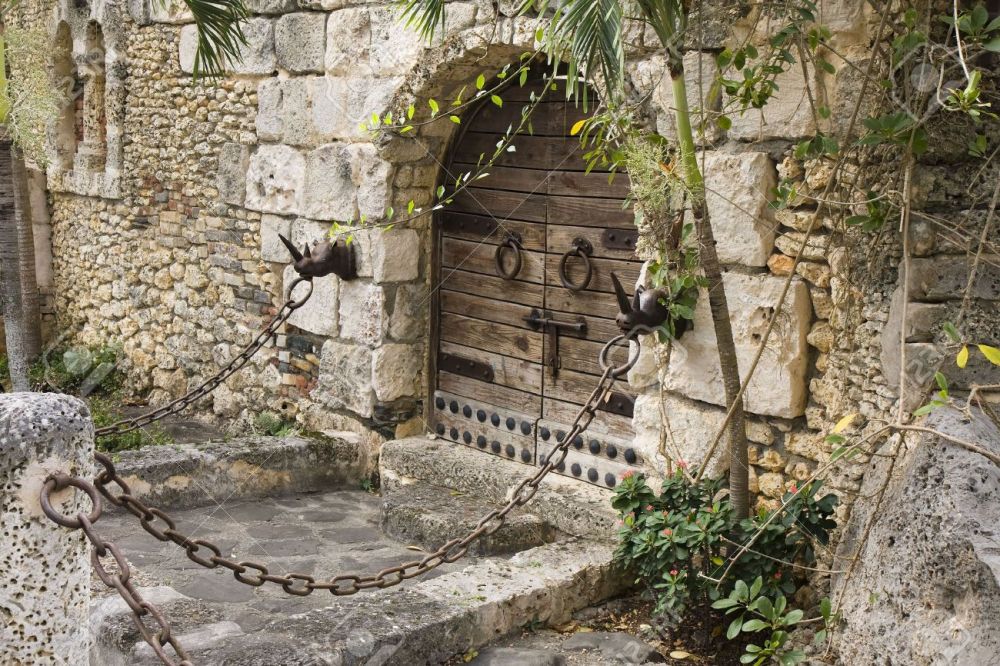
Castle gate and wall. Imposing, no?

When I was a wee Doc we lived in The Old House. The house wasn’t especially old, but we called it The Old House to differentiate it from The New House. We moved to the new house just before My Older Sibling started kindergarten.

The New House was fully and completely new. It stood on what had been a part of a good-sized dairy farm that was subdivided into new blocks of varying sizes with twisty roads, half circles and a few cul-de-sacs. There were two very tall and very impressive trees. They were like Ents. The rest of the greenery was new sod and very young, very slow growing trees. When I left for college they barely provided shade.

The Old House, on the other hand, was surrounded by big old trees in the front and in the back. Indeed, the entire street was protected by limbs stretching and trying to touch their brethren across the street. Dappled gold and bursts of saffron would sneak through the small breaks in the big green canopy like specks of amber in hazel eyes. Closing my own, I can still see it, and feel it.

There were two very frightening things on the street with The Old House. First, the bees.

We were terrified of the bees. Someone told us that if they saw you move, they’d come after you and sting you. They were huge bees, the size of golf balls. No. Tennis balls. They would buzz back and forth among the flowers of the old lady down the street. We called her grandma. Her flowers were lovely, except for the bees that hung in front of the flowers. They looked like they were on wires that someone would occasionally move–either a small jerky up and down motion or a smoother left to right. We would spy them and very carefully, silently and slowly, holding our breaths, walk past grandma’s house.

Aa soon as we passed her property line we’d explode like a pinball out of the chute to our friend’s porch to play. I remember a bunch of cement steps to her porch. It was dark and cool, likely from one of those ancient elms. I don’t remember what we played, though. I think we launched ourselves off the steps.

The other terror was another neighbor’s dog. It would bark in a vicious manner. It was very loud. It’d throw itself against the fence to try and break through while full of snarl and howl to intimidate us as we walked by. And that monstrous dog was on the other side of the street. He really didn’t have to go to all that trouble. We weren’t allowed to cross the street.

One day I was walking back home by myself and the dog was banging against the fence. I was spying for bees and looking back over my shoulder across the street to see him break through. There was no worry and creeping past the bees. I took off as fast as I could to my house. The dog was gaining on me as I ran up the driveway through our open gate. I used all my strength to push the chain link gate closed, and it latched just as Cujo bashed into it. I lay on the ground for a second, catching my breath and watching the insane tirade of the evil dog. Worried he’d force himself through my barrier, I ran around the side of the house to the door and pushed my way to safety.

I was four when we moved. I don’t remember going back to The Old House for a long time.

The next time I saw the house, I was with my Dad. He was visiting our old neighbor, who was his best friend. It was maybe ten years later. I walked up our old driveway to the astonishing fence that saved me from that demon dog. Really, the fence wasn’t as astonishing as I was astonished. The gate that I remember breathlessly dragging to save myself from that ferocious canine wasn’t much more than two-feet tall. It would barely keep out a Jack Russell Terrier. So the dog that was chasing me was not a mastiff. Makes sense. Everything was bigger when I was smaller. I had a good chuckle.

I remembered this fence today. It came to me as I was thinking about fear. What are we afraid of? Do we let the objects of our fears grow huge before us? Or do we take a closer look and see them for what they are? Do we keep the images we had when we were most afraid, or do we gain perspective over time? Can we apply new knowledge to dissect and examine our experience and use that understanding to grow? Or do we stay stuck in that moment of terror, never to lift our heads again?

Eff Your Guns (where Eff is the f-word)

We can do BETTER [sign, I almost typed "sigh"]

I can’t do this. I was writing a post about people leaving, but I just couldn’t.

I couldn’t write another sentence about missing someone who is physically away, because it is selfish since he’s still alive.

I couldn’t think about the loss in my heart as my child grows up, because he has the chance to continue his journey.

Others have none of that. Parents will not see their children again. Friends will not see their friends again. Brothers and sisters will not see their sibs again. In Orlando. In San Bernardino. In Sandy Hook. In Aurora. In too many places.

My feelings of loss are still real, and I’ll finish that post another day–maybe even tomorrow, but today I am stuck on one thing.

I don’t care about your fucking guns. I DON’T CARE ABOUT YOUR FUCKING GUNS.

I am not safer because you have guns. My children are not safer because you have guns. Nobody that I love is safer because you have guns. My neighborhood is not safer because you have guns. And my city, which is the capital of our country, is obviously not safer for your gun fetish.

I’m at a breaking point.

I’m broken.

I don’t personally give a rat’s ass about guns. But I respect my friends, colleagues, some cool hunters and whoever get a kick out of guns. I give such little rat’s ass that I don’t care that people have them for their reasons. Like they hunt. Or collect. Or are sportsman. Or whatevs.

But today, I have to tell you, with all due respect, fuck your guns. Really. I’ve had it.

I DON’T GIVE A FUCK ABOUT YOUR GUNS.

Let me say it again.

WITH ALL DUE RESPECT, FUCK YOUR GUNS.

Really. Don’t tell me how powerful they make us. Because there is no data that convinces me–and I really really loves me some data. Because those constitutional arguments as validated by a Supreme Court intellectual black hole make absolutely no sense vis-à-vis any discussion of any other bill o’ rights issues. And I gotta say, I really really really loves me some U S of A constitutions. Like sickly in love.

Until we can include guns, and any rational role they have in a modern society, in our discussion of solutions to issues of religious extremism, homophobia, hate and intolerance that are expressed in mass murder, I am totally through. There is not a single silver bullet–pardon the gun reference–to stop terrorism and hate crimes. If we don’t put everything on the table, we just keep talking in circles. Like we have. Dizzy. And 50 more dead.

I am very sorry, Loyal Reader, to rant in an incoherent fashion. But this was all I could write today.

And I am sorry. So, so, sorry.  Yes. I am sorry.

Except for saying, fuck your guns. They are not more important than people.


Shook Me All Night Long

Captain Jack Sparrow, offering, or at least toasting you, rum.

He was fit. In that way that the word is used to describe someone who is teetering on the top, but not yet quite over, the hill. Let’s call him Steve.

Steve was a common name in his elementary school. There were two other “Steves” in his fifth grade classroom and seven in all of the fifth grade. They would be called by their first name, Steve, and the initial from their last name. It would be Steve P., or Steve J. It would not be Stevie because you lost the diminutive form of your name before kindergarten–except with your aunts. It would not be Steven because people were never called by their full given name when he was in fifth grade, or even eleventh grade for that matter.

He was born at the very beginning of Gen-X, but was constantly confused with the Baby Boomers. His musical history was Stones, Zep, Rush, the Eagles and Journey to newer music like Bon Jovi and Genesis. Maybe some Men in Work and The Summer of ’69. For hipness there might have been some Elvis Costello and The Clash. Maybe not, though.

He missed out on grunge. He preferred reciting Jenny’s phone number over and over rather than the rhythmic dirge of, All in all is all we are. All in all is all we are. All in all is all we are. Some of his friends just saw their dads on weekends. He came into an uncertain job market after college but did pretty well. He married the friend of his best friend’s sister. They don’t see their old best friends anymore, except on Facebook, to mark their own children’s proms and, most recently, graduations.

It was hot at today’s graduation party but the kegs of beer were on ice and tented with a tarp to protect the brew as well as the brew drinkers. He had a rocks glass in his left hand and a fifth of an artisan whiskey held by it’s neck and trailing down his leg in his right. He was holding it there like Kanye held that bottle of Hennessy the night he interrupted Taylor Swift with “imma let you finish.”

Steve purportedly brought the fine southern bourbon as a gift for the host. The bottle, however, never left his right hand. Sometimes he’d swap his rocks glass out for a clear plastic cup filled with beer. Sometimes he would offer someone else some of the amber booze. Only to men, though. And with a story about the rarity or the exquisiteness or the origin of this particular distillery, punctuated with the adjective “smooth” or the feature “no-burn.” Sometimes the tale included all of this.

He wore the bottle swinging against his thigh like it was a medal or an honor sash. It was almost like a marker of his own substance or significance. As the bottle emptied, his swagger was incrementally augmented. He stopped offering to share his bottle and stopped pouring it into a different container before he drank it. He was pacing himself, though.

The bright sun was replaced by multi-colored party lights hung from the tent poles, tiki torches–which gave everyone a quick rush when they were lit and burned off that petroleum smell–and the light from the French doors leading back into the house.

He drifted away, just on the other side of the tents where his peers were tipping back beers and refilling wines and sharing pictures on their phones from their recent trips to Italy and Ireland and Croatia. The music was loud and carried around from the back of the house past the rows of trees to the neighbors’ acre lot. They were invited and this level of noise was so unusual and it was two hours before midnight so there wasn’t a fear of a complaint. He was down to an inch and a half of liquor at the bottom of his bottle.

It wasn’t clear which woman in the floral sundress was his wife or which clean-shaven young man in a tropical shirt was his son. Nobody was checking in with him. When the tinder was torched for the bonfire, he moved into the circle with the group of people who were now all old enough to bring their own beer to the party at someone’s parents’ house. He sat down on the almost unstable white plastic folding chair. He put the bottle on the ground between his legs and soaked in youth.

He heard the air release from a beer can and called for one. There was a cringe from within a tropical shirt. There’s his kid. The youth next to the boxes of Miller Lite made eye contact with the oldster before he tossed him a can. Underhand rather than the rocket he just hurled to his buddy on the other side of the circle. You don’t want to bean somebody’s dad. Because no matter where the guy sat in the circle, he was somebody’s dad.

Steve pulled the last of the bourbon and opened his beer. Some in the circle around the fire were laughing uproariously. Steve was earnestly tightroping between hanging with the “kids” and dispensing fatherly advice. He was a father. He really couldn’t help it. But he was more than a little drunk, too, so he didn’t realize that he didn’t really belong in this circle. The youths welcomed him, but this wasn’t his tribe.

And then, the band started with the chords from an AC/DC tune. No, Steve. Not the air guitar. Yes. The air guitar.

Steve’s son’s girlfriend turned to him and whispered, “at least he’s not trying to twerk like Liam’s mom.” It was a small consolation, but the young man was consoled. By that and by the next rocket launch of a Miller Lite.

Round and Round and Round

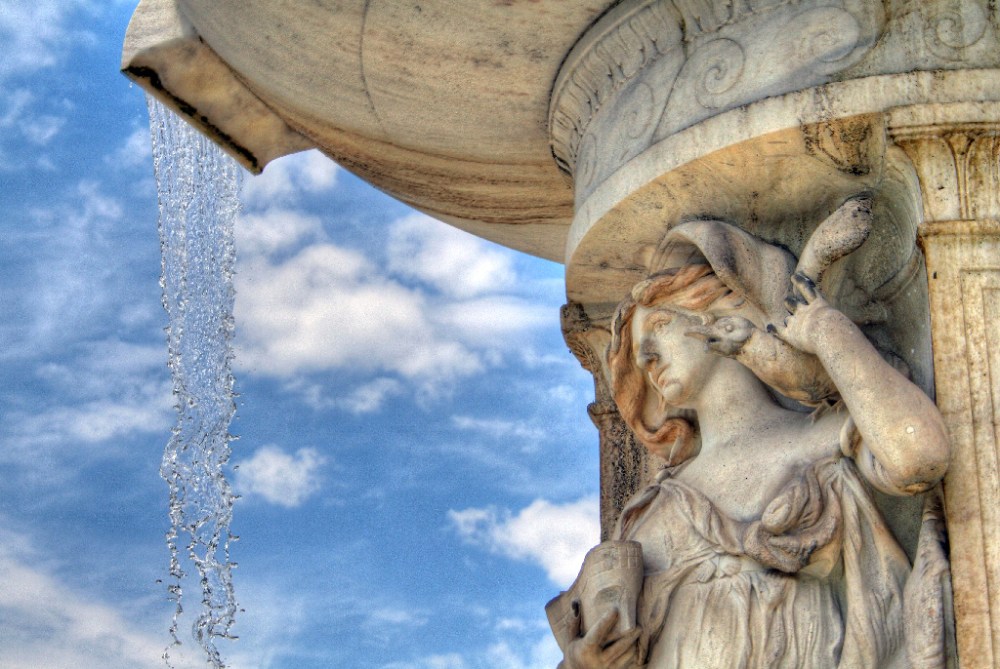
Detail from the fountain at Dupont Circle. It's beautiful when you see it up close.

My initial approach into D.C., was down Connecticut Ave. It included my first traffic circle. But Chevy Chase Circle was nothing like the Circle at DuPont.

At the bullseye of the circle is a huge marble column carved intricately with nymphs. The column is topped by what could definitely be a receiver dish to summon aliens from unknown quadrants of the galaxy. It also functions as a ginormous cistern from which water overflows and splashes into a big round basin below.

But I didn’t see that.

What I saw was a most confusing roundabout. We didn’t have roundabouts where I came from. We had entrance and exit ramps, traffic lights at cross streets and a very odd left turn pattern. Our streets were designed to efficiently move people to and from factories. Not to protect the capital.

Connecticut Avenue off the freeway starts as a typical suburban road and narrows to a tree lined boulevard with traffic lights timed to 30 mph and the signals inexplicably nestled near the trees on the sides of the streets. Where newcomers can’t see them and therefore blow through them.

After driving past old, ivy covered apartment buildings, the zoo and a ridge topping bridge, the road zigs past the Chinese embassy and zags by the Hinckley Hilton to deliver you at the top of the upper DuPont business district. I wrongly avoided the tunnel under the circle and found myself at the “entrance” of the labyrinth. Almost to my doom.

Rolling up to the top of the circle you can see  two rings for cars. The outside ring has access to all ten street openings. Each of these openings have both an entrance and an exit. The inside ring is the express route for Massachusetts Avenue. To round out the picture, there’s also an under the road tesseract wrinkle that allows a clever driver to skip a half dozen blocks at once. But I missed that.

Instead, I merged into the circle and drove all the way around. About four times. It was like a merry-go-round that I couldn’t get off. I wanted to stay on the street I started on, but I couldn’t find it. Not that street. Not that street. Not that street. Wait…was that it? I don’t know. Drive around again. Pass where I came in. Not that street. Not that street. Yikes, did that guy just cut me off? I’m only driving five miles per hour and people are lapping me as they drive off to their destinations. Me? Just making another round.

My window was rolled down, but there was no breeze. My sweaty hands slipped on the steering wheel. I think I knew where to get off this round. No matter what, I was getting off this ride. Made it. Out. As I felt my heartbeat get closer to normal I realized that I had steamed up my glasses with my own humid air.

After that, I did whatever I could to avoid that tangle of streets. I found a good, straight route along Florida Avenue that allowed me to skip the circle. Until that time I walked it.

I had been in DC for two years when I took a job at the DuPont Metro station. It was at the patriotically numbered 1776 building, east of the circle. I normally walked the quarter of the circle to my office until this day. I crossed both rings to traverse the circle itself. It was actually a decent-sized park, with outer and inner walkways, benches, steps, and people playing chess. I walked close to the fountain that was splashing water from the big dish on the top. The wind picked up some of the water as it dropped 15 feet and sprayed it outside the bounds of the sculpture.

I walked around the outside edge and for the first time saw the streets. How they came in and wrapped around and resumed on the other side of the circle. It wasn’t a puzzle at all. From up close it was exact and knowable and smart. It just needed a closer study to reveal itself to me.


Passing Through 

I’m not sure if the arch is an entrance or an exit.

The air is too dry to be DC. The sky is brilliant with the late late daylight. It’s mid June. We’re having our longest days. And today is crisp, too. 

The first batch of happy hour revelers are leaving. The people deciding on that third drink are mixing into the people coming back in for dinner, drinks, theatre or all three.

Does the arch welcome my weekend or do I walk through it to close my week? I think there’s a material difference between these options.

But the difference, while with meaning, is irrelevant.

Rocking Horse People Eat Marshmallow Pies

This slideshow requires JavaScript.

The British Invasion band called the Beatles first played in the States in Washington, DC. It was in an upside down half pipe called the Washington Coliseum. A half pipe the size of an airplane hangar.

There was some kind of massive snowstorm that forced the lads up to New York via train. My favorite recollection was that of a man who said all he remembered was deafening, high pitched screaming. That and the smell of urine. I guess thousands of the teeny bopper fans pissed themselves in excitement.

To me the “coliseum” is a decrepit old building among many old decaying structures on the other side of the train yard where the Amtrak, Maryland light rail and the subway tracks criss cross and then feed in and out of Union Station.  It was tagged by the prolific Cool “Disco” Dan, as well as by more visually talented graffiti artists.

I had no business on 3rd St, NE so I didn’t see it up close until the our offices moved to the development at NOMA–which is a made up developer’s name to make the industrial area of empty lots, bus terminals, armories, and abandoned warehouses that was the real estate surrounding the tracks north of Union Station into a destination for high-rise offices, apartments, coffee and pet stores and restaurants.

I saw the “coliseum” up close the first time I passed under the bridge, driving along M Street. You could park your car in that rundown cavern for $5. That is an unheard of and remarkable price for DC. I kept driving. The overhead of walking under the bridge from a sketchy lot wasn’t worth $4 to me. Seriously, I paid $9–almost double–to not park there.

Now, that spot, where the Beatles played and the girls peed and the cars parked, is being converted to a very nice outdoors sporting goods joint. And condos, and, I bet, a new fast casual spot that has greens and grains in a bowl with some sauce.

This changes the neighborhood. Not a little. But a lot. And it’s mostly good.

In my neighborhood–two subway stops and a scant three miles away–we’ve had a torrent of new people moving in. I am very happy that people are buying houses and making spaces and creating families. This is what people in my neighborhood have been doing for the past hundred years. Not the same people–since our time on this earth is finite–but people who move in after others have moved out.

So, this moving into houses thing is NOT new. But, somehow, some of the people who move into the houses think it’s new. That, somehow, their being here defines new. And special. Really special.

I would call this attitude gentrification. Know that my neighborhood, that we have lived in ourselves for multiple decades and have been overlapping with other multi-decade residents (some from many decades before our multi-decade gig), was just fine before the newest new people got here.

Don’t get me wrong. We are happy you are here. We welcome you. We welcome you when you move in when you’re still are single. We welcome when you adopt your shelter dog and as you struggle through your training. And we are downright excited when you have babies and are tickled when you stay here when they go to school. And when we watch them go to prom and graduate high school, we know you are one of us.

But know that we have been a close knit middle class ‘hood pretty much forever. Maybe you haven’t lived with native Washingtonians before–I know I didn’t before I had my children–but they did fine before you. You are not the savior of our ghetto neighborhood, because this is not the ghetto and we don’t need saving. We are super happy that the clusters of new apartments and condos and overpriced townhomes have increased the density of our neighborhood so we can support more restaurants and a fancy wine store in addition to the liquor stores that don’t have tastings but have carried decent wine and excellent beer for at least a generation.

And, dearest new people,  if I can give you one piece of advice, as you stroke your long beards and push your running strollers and swing your bikes from your driveway past me into the street, say “Hi!” or at least nod your acknowledgement to the olds and the new’s.

Remember, new people and gentrifiers, we are still a sleepy little Southern town; and those niceties that stitch us together into a community go a long way to ensure that your neighbor digs you out of the snow when you have a new baby and your spouse is out of town, that a neighbor anonymously keeps a watchful eye on your house when you’re away for the weekend, that someone gives the stink-eye to a stranger walking on your porch where your Zulily and Amazon boxes lie, that people who know who your kids are peep on them to make sure they “independently” make it to the schoolyard or playground or scout meeting, that an amazing stranger brings a CVS bag filled with toothbrushes and toothpaste and soap and a comb and tampons when your house burned down. Seriously. This is what we do.

Spend the time knowing the old, and the new. It’s really all good.

Hey, are you new? Oh hai!