Wisdom Doesn’t Help

Help us Athena, you're our only hope. More details The Athena Giustiniani, a Roman copy of a Greek statue of Pallas Athena (Vatican Museums)

You can have the milk that has just soured or the milk that’s curdled.

You can choose between the phone with the broken screen and a slow network or the new phone with a data plan you can’t afford.

You can walk in the torrential rain without an umbrella or wait under shelter and abandon your child at daycare.

You can live in a community that disallows any deviation from a very narrow set of norms or you can live where it is unsafe.

You can select either the partner who ignores you or the partner who beats you.

You can opt for an uncertain future in a zombie apocalypse or the certain and immediate death of an asteroid hitting the earth.

Being poisoned or shot in the head?

You can choose someone who thinks that the ends–like protecting the least among us–justifies the means–lying and hiding and evading–or you can chose a bullying, racist demagogue.

What good is the wisdom of Solomon? There isn’t a good choice. But someone is going to win.

Back in ‘Nam

A pair of rockers on a decaying porch. And a cow pitcher on the table in between.

It’s known that I’m thinking that maybe we ain’t that young any more. I’m reminded of it every day.

I look in the mirror and see that skin is hanging a little looser around my eyes. There are fine, and less than fine, lines cropping up around my mouth and striping my forehead. There’s really no hiding them. And the silver tinsel that is my hair is kept at bay by a colorist I see so often she’s now a friend.

I am having a tough time reconciling these outward signals with my mental self image. I say that I think that I’m still in my 20s. But really I don’t.

I’m a much wiser and much calmer and much more confident and much more accepting version of my twenty-something self. I was going to say more patient, but I’m still working on that.

My neurologist said that I have the brain health of an 18-year-old. That means that my physical brain still fills my skull. It isn’t shrinking. It still has lots of twists and turns, where my thinking is done. I wonder if it was even bigger before, and it actually has shrunk. But that wouldn’t explain the youthful folds and crevices of gray matter. It was the nicest thing anyone said to me. At least one of them.

You see, I’ve had many opportunities for nice–and sometimes not so nice–things to be said to me. It’s just a factor of potential volume of opportunities. Opportunities born of time.

There’s an extensive internship program at my current gig–with the youngins between the ages of just barely able to buy a beer to still covered on their parents’ health plan. [Thanks Obama!]

They have full heads of hair, barely grown in beards, skin that doesn’t sag at their upper arms and their first work wardrobes. They think that I came up with John McCain via their Tropic Thunder view of Coppola’s view of Viet Nam (“Wait,” they said, “That was a remix?”) They are… Millennials.

Now, I know I’m not supposed to like them. Especially in the workforce. They are lazy, entitled narcissists. They are disrespectful of their ancestors. They think things are easy, and don’t get why you don’t fix them, duh?! They get their feelings hurt too quick.

And then, Baby Bear told me that he hates Millennials. “I know, and I’m one of them.”

And I was all like, “Bear, you are wrong!”

See. I was impatient too. I knew much more than my bosses credited me. And they were doing things a dumb way. And, Jaysus!, I could do their job. Seriously. I had the smarts. It’s not that hard.

Every generation starts the same. It’s the trajectory we follow over a life’s course. Over a decade or two, I learned that if it were easy, it’d be done. That the battles are much less important than the war. That we have different preferences and styles, like I like the forest and you like the trees. I found out as Broadway Aaron Burr said to young Broadway Alexander Hamilton, “Talk less, smile more.” And, maybe most importantly, life is not fair. The best ideas, the clearest tones, the rightest right, the most honest truths do not win out. Not all the time. Sometimes the bad guys win. I really hate that. But it’s true.

The Bear and I went around and around and when we were done we landed on one big difference between when old people were young and his cohort. It’s the butthurt feelings.

Oh, Millennials! I recommend that you work to gather as big a perspective as you can. And use that vista to inform your view. Make it bigger than you.

My other millennial spawn, The Big Guy, took me to school and flipped my script. Turns out, I’m not the center of the universe. What? Who knew?

When people make decisions that aren’t about me, they are not thinking about me. Seriously. They are making a call for themselves. I might end up as collateral damage–and that may need to be addressed–but their focus wasn’t on causing me butthurt.

Someone else says it best.

Never attribute to malice that which is adequately explained by carelessness.* –Hanlon’s Razor

People are not required to take your feelings or perspective into account. It’s nice and all, but not a requirement. Anyway, it’s a gift to have your perspective challenged. It makes a person think. Thinking is good. That’s something that my young brain/old self can wrap around.

Thanks, Youths, for reminding me that we’re alike, just at different times. Hope you’re not disappointed when you get to my place. Let me know. I’m not as old as you think. If you do the math, I’ll still be alive.


*Other people prefer “Never attribute to malice that which can be adequately explained by stupidity,” but I find it’s more likely omission vs. stupidity.

WWDD?

Here's a patriotic elephant, looking all U.S.A. And his friend, the patriotic donkey, also 'merica'd out.

My dad was a New Deal democrat. He had a spate as shop steward at his factory before me and my sibs were conscious. He filed a grievance after he was fired for taking the day–not the whole day–to bring my mom home from the hospital. She was in the hospital to have a baby. Me. He won. For the other guys, too.

I remember him saying that the union should negotiate for a new dental benefit–of which I begot my straight teeth–rather than incrementally higher wages. He thought he was paid well-enough and that the real value of organized labor was ensuring that his family had access to the tools of good health. He was also for the vision plan.

He worked at the forge plant. In Hamtramck. His toughest days were those days when he had to put out fires. Literally. He’d come home smelling of burning factory with a bit of ash on his cheek as he made his way to the shower. On days his relief didn’t show up, he had to stay at his post. He’d work a double. He couldn’t leave.

He’d get two days off in a row. Each week they would slide one day over so once in a while he’d have a “weekend” off. Weekends weren’t a big part of our family life since the school weekend rarely coincided with his work weekend.

Every fifth or sixth week–I don’t exactly remember but I had it down pat when I was negotiating hard to schedule a trip to Cedar Point–he’d have three consecutive days off. He worked every Christmas Day that I can remember, except one. The calendar dice didn’t roll that way. He did get double time for our troubles. Oh, and he was the only man at ballet class. Again, literally. The only. He took me every week. Sometimes twice a week.

My dad lied to get into the Navy. He said he was older. He was as much looking to sow oats, of the wild variety thank you very much, as he was to serve. He did both. With distinction. His tats displayed ports in Panama, Honolulu, Manila, Cairo and Cyprus. I never asked him if he sailed through the Suez Canal. I’m thinking about that scene when Lawrence of Arabia looks up from his dusty desert journey to see a ship floating out of the sand. I bet Dad rolled through those sandy straits on a U.S.N. boat. I betcha.

He didn’t talk about his service. I know he did a small stint on a sub, which he hated, and once, offhandedly, he said something that made me know that he knew what embalming fluid smelled like.

After the Big War and a stint stateside after he married and after his discharge, he joined the union.

My dad was also a Reagan Democrat. He had no love for a naval officer nor for a peanut farmer. He was frustrated by an awful economy. The auto companies were on life support. There was a steady exodus to the south for jobs. Jobs with less pay, no benefits and no security. He felt betrayed by his union, was adrift from their agenda. He was offered  a buyout deal to get rid of the guys with seniority. To replace them with lower-waged grunts without the same protections.

He took his decent pension. He took his terrific health benefits. He asked me to look at the agreement because he thought my mid-college educated opinion had value. Any value from that request accrued to me. I didn’t add anything to his thinking, since I agreed with him, but he catapulted me into a new part of my life that was grown and independent and validated. Because my Dad believed in me enough to ask my opinion on something important to his life. Jeez.

But, I digress.

Reagan spoke of resolve, of strength and of the promise that is America. My dad didn’t care about taxes. He did care about the U.S.S.R. He was susceptible to the racist dog whistles of busing and welfare queens with big TVs. He cared most about our future. He saw the solutions for that future through the lens of the past.

I railed against his wrong choice of candidate and party with the fervor of a young idealist at the beginning of life’s trail. He respected my disagreement, and we were never disagreeable.

He voted as Dad (R-MI) for Reagan and Bush 41. Then things got a little murky. I don’t know for sure when he started voting D again, but I know that he voted for John Kerry over George W. Bush. He was cagey about his vote for Al Gore, but based on his disgust over the hanging chads and the results, we think he pulled the D lever. And I know without any doubt at all that he thought that George W. Bush was an idiot. I have no doubt because he told me. More than once. Frequently using colorful language that would crack me up.

I would call home and he’d pick up the phone. We’d exchange a few pleasantries and then he would go full tilt into current events. Not conspiracy crap. Not anybody’s party line. Nope. He would read the newspaper (I don’t know how given he was mostly blind) and listen to the radio and watch multiple newscasts, including the Sunday morning public affairs shows. So he was always well informed. And he had a definite point of view.

I loved how he’d get riled up, and we’d get a good exchange going. Then, in the background, I’d hear my mother shouting, “SPOUSE! SPOUSE! What are you talking about? NOBODY cares about what you think.”

She was wrong. I cared very much. He kept me plugged in to where I was from and provided an analysis that I could agree or disagree with, but was an articulation of one American’s legit point of view.

She’d grab the phone away sometimes, just giving me and Dad enough time to share our I-love-yous as the receiver left his hands. But I’d get to talk with him next time, likely the next week, and we would continue. I would just say George Bush to him sometimes. It was my trigger to get him going. I was never disappointed.

My father never had the experience of watching Barack Obama run against Hillary Clinton during the 2008 election. My last discussion of national polictics with him was in early June of 2007. I don’t know if he would have cast a vote for our first African-American president, but I really believe that he would. Because of how I know, I mean knew, him.

I’ve been thinking about my Dad a lot during this presidential campaign dirge. Mostly, I’m thinking WWDD? What would Dad do?

Would he be enraged and engaged with Trump? I don’t really see any of the other Rs inflaming his fancy, but there are some parts of Trump that might appeal to him. Would he settle on Hillary as a solid, but flawed, answer for the next four years? I can see him eyeballing Sanders, especially his fervor over Wall Street largesse, but it’s hard to project him as a Bernie Bro.

I use my Dad as a lens to understand good people that I may disagree with. It’s not really right, though, because I can’t stop seeing his depth of field colored by my own focus through my memories of him. My view of him limits how I can use his view. It’s like a hologram of Tupac singing with Snoop, you can literally see through the facade. Or maybe it was just all a dream, an interpretation.

I’ve been thinking about this for months. I’ve created scenarios and opinions that may not be supported by the historical evidence. Maybe me using him, how I contort him to be my representative of a smart, white, working class man, may be simply ridiculous.

And, if I’m perfectly honest, I just might have to say that I don’t actually know WWDD. But I bet it’d be interesting to find out. Damn. I wish I could find out.

It’s Complicated

Low hanging fruit, specifically apples with a little dew, being picked off the tree.

It’s easy to say it’s easy. If you just blah blah blah, it would be fine. We seek the low hanging fruit, pilot programs to show how this can work and non-specific, non-tactical theories of change that will magically change the game. We dally at the edges, expecting the fundamental change to seep in. As if.

The problems, the big crazy stuff that we’re hating, that hold us back, that fuel anger and frustration, isn’t at the edges. While there are absolutely things to improve–or things to make us think we’ve improved–there are fundamental challenges that are hard to figure out.  The problems and the work are structural or we don’t know the interdependencies or the effort is unfathomable. What needs to be fixed isn’t at the edges. It’s in the middle of this huge mother-f’ng Gordian knot.

Our problems with water in our cities and counties is compounded many times by the decay of the water system and our lack of investment. Chronic underfunding, disagreements on jurisdiction and responsibilities and multiple years of delayed maintenance are behind today’s fire department call to Metro. I won’t try to unravel the geo-political scene, but suffice it to say, it’s knotty.

Like the Biggest Loser, we didn’t get to our current state of excess overnight. There is an accretion of decisions and circumstances and responses to those circumstances that begot today’s environment. And, like we have recently learned, austerity and starvation is not a solution. At least not in the long run.

Advocating platitudes like making government small, putting the Constitution first, or supporting “traditional” values (whatever tradition that calls to mind) doesn’t fix tough challenges caused by a globalized and interconnected economy, disenfranchisement that feeds disgust and polarization or technological changes that are getting in front of our ability to intellectually and ethically integrate and manage them.

We need to recognize our penchant to operate under Parkinson’s Law of Triviality; that we waste time on trivial issues or arguments while the critical problems remain unaddressed and unresolved.

We need to be smarter, more thoughtful, more creative and more flexible in creating a shared future. We need to be realistic and play a long game because it took a long time to get here. Enough of the quick fix. What’s quick doesn’t fix.

Truly, if it were so easy it would be done already. We have real work to do.

What you talkin ’bout Willis?

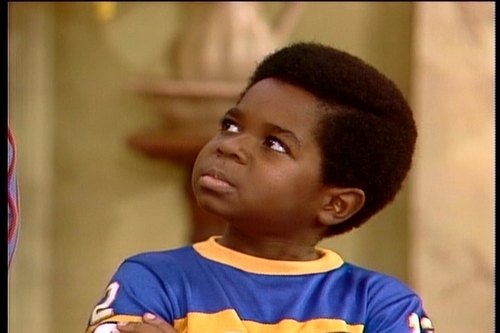
From Different Strokes, when Arnold'd look up and say, "what you talkin bout Willis??"

When I was growing up, I thought my name was roxgwemishDoc.

That’s what my mother called me. She would go through all the names in the credits before she finally got to mine. She’d do it quickly. It sounded like an ancient elvish language. Sometimes it might be Docrocksmish. Then I might be first. It wasn’t logical. Sometimes, in exasperation, she would just point and spit out, “You!”

I have spoken to The Spouse and got his attention by dropping the name of the dog.

For the record: I know that The Spouse is NOT The Beast.

I have seen The Spouse shudder at my error, but he knows it’s a mistake. Everyone knows. Even The Beast himself. He doesn’t move his head, cock an ear or raise an eyelid when I call The Spouse by The Beast’s name.

Sometimes, when I am speaking quickly, which is often, I say the wrong word. When it’s worth a laugh and could be misconstrued as a double entendre, we call it a Freudian Slip.

It could be calling a quarterback by the name of a point guard. It could be misnaming a river. Maybe I say rock when I mean sugar. It could be using the brand name of a cookie for a wine. I know, weird.

In each and every case, I am making a mistake.

Any day I might speak 10 thousand or 15 thousand words. I get some wrong for reasons of speed, laziness and the actual phenomenon of brain efficiency in which I autoinsert a word or phrase that doesn’t belong but could.

Like I might say 7-11 instead of 9-11. Where I am talking at length about how we came together after the terror attack and my brain subbed out the slurpee store on the way.

I know the difference. You do, too. So let’s talk about something else.

Down to the River

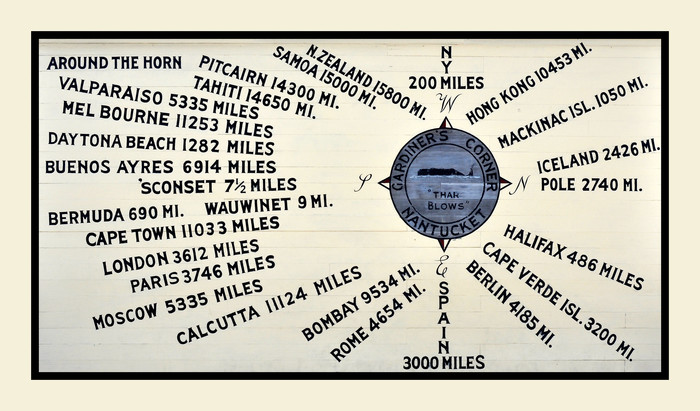
Nantucket, the center of the world. A compass and mileage directory.

People stay where they’re from. So people who leave are different.

It’s easy for those of us who have left the farm to look back at those rooted through a long lens. They aren’t like us. And we aren’t like them.

We pretend we don’t understand them, but, without much effort, we could. Since they are us, and we are them.

I grew up in what is now a desert of empty boxes of buildings that once housed three shifts. Of wide boulevards that once moved those shift workers and now cracked by weeds pushing through concrete. The factories and roads are being reclaimed by nature.

Then there is the other nature. The nature of expectations. People, most of them men-people, were expecting to fill those three shifts. Like their fathers, uncles and even grandfathers did. The work was a grind, day-in day-out in a noisy factory, but you earned enough money to raise your family, an awesome health package, a little cottage near a lake and a minor discount on next year’s model. You married your high school sweetheart. You went out with the guys after shift. You did your part.

But now, instead of a cold one on your dock, you’re the protagonist in a Springsteen ode.

And even The Boss doesn’t get you, anymore. He lives in Greenwich. He takes his daughter to dressage competitions. Is that a sport? You played hockey, in the neighbor’s backyard that they flooded after you got your new skates at Christmas.

You never or just barely had a chance at those high-paying factory jobs. You stuck around, waiting for an industry comeback. Instead, the unskilled and semi-skilled jobs that came back paid less. So yeah. You’re disappointed. You’re willing to work hard. But jobs moved across oceans where people get paid pennies and there aren’t all the rules about health and safety and smokestacks that drove work away. The import side of the equation? People from countries not where your people are from with a dollop of terrorism and fear.

Crashed expectations crash into reality.

Those who left are judging those who stayed. Don’t lie. We know them. They are us. And we are them.

Moshi Moshi

old fashioned rotary phone with the reciever off the hook.

It’s over. I killed the landline.

It was pretty much a waste of budget since nobody has used it in years. We kept the account for Internet–a sluggish DSL service that we never bothered to upgrade because of my absolute HATE for Comcast and because FIOS isn’t an option in our part of Ward 5.

But even after we switched to grown-up Internet, I kept the landline. I said it was because I was being lazy. It was really because I was being sappy.

This was the phone number we had when we we were first married. I put my office number on the invitations to the Spouse’s surprise party and reminded our guests that it would be extraordinarily bad for them to leave a message on our answering machine at home. Only one person did. I don’t think we know them anymore.

This was the line that the Spouse used to tell his Mom that we were going to have a baby. He was instructed to pass the phone over to me. She told me that she didn’t believe him and that she needed to hear it directly from me. Then she whooped.

This was the line that traveled with us from our first house to our current house that delivered more than one conversation with teachers–and more than one conversation with the principal. I dreaded the phone ringing at six o’clock.

This was the line that The Big Guy proudly broadcast his armpit fart version of the ABCs as I sat on the side of the bed in my room on the 33rd floor in a Chicago hotel. The Other Parent had to assist. I pictured the receiver being held inches from his skinny ribs as he went all the way through to X-Y-Z. I don’t remember if that was the call when The Big Guy complained that the Other Parent kept messing up the lunches, but that happened, too. I tucked my boys in via that line every night I was on the road.

This was the line that was attached to the answering machine to which my Sibling delivered a remarkable screed that could be a totally different post except I don’t want to go there. Suffice it to say that I am sorry I wasn’t the first person to hear that message, and I am most sorry that was a very bad turn for us.

This was the line that I would pick up and answer questions about my music preferences, give my opinion of local politicians, take a CDC vaccination survey, test messages with the PR firm for the electric company, and, my favorite, spend time with a stranger talking whiskey. She asked, “When was the last time you drank whiskey?” and I truthfully responded, “about five minutes ago.” The next twenty minutes were hysterical as I asked her to repeat the five choices on the Likert scale almost every time.

A landline is very quaint. It is from a time before we all had our own personal communications devices. It was a shared resource. It created obligations. If I answered the phone I was duty-bound to “take a message.” I had to make sure that it was passed on. My children have never taken a message.

This landline stopped being of any import probably nine or ten years ago. It didn’t bring the news of my parents’ deaths. It didn’t keep me in touch with The Spouse when I was in the hospital. It didn’t participate when someone made the call from the police department. Nobody left messages on it anymore–especially since robocalls don’t count.

I’ve had the same cell number for about fifteen years. I think that everyone who needs to get me has that new number. And now, the old one is gone.

I dialed the old number. I am not sure why. A lady that I didn’t know answered.

The number you have dialed, 2-0-2-2-6-9-3-0-6-5 has been disconnected. No further information is available.

Goodbye.

Inconceivable! [or not]

One of the famous and favorite moments in The Princess Bride is when Inigo Montoya tells Vizzini:

“You keep using that word. I do not think it means what you think it means.”

Watching the Yelling Shows this morning, I kept replaying Inigo’s line in my head.

“You keep using that word. I do not think it means what you think it means.”

I guess Inigo was wondering: Is it a misuse of language? A misunderstanding of what’s actually happening? Or, simply, wishful thinking? But ultimately the why doesn’t matter. If you don’t recognize the reality, you’re in trouble.

I was thinking about this as the guest on the show, in an ominously warning voice, said that people need to understand that Donald Trump is not a Republican, and he does not represent what the Party stands for (he said lots of other stuff, too, but that’s not germane here).

I think that this is the wrong argument.

What if people don’t care that he’s not a Republican? What if THEY are not Republicans, too? [There is a parallel argument on the Democratic side that Senator Sanders is NOT a Democrat, and my thinkings here apply to both parties.]

Earlier this week, Clay Shirky who, by the way, is a much better thinker than DocThink, wrote a tweetstorm outlining a theory of the redundancy of political parties in a networked world. He offers that parties used to be required to access media, to access donors and to access voters through organizing. He traces the arc of a scythe cutting down this syndicate starting with Ross Perot through Howard Dean and Obama for America. He posits that both parties are seeing an internal insurgency where “the people,” or at least a passionate sector of “the people,” are hijacking the party regulars.

I’m not sure that’s exactly right.* I think that we are seeing the hijacking of the parties’ infrastructure for people who may or may not be party members. It could be that the outsiders are not growing the party as much as using the party. They are disruptors.

Conventional wisdom sided against any 3rd or 4th party in the U.S. because of the infrastructure requirements to gain public office. It’s the party apparatus in each state that organizes and hosts primaries. The parties own the statewide infrastructure, the hosting of caucuses and elections, the rules, the timelines and the costs. They own donor lists and vendors who do polling and pipe and drape.

Smart outsider candidates are able to use this structure to launch their own campaigns with enough hat-tipping to the “party,” as long as they have followers. They can build their own followers

  • by addressing them DIRECTLY on social media and use this to pressure and gain earned media,
  • by raising money from them DIRECTLY online, and
  • by getting their names and emails and Facebook likes and Twitter follows to call on them DIRECTLY as well as ask them to call on each other when it’s time to GOTV.

We might be seeing a disruption on the scale of Amazon for commerce, Uber for transportation, Airbnb for lodging or Facebook for communications.

It makes me think, too, about another Clay. Clay Christensen wrote the Innovator’s Dilemma. I’m still working my brain through this but I think I’ll throw it out to see if it’s a useful model to apply. Christensen says*

  • Companies innovate faster than their customers’ needs evolve and eventually produce products that are actually too sophisticated, too expensive, and too complicated for many customers.
  • Companies pursue these “sustaining innovations” at the higher tiers of their markets because that’s what made them successful– charging the highest prices to their most demanding and sophisticated customers at the top of the market.
  • This leaves a gap at the bottom of the market for competitors to emerge and go after smaller markets with simpler products that might not be attractive to the “establishment” organization.
  • See a full and smarter version here.

So the people who were in the market, but couldn’t afford the goods are happy with a cheaper, less feature-rich version that they can have. Or maybe they don’t see themselves as customers of the Party as it is, and are open to an offering that better meets their beliefs.

But what about the Brand value of the Parties. Parties still offer a shorthand to understand where a candidate stands. I did voter studies in the 80’s. I know about party affiliation. But I also know about brands. So I’ll offer one thought. How does that brand–of establishment political parties–make people who are angry and left out feel?

The first Clay put out a stat that floored me. There are 150 million registered voters in the U.S. That would be considered a MEDIUM-sized group on Facebook. Shirky said, “All voters’ used to be a big number. Now it’s less than 10 percent of Facebook’s audience.”

Whoa.

in·con·ceiv·a·bleˌ inkənˈsēvəb(ə)l/adjective
     1. not capable of being imagined or grasped mentally; unbelievable.

* Apologies for my reductionist parsing of both Clays’ arguments. I’m just trying this out, Loyal Reader. I suggest you read them both and help me hone my Thinkings.

Dyscussion

You know that email you wrote? Telling someone how absolutely and completely wronged you are by their cruel, thoughtless and idiotic deeds? You know that one? Don’t send it.

When I’m writing a howler, I very deliberately leave the “TO:” line blank.  That way, I can’t even mistakenly send it.

I’m definitely composing that ferocious email. I’m carefully going back and editing that email to hone all the barbs until they are quite sharp. I am ensuring that it is fully TO THE POINT and that no one could mistake my intention. Then I’m walking away. I might delete it right then. Or I might see it in my drafts folder later. I have never sent it when I saw it again later.

I, like you, need to get that righteous anger out of my system. I can’t imagine a scenario in which I need to put it directly into someone else’s system, just for one simple reason.

Nothing good will come of it.

I’m not motivated by making something bad happen. I personally get nothing out of exacting revenge. Ugliness I lavish will likely

  • escalate
  • screw me over
  • not make a whiff of difference in the other’s behavior
  • damage a relationship that I want (or need) to maintain
  • All of the Above

Hence, no good will come of it.

I’ve been contemplating rage-quitting Medium over the cycle of hurt and outrage that is brewing on that platform. But rage quitting feeds that shit cycle. So, if I’m leaving the platform behind, I will just pick up my keyboard and leave. Without a public fuss.

I was watching a clip from a TV show where grown men in suits and ties were calling each other names, being mean and dismissive, yelling over each other and, I dunno. It definitely was not civil. It was remarkably angry. It included glowering.  It was dysfunction dyscussion.

Is your goal to make some afraid? To force an error? To slam the door in someone’s face? To punish? To hurt? To win at any cost?

Let me be clear. I used to be much meaner. It just doesn’t work. Not for what I want, anyway.

Friends Like That

Night at the opera, Ginsberg and Scalia

I  was shocked to hear that Justice Scalia passed away. I think we were all shocked.

Although I have not been a fan of his work from the bench of our highest court, my first reaction was a sense of loss.

I knew that he and the Notorious RBG were notoriously friends. In reading people’s memories of him, I learned that he and another ideological foe, Justice Elena Kagan, were hunting buddies. Scalia even recommended her to an Obama confidant–saying, “I hope he sends us someone smart,” before naming Kagan as one who met that criteria. I guess he wanted a worthy opponent.

Witty, gregarious, and fun are words that are most associated with him by colleagues and friends or various leanings–left and right, D and R.

I learned about Justice Scalia’s death on Twitter which almost immediately brought me the second shock. The Senate Majority Leader ran breathlessly to a mic within an hour to let the world know that our sitting President should not even THINK about nominating someone to fill that seat on the bench.

Oh, just stop.

Then there was the line of people disagreeing with McConnell from the Senate chambers bringing politics to the fore before anyone had a chance to pay their respects. Turning the Justice into a political football.

Please. Please just stop.

Others started piling on saying mean things–really mean. And I all could think about was that I could NOT agree with any of them. At all. Because no matter how much I disagreed with Scalia, no matter how wrong I believed his skewed intellectual gymnastics on more than one decision or dissent, he always seemed to me to be very much human.

They say he changed the Court, that he was the first to really take control of the arguments and ask challenging questions. He was a New Yorker. He was a first generation Italian-American. He was smart. He was confident. He was brash. He pushed his ideas but could obviously listen to others and agree to disagree. Without being disagreeable. I love this.

I’m not saying he’s a saint or that he should be revered. I’m just saying he might have been wrong, but he wasn’t bad. Just look close around him.

RIP, Justice Nino. Peace to your family and friends.